



The 80th Avignon Festival, held from July 4 to 26, was especially exciting this year. Throughout the bustling streets of this 14th century city, with its buildings covered with posters and programs to entice visitors to discover new performances among the many presentations of the official festival – the “In,” not to mention the many intriguing productions of the “Off” – adventure seeking was palpable. Perhaps I was especially attuned to the excitement of Avignon given that I have been attending this incomparable festival since 1968. I am always thrilled to return despite the intense heat and rain storms this year.
For the program cover of the 80th edition, festival director Tiago Rodrigues chose an artist’s rendering of a gigantic black question mark sprawled across a bright yellow background thus dedicating his festival to a spirit of questioning, culminating in an extraordinary gathering in the Cour d’honneur of the Pope’s Palace at 5 a.m. on July 26. Entitled L’Aube des Questions [EN: Questions at Dawn], 80 questions for the future, this special sunrise event was dedicated to “the beauty of doubt.” The idea was not to divide an already deeply polarized society but to address today’s pressing issues with the audience.
From the beginning of his tenure, Tiago has focused his program choices on a different language or country each year. Last year it was Arabic. This year Korea held the honor. From traditional forms of theater such as pansori, a Korean oral tradition introduced to Avignon audiences by the renowned contemporary pansori artist Lee Jaram at the Avignon Opera House to a staged reading of Nobel Prize winner Han Kang’s novel Impossibles Adieux [EN: We Do Not Part] in the Cour d’honneur and a five-hour romp through a selection of Molière’s farces performed by the inimitable tg STAN collective at the Boulbon quarry. Some performances had only two shows, others played for six or seven. Times varied from 2 o’clock in the afternoon to the “traditional” 10 p.m.. And, to top it all off, there were more female directors than men this year.
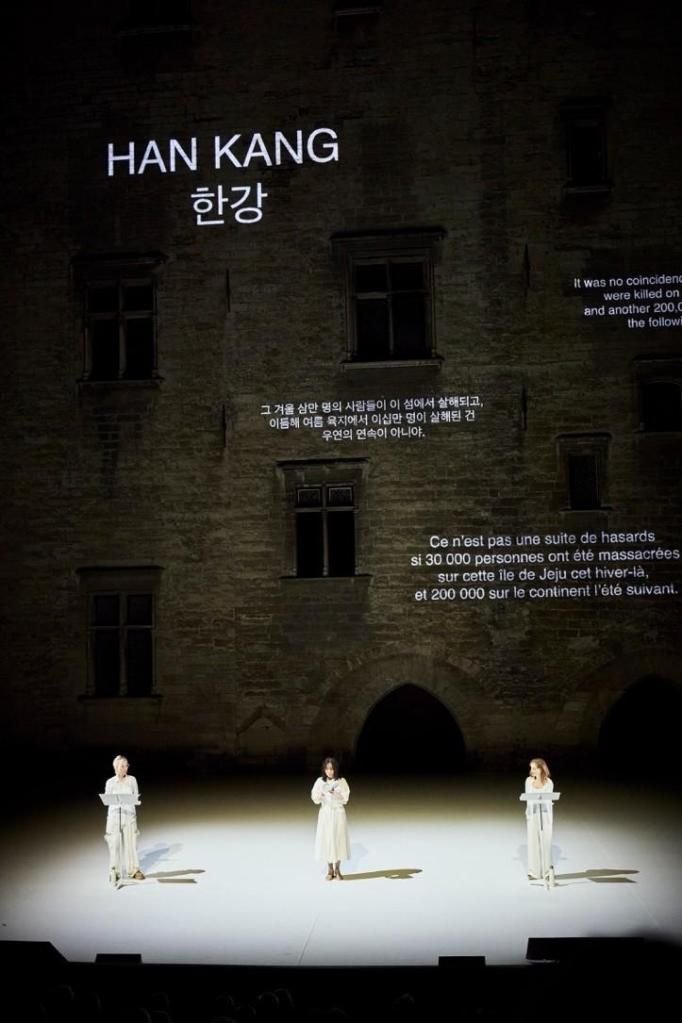
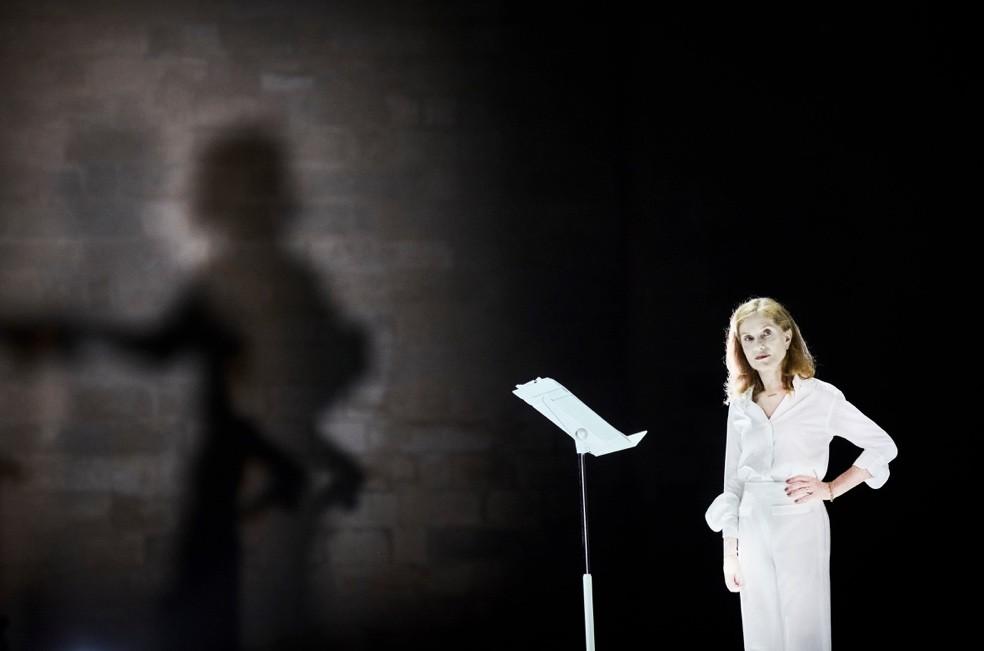
Oiseau (Bird), a staged reading in French and Korean of the first chapter of Han Kang’s We Do Not Part in the Cour d’honneur of the Popes palace, by well-known actresses Isabelle Huppert and Hyeyoung Lee, and directed by Julie Deliquet (Artistic Director of the La Colline theater in Paris), was a featured event of the festival.
Oiseau, 2026. Photo credits: Christophe Raynaud de Lage, Festival d’Avignon.
With the help of supertitles in English and French projected on the south wall of the Cour d’honneur, Isabelle Huppert and Hyeyoung Lee, led by Julie Deliquet, quietly introduced the audience of 2,000 to a tale of enduring friendship and hidden revelations. Just three women standing in the middle of a white circle of light barely moving, except to change places, as they read from standing lecterns, their voices barely resonating against the stone walls. This was an unusual experience for Avignon. No flourishes, no costumes. Just a straightforward reading of a fascinating tale leaving the audience with a powerful story of friendship, loyalty and the revelation of a bloody massacre that had been kept hidden for many years.
Listening to words in French and Korean, searching for their meaning on the walls of the Cour d’honneur and composing for myself the story being told for an hour and a half, was both a challenging and rewarding experience.

Oiseau, 2026. Photo credits: Christophe Raynaud de Lage, Festival d’Avignon.
Kyungha, the narrator, has received a message from her friend Inseon, who lives on Jeju Island, in South Korea. Inseon has seriously injured herself carving logs to create an art installation the friends had been working on and she has been taken to a hospital back on the mainland. She had to leave behind her pet parakeet Ama and she asks Kyungha to go to the island to rescue her. Kyungha agrees but during her trip a fierce snow storm keeps her from arriving in time to save Ama and, to make matters worse, there is a power outage and she finds herself alone in the dark, in the middle of a blizzard. With only a candle to provide some light, Kyungha manages to read documents she has discovered in boxes at Inseon’s house. They concern the Jeju uprising of 1948 (a state-sponsored civilian massacre when 30,000 people were killed, 6,500 of them children, and villages were destroyed). We learn that Inseon’s mother had lived on the island at the time of the massacre but was absent when it happened. And that she had spoken of its horrors to her daughter when she was growing up.
*****************
Che dolore terribile è l’amore [EN: What a terrible pain love is], after We Do Not Part by Han Kang, at the Carmes theater, by well-known Italian director and actress Daria Deflorien, Associate artist at Milan’s Piccolo Teatro, explores and adapts this same material, transforming it into a hauntingly beautiful performance.

Che dolore terribile è l’amore, Daria Deflorien, 2026. Photo credits: Christophe Raynaud de Lage, Festival d’Avignon.
Che dolore terribile è l’amore, Daria Deflorien, 2026. Photo credits: Christophe Raynaud de Lage, Festival d’Avignon. Against the illuminated arches of the Carmes cloister.
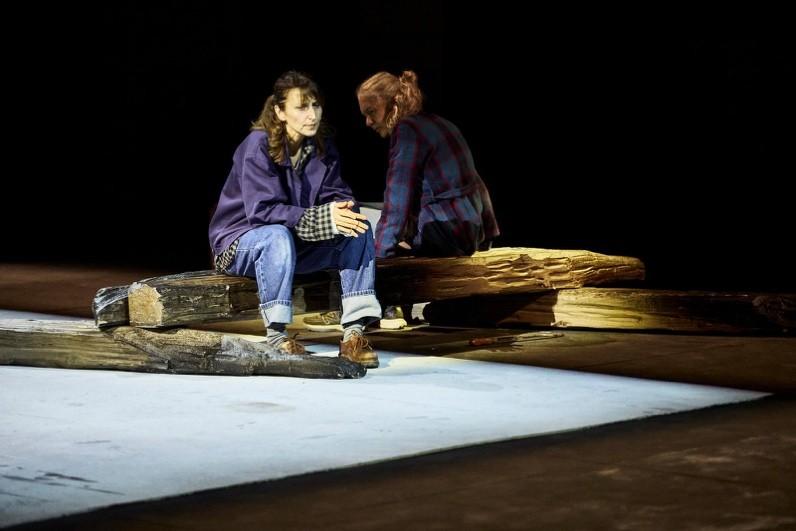
In Deflorien’s version, the two friends meet up at Inseon’s wood working shop on Jeju Island where Inseon has been working on their installation project. The stage is mostly dark but for a pile of blackened tree trunks spread out on the floor. A small empty bird cage hangs above the logs and boxes filled with documents are lined up on the side of the stage. Inseon is busy re-arranging the heavy logs, picking them up, carrying them and placing them on top of each other. Exhausted, she sits on one of them, lost in her thoughts, soon to be joined by Kyungha who mysteriously appears out of the shadows. Together they speak of Inseon’s relationship with her mother as they review the story of the Jeju uprising and massacre that her mother had told her when she was little. An old woman (Inseon’s mother), a ghost-like figure, wanders silently in the background. Kyungha, a film maker, seems to conduct an interview with the mother who describes the 1948 Jeju massacre to her or is this perhaps the same information contained in the boxes on the stage that are filled with the archives from that period that the friends are reviewing? It is not always easy to follow the supertitles in the shadows, but the beauty of the mise-en-scène and the superb performances are memorable. As the play draws to a close, we learn that a red rag has fallen out of one of the open boxes. Inseon insists on keeping it in memory of the horrors that her mother had told her, wounds that have remained with her throughout her life.

Che dolore terribile è l’amore, Daria Deflorien, 2026. Photo credits: Christophe Raynaud de Lage, Festival d’Avignon. Against the illuminated arches of the Carmes cloister.
*****************
Neige, neige, neige [EN: Snow, snow, snow], based on Leo Tolstoy’s 1789 short story Maître et serviteur [EN: Master and Servant].


Neige, neige, neige – Lee Jaram, 2026. Photo credits: Christophe Raynaud de Lage, Festival d’Avignon.
Although Neige, neige, neige is not an adaptation of Oiseau or even a reference to Han Kang’s novel, still the presence of a severe snow storm with biting winds and tragic endings evoked in this performance, reminded me of the blizzard we heard so much about in Han’s novel.
Lee Jaram, the most singular voice in contemporary pansori is the creator of this captivating performance. In black hanbok, jacket and skirt, with only a folding fan and the drum beats and vocal utterances of Lee Jun Hyou to accompany her narrative, she tells and sings her version of Tolstoy’s short story Master and Servant. Her performance was stunning. It was wonderful to watch her include the audience in her story telling us from the beginning that “We are the kindred souls of this world,” she tells us. “Our lives are so bittersweet. Summers are humid and getting hotter. How long will we survive?” she wonders with a sharp, sudden snap of her fan.
She even invited us to provide sound effects. Dividing the audience into three sections, she led us in creating the biting wind and freezing snow of her story. It is Christmas. The fields are covered with snow and the storm is getting worse.


Neige, neige, neige – Lee Jaram, 2026. Photo credits: Christophe Raynaud de Lage, Festival d’Avignon.
Using only her fan, and modulating her beautiful voice to play all of the roles in her story, she introduces us to the characters. At first, she sings the story of Vasili, a wealthy land owner who has his eye on a plot of land that is for sale at a reasonable price. He is determined to grab it before anyone else and even though there is a major storm brewing, he must get there first. He orders his peasant Nikita to go with him even though the poor fellow does not have any warm clothes and it is Christmas. As for his horse, Zetty, he waits patiently as he chomps on the carrot Nikita has given him and neighs in expectation as the sleigh is hastily being prepared. Lee Jaram’s imitation of Zetty’s neighing and shivering are perfection.
Before long, the snow is so blinding that they no longer know where they are. There is no turning back. Zetty shivers and sinks into the snow and Vasili has no choice but to pull over. When it becomes clear that they can go no further, Vasili and Nikita are left to shelter in the freezing snow. Amazingly, Vasili orders his servant to join him, sacrificing himself with his own body to protect Nikita. In the morning, the villagers discover Vasili’s body lying on top of Nikita, protecting him from the storm.
To read PART II of this interview, go to this link.
This post was written by the author in their personal capacity.The opinions expressed in this article are the author’s own and do not reflect the view of The Theatre Times, their staff or collaborators.
This post was written by Philippa Wehle.
The views expressed here belong to the author and do not necessarily reflect our views and opinions.