



From May to July 2019, I went through the administrative procedures of setting up the theatre ready for August 2019. I had to apply to the senator for culture in the federal state of Bremen for a certificate indicating that my theatre would be considered of equal status to theatres owned by the state and the municipality in terms of tax status, especially turnover tax. I had to apply to the municipality of Bremerhaven for permission and license to sell alcoholic beverages in the theatre. I had to register the theatre with the local and federal agency for employment, and, through my tax advisor, with the inland revenue.
I had to register with the local branch of the Chamber of Commerce, and take out insurance of liability, to protect the theatre and its contents from fire or theft, and a separate personal injury insurance. I had to renew the safety license of the two fire extinguishers on site, open a separate bank account for the theatre, renew the rental contract for the flat the theatre uses for visiting artists, and renew utilities of gas and electricity, as well as telephone, for the theatre and the artists’ flat.
I had to register with the artists’ social insurance (KSK), with the federal pension authorities, and the artists’ additional special insurance (VddB). The artists’ social insurance would later receive 5% of all salary / fee / honorarium or other payments paid to all artists. They would raise a monthly subscription fee from the theatre, based on my estimate of yearly total of payments to artists, and once I reported the total figure, would receive a refund or have to pay the balance, and on the basis of that figure the monthly instalments for the next twelve months were calculated. The additional special insurance was for actors only, for whom I paid in 9% of the actual monthly payment received by the actors, of which I kept 4.5% back from the salary paid to the actor, so that the actors, in fact, contributed 4.5% to that insurance.
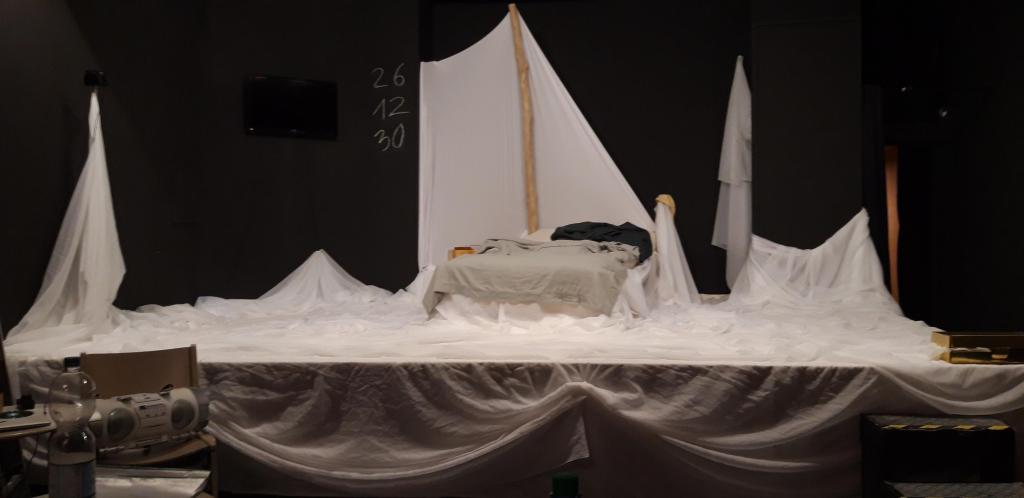
Friedo Stucke’s set design for Penelope – Nacherzählt [EN: Penelope Retold] by Caroline Horton: piccolo teatro Haventheater Bremerhaven, 2021.
I also set up a contract with the federal agency in charge of collecting royalties for the use of music in theatre productions, GEMA. For each production I then had to inform GEMA precisely of how many minutes and / or seconds each piece was played for, on what medium from, from which source, and with precise details of composer, singer, librettist, etc., as applicable. I also had to list, for each performance, duration of the performance, date, start time, end time, total time of music, number of spectators, venue, size of venue, and income from ticket sales. Within the tariff of use of music for theatre performances, GEMA then calculated the amount due, and I received their bill usually within hours of having submitted my details. I traced and found a couple of websites that offered GEMA-free music, but where royalties were due to the composers, usually higher than the GEMA fees I had to pay. I also found one site with numerous tracks of different kinds of music that were both GEMA and royalty-free. I found most of my music needs from that source.
I introduced myself as a new player on the theatre market to the leading theatre publishers in Germany and Austria. Dramatists seek to place their play with one of those publishers, who provide some editorial guidance, keep PDFs of the latest approved version of the plays and serve as the dramatists’ agents in working with theatres interested in presenting their plays. For each performance, royalties are due, with either a contractually set minimum fee, or 10% of the raw income generated by that performance, whichever amount is higher, plus a small percentage on the total as contribution to the money the dramatist is due to pay to the artist’s social insurance (KSK), plus 7% VAT on the subtotal. Payments were due around 15 days after the final performance, or on a monthly basis. These publishers have their internal catalogues; some offer a service allowing approved theatres to download PDFs of plays they are considering. Most publishers place the details of the plays in their catalogue in a central website, Theatertexte, which is open to the public, fully searchable, an offers a mailing list alerting to new entries (86 entries for the two-week period 8 to 22 October as an example).
When casting was complete (more about the artistic side of that later), I had to draw up a contract, ensuring phrasing and details combine both what my tax adviser tells me he needs to ensure compliance with financial regulations, and individual needs of the artists in terms of periods of unemployment and maximum payments received within any given time period so as not to lose entitlements to all kinds of benefits, or to avoid having to fill in another 20-page application form to re-apply to the same pot of funding from which they received support before the contract with me.
A round of introductions to people and places of interest to me and my work followed. I met with the head of the municipal library, which has a special section of material for each of the productions of the municipal theatre across opera, dance, drama, and youth theatre. I met with the head of the adult education center (Volkshochschule), the head of the Klimahaus (an experience environment showcasing special arrangements from around the world at 8˚ East), and the head of the municipal theatre (as an aside: he had attended the same secondary school as I did; I was several years his senior, and he turned out to have been inspired to embark on a theatre career initially by seeing a school production of Twelfth Night in which I played Sir Andrew…).
In each season I presented five to seven in-house productions with five to six weeks of rehearsals each; the number of financially viable performances balanced itself at ten on average. I address conditions under the pandemic in a separate contribution. In addition to the in-house productions, there were one-off invited guest performances of various kinds. For each production or guest performance, I was thus tasked with a raft of administrative activity that happened in the background: selecting the plays, casting, deciding whether I would direct myself or whether I could afford to invite a guest director, agreeing contracts with all artists involved, composing the contract, chasing the signatures, arranging the contract with the play publishers, selecting visiting performances from my own list of potential candidates and unsolicited expressions of interest I received regularly, arranging dates and times for guest performances, as well as terms, and composing contracts and seeing those through to signature.
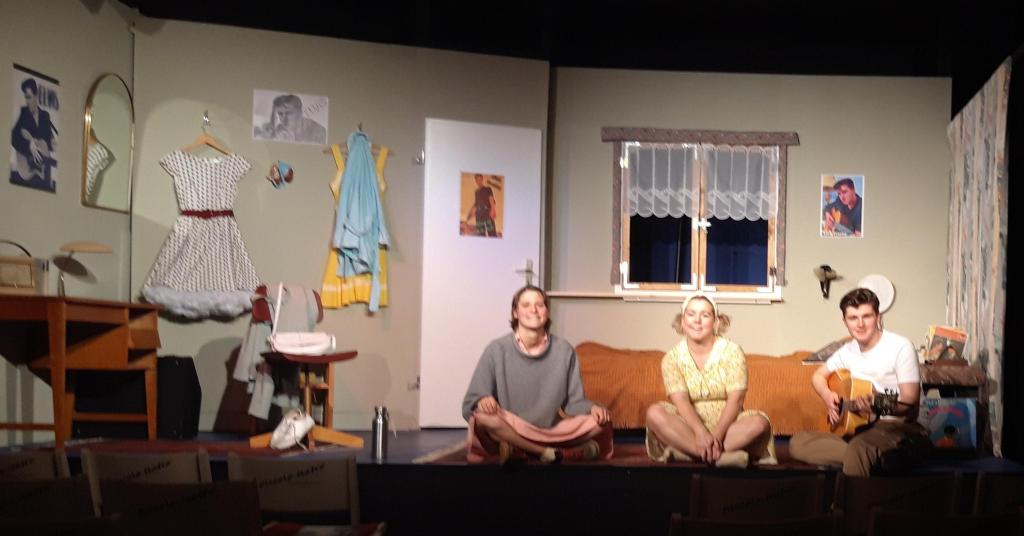
Friedo Stucke’s set design for Meine Nacht mit Elvis [EN: My night with Elvis]. By Dirk Böhling. With Meike Lehmann, Maja Rodigast and Robin Katona. piccolo teatro Haventheater Bremerhaven, 2023.
Ongoing communication with GEMA as needed, collating monthly reports of all incomes and expenses to my tax advisor’s book-keeper, keeping up-to-date with funding opportunities and writing funding applications accordingly, maintaining the website, updating marketing in social media and major platforms for cultural events, keeping contact with the one local newspaper, keeping the box office (keeping track on online bookings through a third-party service and, most importantly, answering a few emails with ticket bookings every day, as well as answering the phone: the majority of ticket bookings came in over the phone, given that the demographic of the theatre preferred talking in person over the phone. On days when announcements for new productions, or reviews, were published in the print edition of the local newspaper, I would often receive around 100 phone calls and reserve between 200 to 300 tickets. Add to that time in the theatre for rehearsals and front of house work.
Five full-time volunteers under the federal volunteering scheme supported my work throughout, each for between 12 to 18 months. They were officially registered as volunteers, had a membership card for a range of special offers. They would receive a certain amount of pocket money and their social insurance was covered by the theatre as well. In return, the federal authorities in charge of this scheme refunded a certain fixed amount per month, about half the theatre’s total expense. Our volunteer predominantly served as assistant director and as stage manager (running sound and light boards for rehearsals and performances). Because the box office was inseparable from the bar, and the federal volunteering authorities explicitly did not allow volunteers to work in bar contexts, our volunteer never operated the box office. All five went on to interesting roles after their volunteering: one runs seminars for school leavers, on teaches EFL, currently in Thailand, one has just completed an apprenticeship as a baker, one is in the middle of an apprenticeship for a large German drugstore chain, and one has just embarked on an apprenticeship in event technology (at the local municipal theatre).
On taking over, my predecessor had recommended two possible set designers and builders, one fairly local and able to reside at home, one from further away who would need accommodation while working locally. Fortunately, the local colleague, Friedo Stucke, and I developed a very strong working relationship and friendship, and he soon took on all practical and technical aspects of the theatre. He designed and built all sets, as well as writing some plays and directing them. He suffered a stroke in the summer of 2024, from which he has been recovering, fortunately, but it cut short his contribution to the theatre completely. After a few months relying on generous support from the local community in the area where the theatre is located, my eventual successors, Vania and Andreas Brendel, took over that side of things, in return for a discount on the one-off payment to take over the theatre.
This post was written by the author in their personal capacity.The opinions expressed in this article are the author’s own and do not reflect the view of The Theatre Times, their staff or collaborators.