



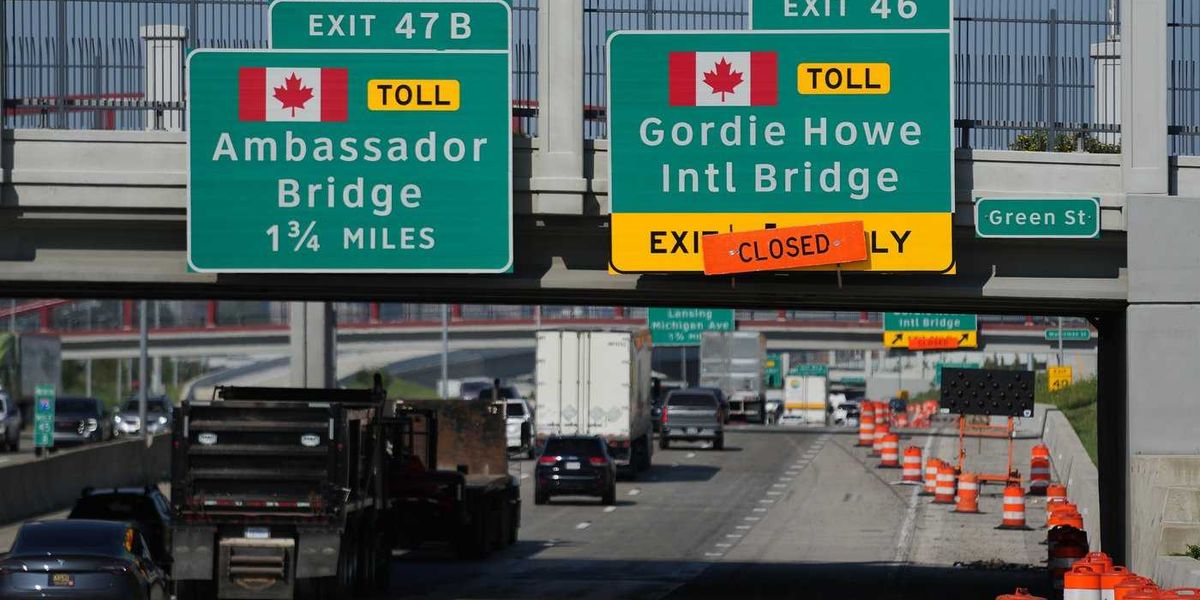
The Conservatives are looking at using parliamentary tools to coax the Carney government to release the deal it made to convince the Trump administration to open up the Gordie Howe International Bridge.
“There is no transparency,” Conservative critic Shuvaloy Majumdar told The Canadian Press on Monday.
The Calgary MP said the government has been “flip-flopping between net revenue and net profit and deal-sharing” and the Official Opposition might seek to get the House of Commons to call in witnesses and demand documents.
“We are all looking at finding ways in which Parliament can be used to encourage this kind of disclosure,” he said.
Prime Minister Mark Carney was accused of spreading confusion about the bridge deal last week when he said that any sharing of toll revenue with the U.S. would not happen until after repayment of the debt Canada took on to build the bridge.
Carney also said Canada and the U.S. would split net revenues — after operational costs — over the first 15 years.
The 15-year agreement to open the bridge connecting Michigan and Ontario is separate from the deal Ottawa signed in 2012.
The Harper government signed a deal in 2012 which committed Ottawa to shouldering the full $6.4 billion cost of building the bridge while sharing ownership with Michigan. Under that plan, the two sides would split toll revenues only once Canada’s construction debt, including interest, was paid off.
The plan was endorsed by U.S. President Donald Trump during his first term.
But a ribbon-cutting ceremony planned for last month was delayed after the Trump administration sought to renegotiate the plan following pushback from the billionaire Moroun family, which owns the competing Ambassador Bridge and is a significant Republican donor.
Trump announced last week that the bridge will open July 27 under a new agreement. Neither country has published its terms.
The Carney government insists it has landed a good deal for Canadians that will unlock more bilateral trade.
Carney’s description of the new arrangement led to contrasting interpretations by major news outlets. His office later said the new deal will mean that for the first 15 years of the bridge’s operations, the toll revenues that remain after the cost of operating the bridge is deducted will be split 50-50 with the U.S.
After 15 years, that arrangement will revert to the deal signed with Michigan and all toll revenues will go to Canada until the full construction cost is repaid. After the construction cost is covered, the toll revenues will be split with Michigan.
Majumdar said MPs should be able to see the deal laid out in full instead of trying to grasp it from anonymous reports.
He said it’s not clear whether Canada has surrendered the ability to set competitive tolls — as some reports have suggested — has ceded sovereignty over territory near the bridge or has agreed to side deals that include trade concessions.
“Our government has not been releasing any of the kind of information that would be meaningful and helpful for Canadians to understand what the nature of the deal was,” he said.
“What could be a lot easier for all of them, is if the government just chose to release the deal and to disclose to Canadians what they actually said — and stop allowing either wayward communications or intentional deception.”
Majumdar says Conservatives could use parliamentary manoeuvres, such as calling for documents or witnesses, to push for answers.
“The opposition has sympathy for the government dealing with a tough and unpredictable negotiator in Washington,” he said. “Where we don’t have sympathy is how the government’s positioned itself over the last 15 months.”
Trump has levied tariffs against sectors like steel, lumber and automotives. On Monday, the White House indicated Trump would sign a new executive order hitting certain Canadian products with 50 per cent tariffs in 30 days.
Majumdar said the Carney government’s attempts to expand trade beyond the U.S. should not come at the expense of making the case that Canada is essential to U.S. economic growth.
“The relationship is not just Washington. It’s New York, California, Florida, Texas (and) the industrial heartland, where Canadian ministers should be engaging with as much enthusiasm, if not more so, than they have under Mark Carney with Beijing and with Europe,” he said.
This report by The Canadian Press was first published July 20, 2026.
By Dylan Robertson | Copyright 2026, The Canadian Press. All rights reserved.