


![11th Jul: One Piece: Heroines (2026), 23m [TV-PG] (6/10)](https://occ-0-953-999.1.nflxso.net/dnm/api/v6/0Qzqdxw-HG1AiOKLWWPsFOUDA2E/AAAABdxjentJWFlz5FhIiLJwLTWPUrwzk7AMwcFj50r4R6EVtAa9zrY_Q4SGLKszu4EtnmB2H78Fm38aRBezXVsfAwW1bVZcaUADZ1zopXt0_86GeTj4vi2j6xnmHa825ghMJTzzjj9Vi1YK6bnYzzqRqUpXAOWmw8UDmtlH2I7OzK4bBQ.jpg?r=5af "11th Jul: One Piece: Heroines (2026), 23m [TV-PG] (6/10)")





The Broadway Theatre Review: John Lithgow leads a razor-sharp Broadway transfer of Mark Rosenblatt’s Olivier-winning play
By Ross
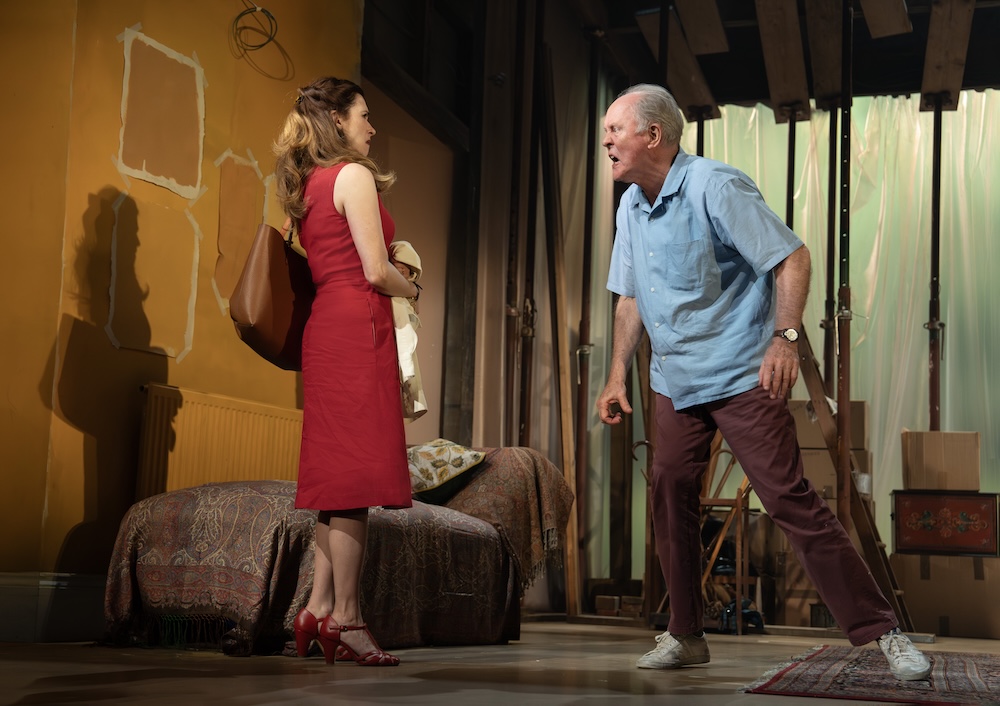
Hammering echoes behind the tarps and scaffolding before anyone on stage raises their voice, a dull, persistent thud that feels like it belongs to another process unfolding just out of sight. Inside Broadway’s Music Box Theatre, that sense of something being worked on, taken apart, perhaps even the possibility of repair, hangs in the air like opportunity as Giant, the new play by Mark Rosenblatt (“Ganef“), begins. What unfolds over the course of one afternoon is not as loud as the restoration, but it is as relentless and nerve-rattling. It is a tightening knot of words drawn into a conversation that tightens in on a man who refuses to hear what is being asked of him.
As directed with exacting control by Nicholas Hytner (Bridge’s Guys & Dolls), Giant summons us into a contained and increasingly volatile room in 1983, where children’s author Roald Dahl faces mounting pressure from his publishers following accusations of antisemitism because of a review he authored. The structure is clean and unadorned. One space, one sustained confrontation, and a series of conversations that circle, escalate, and fracture. It is, most definitely, a talk-heavy play, but one that rarely loosens its grip, because every sentence carries consequence. The language is the action. Each attempt to clarify, defend, or retract only seems to push the argument deeper and further out of reach.
John Lithgow’s performance as Dahl is commanding, precise, and deeply unsettling. He does not soften the man, nor does he search for easy pathways towards anything that resembles sympathy. Instead, he presents a figure who demands to be understood while refusing any real act of self-examination. When he is told, “You know you’re not a giant,” the line lands as a quiet dismantling of the identity he clings to. Lithgow (Broadway’s Hillary and Clinton) leans into that tension with remarkable determination and self-control, allowing Dahl’s charm, wit, and volatility to exist all at once, authentic and consistent. There is humour here, often sharp and surprising, but it curdles quickly, leaving behind something abstractly sour, lingering in the air like “so much stink.” And once we take that in, it’s impossible not to be changed or challenged by it.

Standing, not sitting, opposite him, Elliot Levey (West End’s Good), reprising his Olivier Award-winning role as publisher Tom Maschler, brings a steady, deeply felt restraint to the table. His Maschler is not simply arguing a point, but attempting to hold together an important relationship, a legacy, and a moral line that keeps shifting beneath his feet. Opposite that position is Aya Cash’s Jessie Stone, who offers a different kind of pressure, direct and unsparing, cutting through Dahl’s deflections with a clarity that sharpens the stakes of every exchange. Cash (PH’s The Light Years) stands firm, even when she is shaken by seeing her hero crumbling before her. Moving carefully around the conflict, Rachael Stirling (Chichester’s Plenty) is Felicity Crosland, navigating both her personal and professional loyalties with care and force combined, while Stella Everett and David Manis round out the world, reinforcing just how many perspectives are colliding in this single room.
The physicality of the room, designed distinctly by Bob Crowley (Broadway’s The Inheritance), quietly underscores the central tension. The space feels mid-restoration, as if something is being stripped back and rebuilt, surfaces exposed, elements unsettled. It becomes an unspoken metaphor for what is being asked of Dahl, a willingness to examine, to reconsider, and most importantly, to repair. Yet while the room suggests the possibility of change, the man at its centre resists it at every turn. Crowley’s costume design subtly reinforces that rigidity, dressing each character in tones that feel almost ideologically fixed: Jessie in a striking red, Tom in a softer, yielding pink, Felicity grounded in earth tones, and Dahl himself in a sharp, unbending blue. That friction between environment and behaviour unleashes an added layer of unease. The world around him is in motion, but he remains fixed, digging himself in deeper with each attempt to justify his words.
Rosenblatt’s writing is sharp, layered, and unafraid of discomfort. The play leans into difficult territory, particularly in its examination of what it means to speak publicly about political violence and whether intent can ever be separated from impact. Dahl insists on positioning his work within a broader moral argument, yet the responses around him make clear how that framing collapses under scrutiny. At one point, the idea that people should “take him with a pinch of salt” is delivered into the air, an attempt to soften that feels increasingly insufficient. When he declares that “nothing will be enough” in response to the idea of an apology, it lands as both defiance and surrender, a recognition that the damage cannot be easily undone, paired with a refusal to truly engage with why.

The production does not shy away from the discomfort of these conversations. Audible reactions ripple through the theatre, particularly when Dahl’s language edges into territory that is impossible to ignore. The play understands the weight of those moments and allows them to sit, resisting any urge to smooth them over. It is in that sustained tension that Giant finds much of its power, forcing us to remain present with ideas that do not resolve cleanly.
The second act shifts the rhythm slightly, extending the conversation beyond its most immediate peaks. Some of the urgency diffuses as the arguments begin to circle, revisiting ground that has already been forcefully covered. Yet even within that repetition, something is revealed. The inability to move forward becomes its own kind of statement, a reflection of a man locked into his own certainty, unable or unwilling to step outside of it. The temperature changes, but the underlying pressure remains.
There is not a single line or confrontation, but the accumulation of them that becomes the dust particles in the room, something hard to breathe in without choking. The way each statement builds on the last, the way each opportunity for reflection is met with further entrenchment, it can’t be just willed away. By the time that final phone call is made, holding with it the faintest possibility of repair, it does not land as a resolution. It lands as a collapse. Whatever space existed for understanding has narrowed to almost nothing, leaving behind a silence that feels heavier than anything that came before it.
As the guests drive away, that earlier sense of something being worked on lingers, only now it feels completely beyond repair. Inside Giant, the room may still be under construction, but the person within it has chosen not to be. There is an echo of words that cannot be pulled back, and the unsettling recognition of how easily they continue to reverberate long after they have been spoken.


