



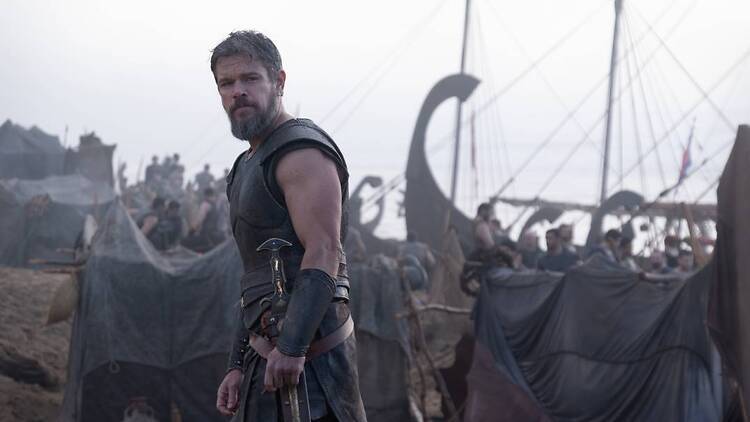
The debate over The Odyssey was raging long before anyone saw the movie. Culture warriors weighed in on its colour-blind casting, accusing Christopher Nolan of ‘desecrating’ Homer, and stopped just short of comparing the Cyclops to Hunter Biden. Had the British writer-director really caught a dose of the ‘woke mind virus’? Was Homer about to the slayed on the Academy’s altar of woke ideology?
Well, no. Inevitably, the release of the movie has quietened the point-scoring voices on social media and brought a more nuanced appraisal. Instead of rabid, sight-unseen criticisms, the debate has zeroed in on slightly sunnier corners of the movie’s depiction of Homer’s 12,109-line poem: whether Tom Holland’s Telemachus should be calling Odysseus ‘dad’; the realism of the Greeks’ armour; and whether one Cyclops could really make all that cheese.
So we phoned up award-winning classicist and author Dr Daisy Dunn to get the answers to a few of these big questions. So, has the legendary filmmaker done justice to western literature’s foundational text? Read on to find out.
*Warning: contains mild spoilers to The Odyssey*
How true-to-life is Travis Scott’s bard?
The film opens with rapper-turned-actor Travis Scott recounting the story of the Trojan War to an Ithacan court packed with Penelope’s suitors. Accurate, says Dr Dunn. ‘Homer’s poem refers to these bards living in the royal courts singing songs for entertainment. [The scene] reminds us that The Odyssey itself began as a song, centuries before it was actually written down.’
Which character is furthest from Homer’s depiction?
The majority of the movie’s characters tally closely with Homer’s versions, says Dunn – with one exception. ‘Jon Bernthal is a great actor, but he just didn’t match the role of Menelaus, Helen’s husband,’ she notes. ‘He played it as a tough guy – quite soldiery – whereas in the poem Menelaus is quite stately and formal. He’s very weak-willed but authoritative, but not in a butch way.’
Did the ancient Greeks understand PTSD?
Nolan introduces the idea that Odysseus is experiencing trauma from his wartime experiences and the brutal sacking of Troy. It’s a modern read that has some roots in Bronze Age thinking. ‘Scholars have been talking about Odysseus having PTSD for decades,’ says Dunn, ‘and the ancient Greeks had an understanding of that too. One of Odysseus’ comrades, Ajax, for example, commits suicide after the war, and it’s understood that he was suffering from [trauma]. The movie has taken what’s in the poem and really enlarged on it.’
What is the most radical change from Homer’s version?
The biggest change from Homer’s narrative is the removal of Odysseus’ time with the Phaeacians on the mellow island of Scheria. In the poem, he washes up on their island after his time with Calypso. ‘Historically, we think that its probably Corfu. In the film, he relates his adventures to Calypso; in the poem, he shares them with the Phaeacian court. They give him a ship and sail him home.’

What did Christopher Nolan change in the Polyphemus sequence?
In the poem, Polyphemus calls on his fellow Cyclops to help deal with Odysseus and his crew, only to be foiled because Odysseus has told him his name is ‘No One’. ‘The other Cyclops says: “What’s happened, who’s hurt you?” And he says: “No one’s hurt me, no one’s hurt me.” So nobody helps him.’ Dunn argues that the movie’s different spin on the episode downplays Odysseus’ wiles. ‘I think the absence of the “nobody” trick is the thing that’s going to annoy the most people who’ve read the poem. We miss that trickiness from Odysseus that’s so key in Homer.’
Didn’t Circe sleep with Odysseus in Homer’s story?
The movie removes the lustier aspect of the interaction between Odysseus and Samantha Morton’s sorceress, giving a more psychological read on their interaction instead. ‘It’s pretty clear that they have an affair for a year, and that doesn’t come across in the film,’ says Dunn. ‘As in the film, she advises him to go down to the underworld to talk to the prophet Tiresias; she turns the men into pigs. I actually found her more fully fleshed than she is in Homer.’
Why is the Cyclops’ cheese so significant?
‘The cheese is really prominent in the poem,’ says Dunn. ‘Homer makes a big thing of the Cyclops loving his sheep and making all these cheeses.’ When Matt Damon’s Odysseus helps himself to this bag of giant person’s feta, he’s making an offence against the gods’ protocols. ‘The law of Zeus is something called “xenia” – guest-friendship – you’re breaking it you go into someone’s home and you eat their food.’
Were the Sea Peoples real?
‘The sea peoples’ are significant in the movie, and while there’s no mention of them in Homer’s poem, there’s a good reason for that. ‘I always say to people that [The Odyssey] is like a historical novel,’ says Dunn. ‘Say the poem was finished in the 8th century BC, it’s actually set around 1200 BC – the equivalent of us talking about Shakespeare’s time – and people in Homer’s time were aware that they’d just emerged from a dark age. The sea peoples is one of the explanations historians give as to why civilization collapsed. They were pirates who travelled around sacking cities and destroying these palaces. Homer doesn’t have to mention them because everyone knew about them].’

How realistic is Agamemnon’s armour?
Poetic license – not to mention the cinematic merits of making things look dope AF – guided the choice of blackened bronze armour for Benny Safdie’s Mycenae monarch. ‘He’s kind of like Batman, isn’t he?’ says Dunn. ‘It’s a weird decision, but clearly a conscious one. The armour stands out the most as being at odds with Homer’s descriptions.’ But Odysseus’s plumed helmet, by contrast, is 100 percent accurate. ‘Plumed helmets are referenced in Homer,’ the classicist notes.

Is Penelope’s palace accurate to the time?
Almost certainly, yes. ‘The settings seem very authentic to the actual palaces in ancient Greece. I was struck by the dining room, the long tables, the seats, Penelope’s loom, all of those details are authentic. They’re all based on the archaeology of these palaces.’

Would Telemachus have called Odysseus ‘dad’?
Definitely not in the poem. ‘It seems very informal, whereas Homer’s Greek is very formal,’ says Dunn. ‘I found that a bit jarring.’ Emily Wilson’s 2017 translation of The Odyssey was a Nolan touchpoint, and Dunn believes her version influenced the film’s approach to female characters like Circe, Penelope, Athena and Calypso. ‘It’s [also] quite blunt in places and some scholars think it’s not the most poetical, beautiful translation – Robert Fagles’ 1996 translation is still a favourite of many people – but it’s a landmark translation, so I’m not surprised that [he] would go to it.’
Does ‘The Odyssey’ capture the reality of the Trojan War?
Probably not. ‘Helen’s a complete fiction, and even in ancient times people knew that the Trojan Horse was a fiction,’ says Dunn. ‘One of the writers [at the time] concluded that it was probably a siege engine.’ A lot of Troy still survives, though, and can be found on the west coast of Turkey at Hissarlik, where big sloping walls and archeological grandeur tally with Homer’s descriptions. ‘People debate whether the Trojan War happened,’ notes the classicist. ‘It definitely wasn’t a 10-year war in the way Homer described it. My personal feeling is that there was a series of wars in that part of the world, because there’s evidence of burnings and arrowheads at the site of Troy.’
Daisy Dunn is an award-winning classicist and author. Her latest book is The Missing Thread: A New History of the Ancient World through the Women Who Shaped It.
Every Christopher Nolan film – ranked.
7 spectacular The Odyssey filming locations to visit – and where to stay when you get there.