



This photo taken on Nov. 18, 2025 shows the Leonid meteor shower seen in Jiamusi City, northeast China’s Heilongjiang Province. (Photo by Chen Zhiguo/Xinhua via Getty Images)
DALLAS – Skywatchers can catch a glimpse of the Leonids meteor shower during the early morning hours of Nov. 17 and 18, and a few simple camera adjustments can help you capture it using just an iPhone.
How to photograph meteors using an iPhone
What you can do:
Under ideal conditions, the shower can produce up to 15 meteors per hour, according to NASA.
To get the best view, you’ll need to get away from city lights.
The best time to watch? NASA recommends viewing from midnight until dawn.
You should also head out early. Give your eyes about half an hour to adjust to the dark.
- Stabilize the camera: Mount the iPhone on a tripod. If you do not have a tripod, rest the phone against a still object such as a rock or backpack. You cannot hold the phone, because the slightest movement will create a blurry image.
- Turn on Night Mode to max: When your phone is in low light, Night Mode will automatically turn on. From there, tap and hold on the moon icon in the top-right-hand corner of your screen. Select “max” and make sure your phone is still for this part!
- Lock the focus: Locate a star or the object you want to capture, then tap and hold on the main subject on the screen. A yellow box will appear over the object, indicating the focus is locked.
- Optional: You should aim for as little movement as possible. Instead of tapping the photo button, consider taking the photo using a Bluetooth remote, AirPods or your Apple Watch.
Now you’re ready to take photos!
After capturing the images, you can edit the photos by changing the contrast, saturation, and exposure to get the best result. Advanced photographers can also stack multiple images to blend several meteors into a single photo.
What is a meteor shower?
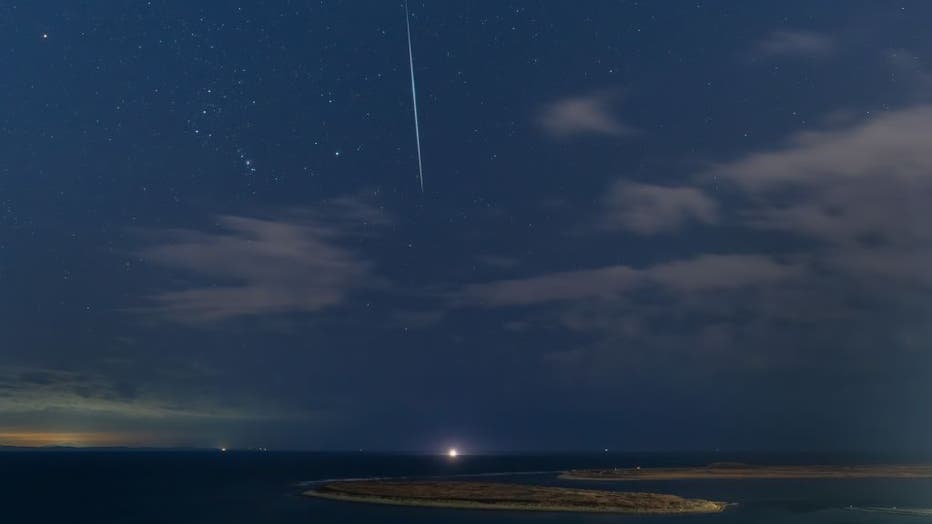
This photo taken on Nov. 17, 2022 shows the Leonid meteor shower pictured at the seaside of Vladivostok, Russia. (Photo by Guo Feizhou/Xinhua via Getty Images)
Dig deeper:
Meteors are created when Earth passes through dusty trails of debris left behind by comets and broken asteroids, NASA says. As tiny space particles collide with Earth’s atmosphere, they burn up and disintegrate, creating colorful streaks in the sky.
The cosmic debris that creates the Leonids comes from comet 55P Tempel-Tuttle, which takes 33 years to orbit the sun. Roughly every 33 years, Earth passes through a particularly dense pocket of the comet’s trail, triggering the rare Leonid storms.
What’s next:
If you miss the Leonids, another meteor shower is just around the corner.
The Geminids happen Dec. 13 and 14, followed by the Ursids on Dec. 22 and 23.
The Source: The information in this article comes from NASA, FOX Weather, and previous FOX 4 reporting.