







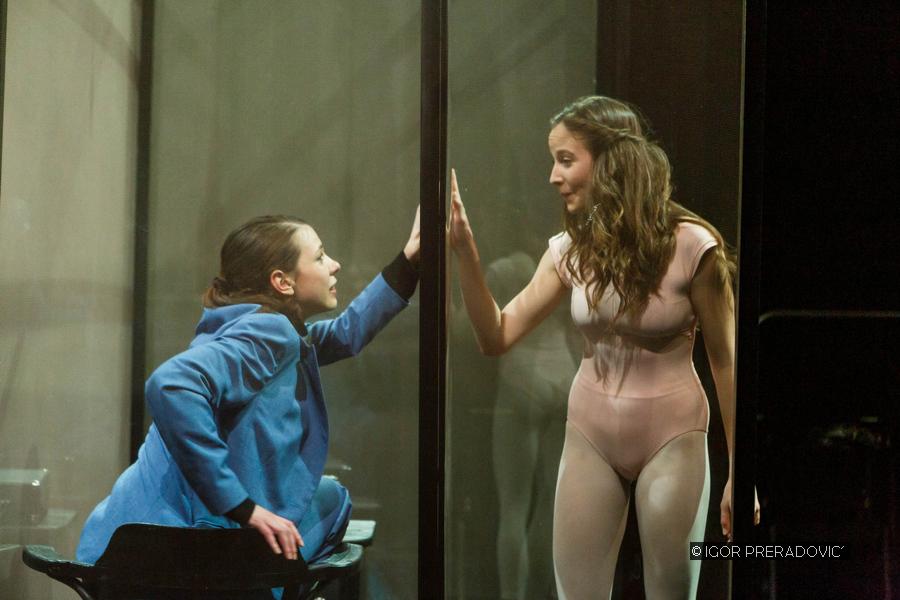
Nina Plavanjac’s The Aquarium, produced by the Subotica National Theatre in Serbia and presented within the Hungary-Serbian Cultural Season at MİTEM, is a chamber work about inheritance – not the comfortable inheritance of houses, objects, or family names, but the more dangerous transmission of silence, fear, and emotional reflex. Written and directed by Plavanjac, the production places a mother and daughter inside a domestic space that behaves less like an apartment than like a memory under pressure.
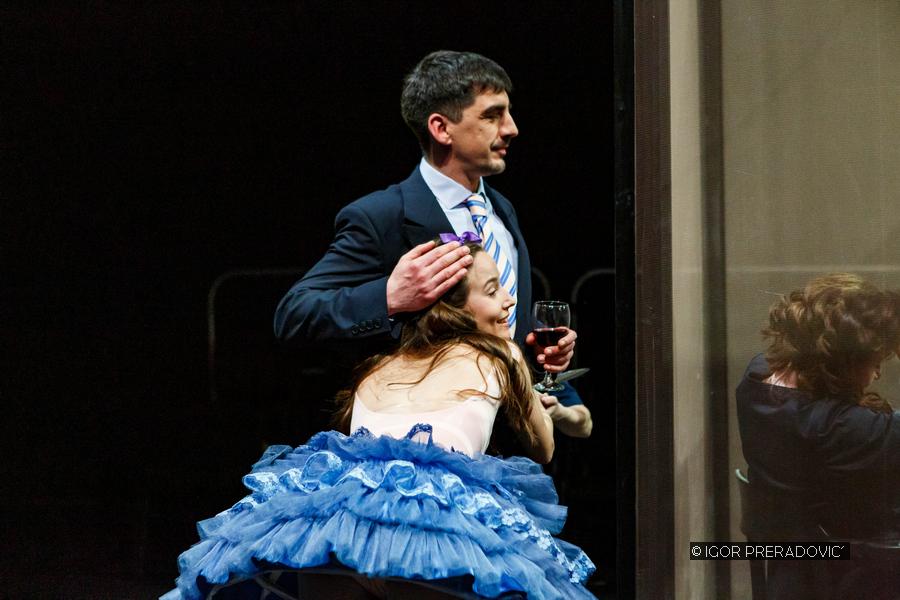
Photo by Igor Preradović
The story begins with a forced return. Lenka comes back from abroad to her childhood apartment after her mother, Snežana, who suffers from advanced dementia, is removed from a nursing home. This premise could easily lead to a conventional drama of care, resentment, and belated reconciliation. Plavanjac’s work appears to move toward something more unsettling: a confrontation not only between two women, but between several generations of women whose unresolved pain has become part of the family’s emotional architecture.
The MİTEM presentation frames The Aquarium for an international audience: the performance is in Serbian, with Hungarian and English subtitles, and runs without an intermission. That information matters. This is not a play that one should interrupt. Its subject is accumulation – the way unasked questions, unspoken grief, and unlived tenderness gather until they become almost physical. The absence of a break suggests a dramaturgy of immersion. Once the audience enters this aquarium, it stays there.
The central metaphor is exact and quietly cruel. An aquarium is transparent but closed; everything inside is visible, yet nothing inside is free. Plavanjac has described the title as arising intuitively, later shaping the stage concept itself: a bounded world in which there is nowhere to hide. In the context of dementia, the image becomes even more charged. Snežana is not simply losing memory; she is trapped inside its fragments. Lenka, returning from elsewhere, discovers that leaving home did not free her from it. The family apartment becomes a vessel in which the past continues to breathe.
What makes the premise artistically compelling is that The Aquarium does not seem interested in assigning guilt in the simplest sense. Its dramatic force lies in the question of repetition. Family trauma, in Plavanjac’s formulation, moves through generations; it does not disappear merely because one person decides to survive it. The daughter may recognize the mother’s wound, but recognition does not automatically produce forgiveness. The mother may be ill, but illness does not erase the damage she has done. This is the moral difficulty the play appears to inhabit with unusual delicacy.

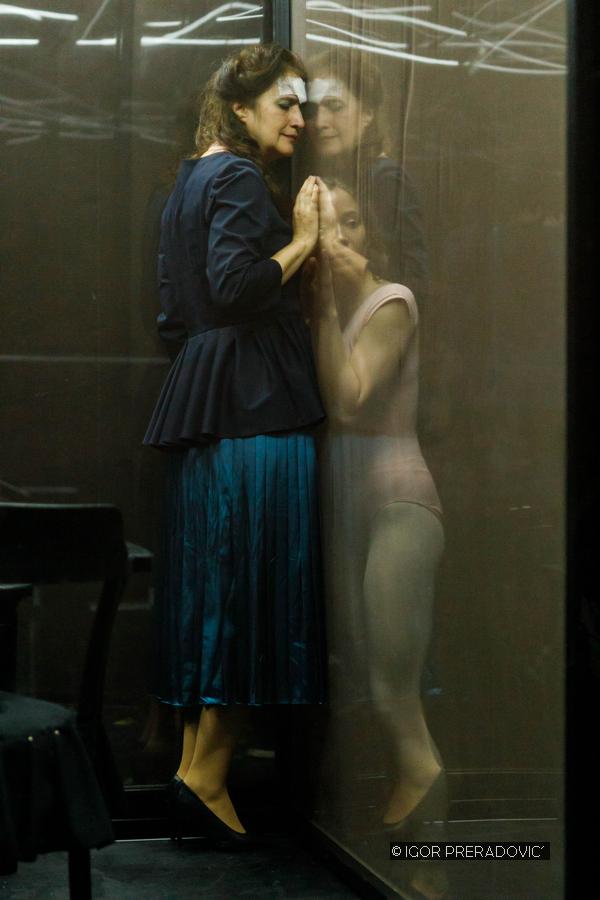
Photo by Igor Preradović
The figure of Stanija, the grandmother, is crucial here. The Aquarium becomes not only a family drama but a study of female succession: how pain, discipline, fear, and belief pass from one woman to another, sometimes disguised as protection, sometimes as love. This is where Plavanjac’s work seems strongest. It refuses the sentimental fantasy that every wound can be healed by one final conversation. Instead, it asks what kind of tenderness remains possible when tenderness has been damaged by history. The production’s emphasis on dementia is not merely medical, it is theatrical. Dementia collapses time. So does trauma. In both, the past does not stay past. It returns in gestures, phrases, accusations, and bodily habits. In The Aquarium, this collapse becomes the play’s structure.
The cast list itself suggests a carefully layered psychological field: Snežana, Lenka, Petar, Stanija, and “Other Lenka.” That last figure is especially suggestive. “Other Lenka” implies not only a double, but an imagined daughter – the child the mother may have wanted, invented, or needed. Such a presence can turn family drama into an internal tribunal. The daughter onstage must compete with a fantasy version of herself, and perhaps with the person she had to become in order to leave. Few family wounds are more painful than being measured against an impossible version of oneself.

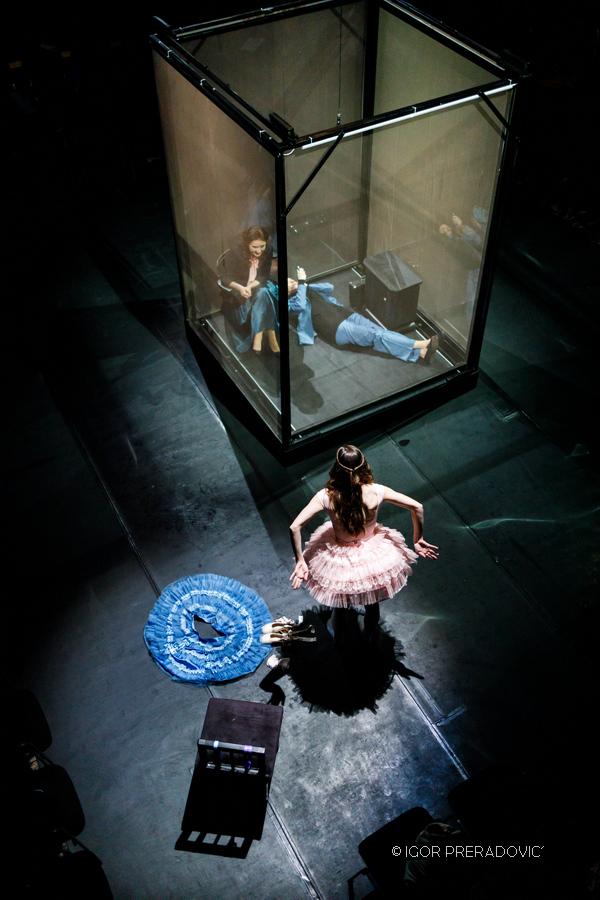
Photo by Igor Preradović
What gives the production its force onstage is its patience. The actors do not rush the conflict; they let it thicken. Conversations begin almost practically, as family conversations often do, and then suddenly reveal an old wound underneath. Lenka’s restraint is as important as her anger, while Snežana’s illness is played not as a single condition but as a series of shifts – fragility, irritation, dependence, flashes of recognition. The room seems to tighten around them. By the end, the audience is not simply following a story about care and resentment; it is sitting inside the uncomfortable tempo of a family that has spent years learning how not to say what hurts.
Zoja Erdeljan’s stage design, Marko Marosiuk’s costumes, Goran Balaban’s video projections, Andreja Kargačin’s choreography, and Sara Ristić’s music are all credited as part of a production that seems to think in atmospheres as much as in dialogue. That matters for a play about dementia and inherited trauma, where the invisible must become perceptible without becoming explanatory. A realist living room would risk reducing the work to domestic conflict. The aquarium image allows the domestic to become symbolic without losing its intimacy.
What is most moving in the idea of The Aquarium is its refusal to make darkness self-sufficient. In interviews around the premiere, Plavanjac spoke not only about illness and transgenerational trauma, but also about tenderness, love, forgiveness, and understanding. That balance is essential. A play about family pain can become punitive; a play about forgiveness can become false. The more difficult path is to let both remain present: injury and attachment, resentment and care, the wish to flee and the need to stay.

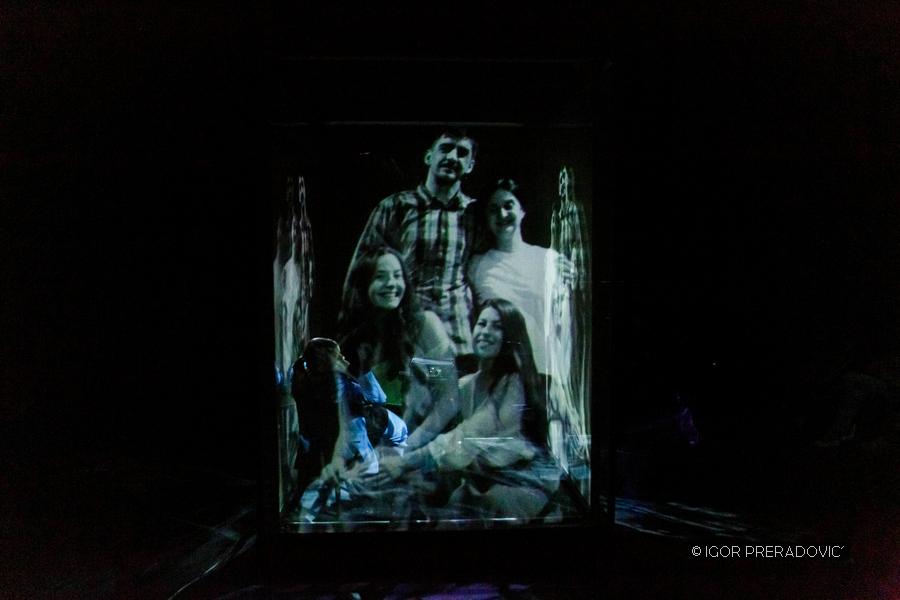
Photo by Igor Preradović
For MİTEM, this production is a particularly meaningful inclusion. The festival context invites works to travel across languages and theatrical cultures, but The Aquarium travels through something more intimate than translation. Nearly every culture has its own rituals of family silence. Nearly every family has a room where certain questions are never asked. Plavanjac’s play appears to locate that room and then seal the doors.
The play’s power lies precisely in the fact that catharsis here seems earned through discomfort. It asks the audience to look at the mother not only as a mother, the daughter not only as a victim, and the grandmother not only as a figure from the past. Each is also a carrier: of language, damage, memory, and perhaps the first fragile possibility of interruption.
In that sense, The Aquarium belongs to a contemporary theatre increasingly attentive to what families preserve without knowing it. Plavanjac’s achievement is to give this inheritance a lucid image: a glass container, transparent and suffocating, beautiful only from the outside. Inside it, women swim through the water of memory, watched by others, unable to leave, still searching for air.
For an international audience at MİTEM, the production offers not an exotic family story from Serbia, but a precise theatrical meditation on a shared human problem: how to love those who have wounded us, how to mourn what they never gave, and how to stop passing the wound forward. That is why The Aquarium feels important. It does not promise release easily. It simply shows, with patience and grace, why release is necessary.

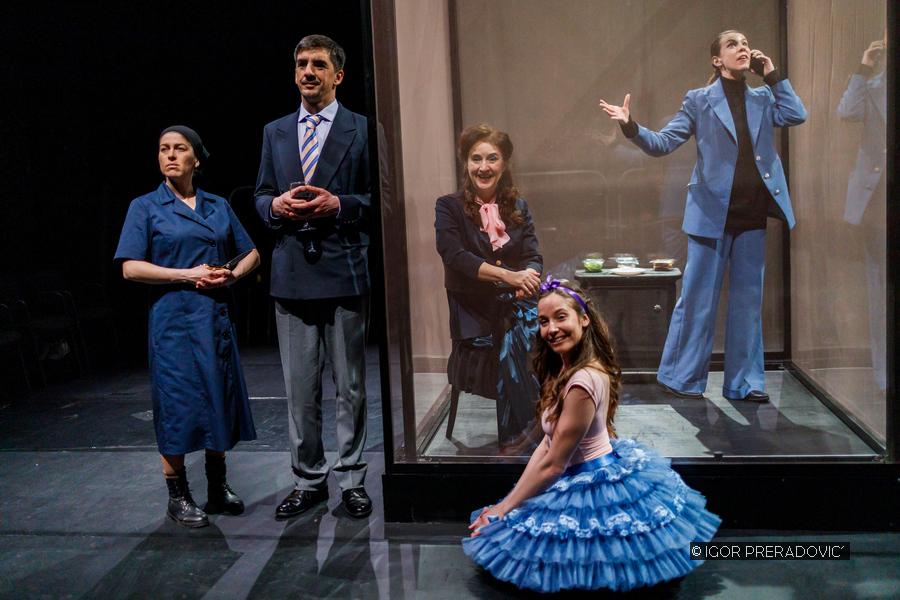
Photo by Igor Preradović
This post was written by the author in their personal capacity.The opinions expressed in this article are the author’s own and do not reflect the view of The Theatre Times, their staff or collaborators.
This post was written by Emiliia Dementsova.
The views expressed here belong to the author and do not necessarily reflect our views and opinions.