



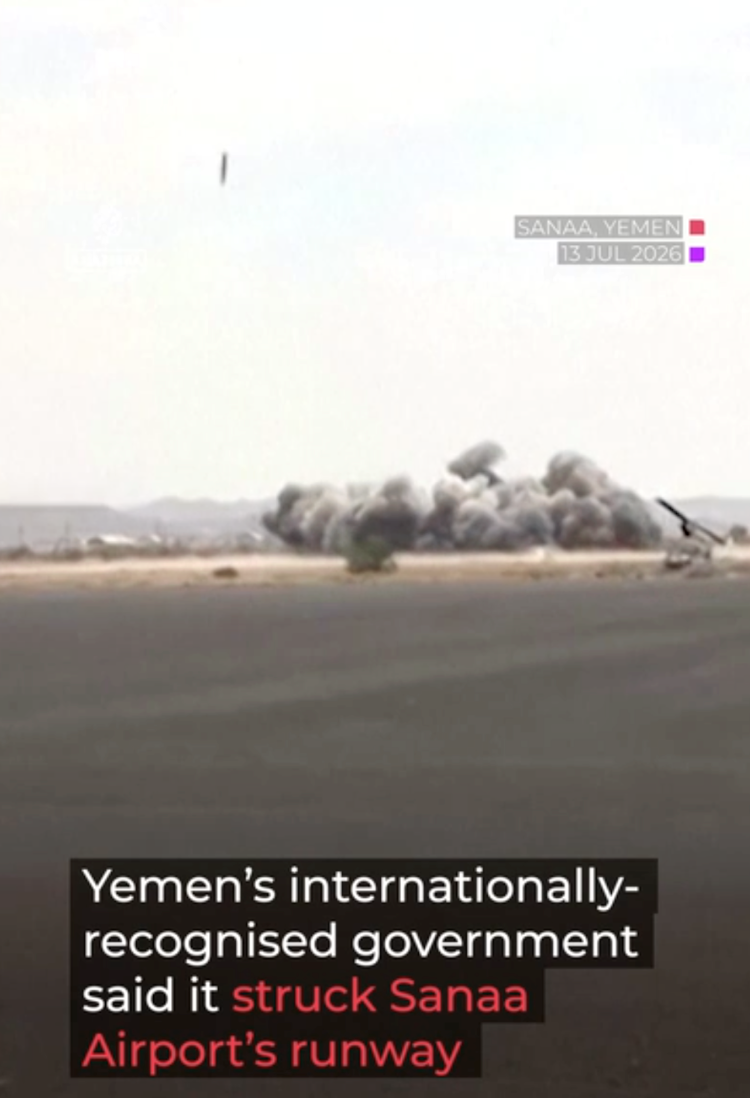
(Al Jazeera Media Network) A leading official with Yemen’s Houthi rebels, officially known as Ansar Allah, has threatened a “siege” on Saudi Arabia in retaliation for an attack on Sanaa International Airport. The Houthis blamed Saudi Arabia for the Monday attack, but Yemen’s internationally recognised government has claimed responsibility, saying that it was a measure to prevent an Iranian plane from landing in Yemen’s Houthi-controlled capital.
Speaking to Al Jazeera, Mohammed al-Bukhaiti, a member of the Houthi political bureau, said that the group would respond to attacks they perceived to be from Saudi Arabia.
“Their willingness to attack Sanaa Airport to prevent flights from arriving or departing gives Yemen the right to strike their airports and to impose on them a siege just as they have done to us,” al-Bukhaiti said.
Houthi spokesperson Yahya Saree said that Monday’s attack ended the “de-escalation phase” of Yemen’s war, which has been ongoing since a Houthi takeover of Sanaa in 2014. This week’s violence follows clashes in Hodeidah between Houthi and government forces earlier in July, and threatens to end four years of relative calm since a temporary truce was agreed.
The strikes, which al-Bukhaiti said “will not pass without response and punishment”, targeted Sanaa Airport’s runway as an Iranian plane carrying a Houthi delegation from Tehran was approaching. The delegation had been attending the funeral of Iran’s late Supreme Leader Ali Khamenei, who was killed at the start of the US-Israeli war on Iran on February 28.
Al-Bukhaiti had been among the officials travelling on the Iranian airliner, which was diverted to Hodeidah, a city on Yemen’s Red Sea coast that is also controlled by the pro-Iran Houthis.
His comments followed the Houthis’ own response to the Sanaa Airport attack: a ballistic missile salvo fired at southern Saudi Arabia’s Abha International Airport. The Saudi-led coalition said that it successfully intercepted the missiles.
The Houthis have threatened further action to end the “siege” on Sanaa Airport, and pledged to keep flights between Sanaa and Tehran running. They say they have no issue paralysing Saudi airports in order to achieve that goal.
A flight between Tehran and Sanaa on July 3 caused the recent tension, after the Houthis accused Saudi warplanes of attempting to prevent the Iranian plane from landing. The flight was the first publicly announced Iranian flight to land in Sanaa for more than a decade.
The Yemeni government has accused Iran of using flights to Yemen as cover to send equipment to the Houthis. Speaking at the United Nations Security Council on Monday, Yemen’s ambassador to the UN Abdullah al-Saadi said that the plane attempting to land in Sanaa was linked to Iran’s Islamic Revolutionary Guard Corps (IRGC), and had “personnel, know-how, and military and dual-use equipment”. He added that the Yemeni government had offered to fly the Houthi delegation from Tehran to Sanaa on a Yemeni airline.
With the potential for violence to escalate in Yemen, there are now fears that the Houthis will use their control of territory along the Red Sea to close the Bab al-Mandeb Strait, the southern entry point to the vital waterway.
Coupled with continued threats to shipping in the Strait of Hormuz – on the other side of the Arabian Peninsula – as a result of the US war with Iran, any attacks on shipping off Yemen’s coast would further rock the global economy.
When asked about the possibility of the Bab al-Mandeb Strait being closed, al-Bukhaiti expressed that all options are on the table for the Houthis.
“The Bab al-Mandeb card is a strategic asset that Yemen has the luxury of utilising,” al-Bukhati said. “We will use this card against nations that are actively transgressing on us. We will use Bab al-Mandeb in a way that will bring no harm to nations that are not involved in hostilities toward Yemen.”
https://www.aljazeera.com/news/2026/7/14/leading-houthi-threatens-siege-on-saudi-arabia-after-yemen-airport-attack