




The notion of stakes doesn’t really exist within Forza Horizon. Playground Games’ open-world racing game series is all about keeping it breezy. It’s cool if you win; it’s OK if you don’t. At the Horizon festival, the vibes are good, the music’s banging, everyone loves cars, everyone’s a friend. You can progress meaningfully in the game by playing online or solo, by racing, drifting, exploring, collecting, tuning, painting, or taking photos. It’s chill.
The stakes aren’t particularly high for Forza Horizon as an enterprise, either. With quiet good cheer, Playground has crushed almost all mainstream competition within the racing game genre — including Horizon’s elder sibling, Forza Motorsport. Now that it’s available on PlayStation as well, there’s no argument that Forza Horizon is the definitive racing series of the moment.
Even the relatively long gap of four-and-a-half years since Forza Horizon 5 lowers the temperature ahead of new entry Forza Horizon 6. You know what they say about absence. It’s been long enough for all but the most dedicated fans to forget that the series’ formula might be at risk of going stale or losing focus. We’re not impatient for change; we’re impatient to have our favorite automotive comfort game back. It’s perhaps the most reliable game franchise of the last 14 years. Every game in the series is expansive, technically superlative, critically acclaimed, and broadly loved.
Things might not have felt so stable within Playground, however. Forza Horizon has been bleeding development talent, both internally to Playground’s Fable team and to rival studios set up by former colleagues. And to keep things interesting, Playground opted to set Forza Horizon 6 in Japan. It’s a safe choice in terms of fan demand, but one fraught with risk in terms of meeting those expectations, and a high degree of difficulty in terms of accurately and sensitively capturing the country’s geography and culture.
Ah, who am I kidding? There’s no drama here. Forza Horizon 6 is excellent, because of course it is. It’s polished, welcoming, huge, sensible, gorgeous, flexible, intense, relaxing, lavish, detailed, tasteful, dorky, glamorous, and upbeat, because of course it is. It’s everything you already know Forza Horizon to be — including slightly overwhelming in its eagerness to please, and maybe a little insistent in the fusillade of micro dopamine hits it offers. But that’s OK. It only wants to be liked, and it’s so damn likable.
I’m not going to break down everything that makes up Forza Horizon 6 here, because the series is both a known quantity and, at this point, far too big to get your arms around. It unites racing games with the infinite sprawl of open-world action-adventures with devastating effectiveness. It can turn itself into anything you could reasonably want a driving game to be, except maybe a hardcore simulation. The car handling has a tactile credibility to it and is wonderfully supple. But as you soar kilometers through the air off spectacular ramps, sideswipe mighty trees out of existence with a humble hatchback, and thread through city traffic at 180 miles per hour, you would be hard pressed to call it realistic.
As you might expect when a game series that was basically perfect to begin with hits its sixth instalment, there’s some gilding of the lily going on. Does Forza Horizon really need an intricate new environmental creation mode that allows you to painstakingly decorate your garage, not to mention build anything you can imagine in the sprawling acreage of your own private Estate? Probably not, although I can’t wait to see what the community can make with it. For my part, I got excited about the idea of recreating Mario Circuit 1 from Super Mario Kart, fiddled about deleting bushes for 15 minutes, and then decided life was too short.
No, what Forza Horizon really needs is a firm hand on its wild profusion of activities, and a few (but not too many) new ways to drive cars around that are either genuinely additive, thematically appropriate, or both. Fortunately, in both respects, the Playground team remains alert and on the case.
To some extent, reining in this overflowing cornucopia of stuff to do is a losing battle, and as you play through Forza Horizon 6 you will still frequently find yourself stricken by the paralysis of choice. But Playground has made some smart choices in organizing the game’s content. Chief of these is splitting the campaign into two separate progression tracks: the Horizon Festival (racing, stunts, time trials, driving skills) and Discover Japan (collection, exploration, customization, story missions). Each comes with a neat collection journal, lots of micro rewards, and big level-ups that unlock more stuff on the map.
There’s still a bewildering amount of stuff, and it’s still easy to slip into obsessive box-ticking as you play. But I’ve found it really helps focus my time with the game to have two distinct play styles and sets of priorities to swing between.
I’m also a fan of the decision to reinstate the original Forza Horizon‘s wristband progression for the Horizon Festival races, which sees players move up through faster car classes as they get deeper into the game. This will be divisive — some racing game fans will always prefer to be in the quickest car from the get-go. But there are plenty of other avenues for unrestricted play, including drag races, time trials, and illicit street races. For me, the RPG-like sense of progression gives the campaign a much more defined shape.

Playground is also on a drive to keep players in the map for longer, reward players who prefer to just explore, and provide more organic social multiplayer opportunities in free-roam. I love the aftermarket cars for sale by the side of the road, curated and upgraded to fit your progress and nearby events. They imbue everyday car shopping with a sense of personal discovery — and they mean less time browsing menus and more time spent enjoying the world.
Forza Horizon has always flirted with being a racing MMO, but struggled to find the structure for it. Forza Horizon 6 doesn’t get there either, but it’s closer than ever. This is exemplified by the brilliant new Time Trials: circuits you can find on the map and start lapping without breaking out of your free-roam session. These are a magnet for other players and prompt spontaneous convoy invites so you can compare times as you lap — a great new example of Forza Horizon’s latent potential for emergent multiplayer being realized. (You can engage in impromptu drag races in the same way.)
Elsewhere, Forza Horizon 6 adds Horizon Rush events — showy, stunt-heavy, gymkhana-style time trials — as well as Touge one-on-ones, the snaking downhill mountain races particular to Japanese street racing culture and made famous by Initial D. They’re both pretty thrilling. The celebration of Japan continues in the narrated sightseeing of the chill Day Trips, in Drift Club Japan, and in the car catalog’s deep dive into local esoterica that includes tiny K-cars, service vehicles, taxis, and discreet limousines, as well as the more familiar, sporty JDM imports.

Representations of Japanese culture in Western media tend to draw particularly acute scrutiny for their authenticity, and Forza Horizon 6 will be no different. The truth is that this series has always indulged in a strain of glossily inoffensive, surface-level, tourist-board-approved cliché. (Remember when Forza Horizon 4, set in Playground’s native Britain, effectively had you race the Hogwarts Express?) You could justifiably ding Forza Horizon 6 for the absurd-yet-generalized fantasy of staging a race against a Gundam mech, or for tasking the player with running over hundreds of kawaii mascots of Japanese foods. It’s certainly the kind of package tour that gives the visitor what they want over any deeper insight.
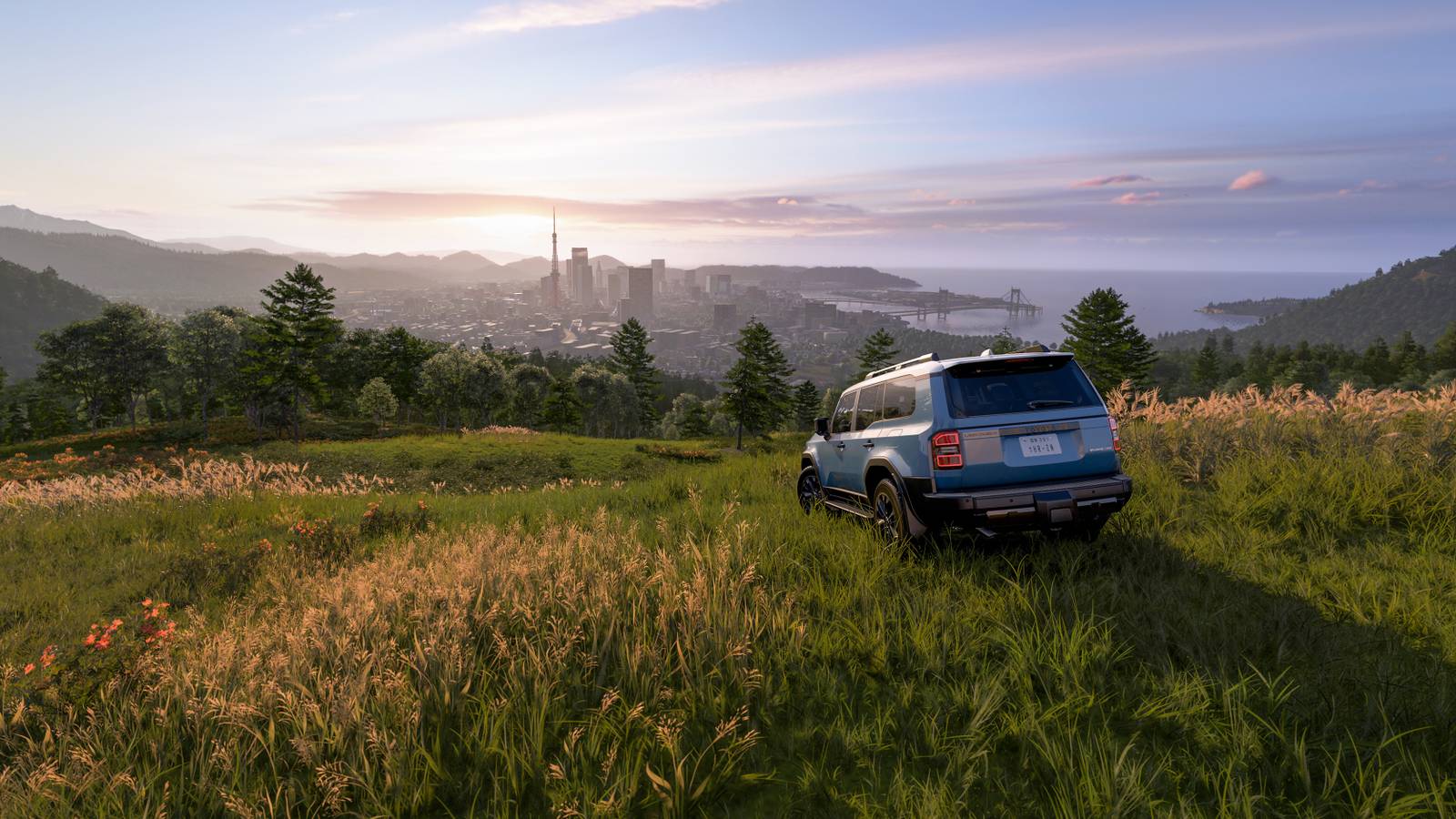
But I don’t think you can fault the sincerity of Playground’s appreciation of the Japanese landscape, or the verve and skill with which it has been rendered. This is yet another astonishing map: not quite as geologically awe-inspiring as 3‘s Australia or 5‘s Mexico, but with a coherence and evocative sense of place reminiscent of 4‘s Britain and 2‘s Mediterranean coast. Tokyo City, spanned by arcing, spiraling elevated freeways, is far and away the series’ grandest urban environment yet. The rest of the map is a lush climb from coastal fishing villages, through humid rice paddies and forested slopes, to a towering, snowy alpine range. It’s absolutely beautiful, but just as crucially, it’s nuanced and genuine, avoiding the sudden transitions and lacquered unreality of a theme park. I can tell that, if I give it long enough, I’ll be able to navigate it from memory, and I can’t wait to see it move through Japan’s temperate seasons. (The game was locked to summer during the review period, but like 4, it will have a weekly seasonal rotation.)
At this stage in Forza Horizon’s life, it’s justifiable to ask how much longer it can follow the smooth grooves of its long-perfected formula without settling into a suffocating routine. But it’s also easy to take for granted what these games do so well beneath all those noisy layers of activity: They realize the romance and freedom of the open road. Unspooling their miles of tarmac through majestic scenery is a pure, undirected, unfettered joy. Horizon 6 is as good at that as any of its predecessors. Arguably, it’s better.
Forza Horizon 6 will be released May 19 on Windows PC and Xbox Series X (with early access from May 15). The game was reviewed on Xbox Series S and Xbox Ally X using a prerelease download code provided by Xbox. You can find additional information about Polygon’s ethics policy here.