



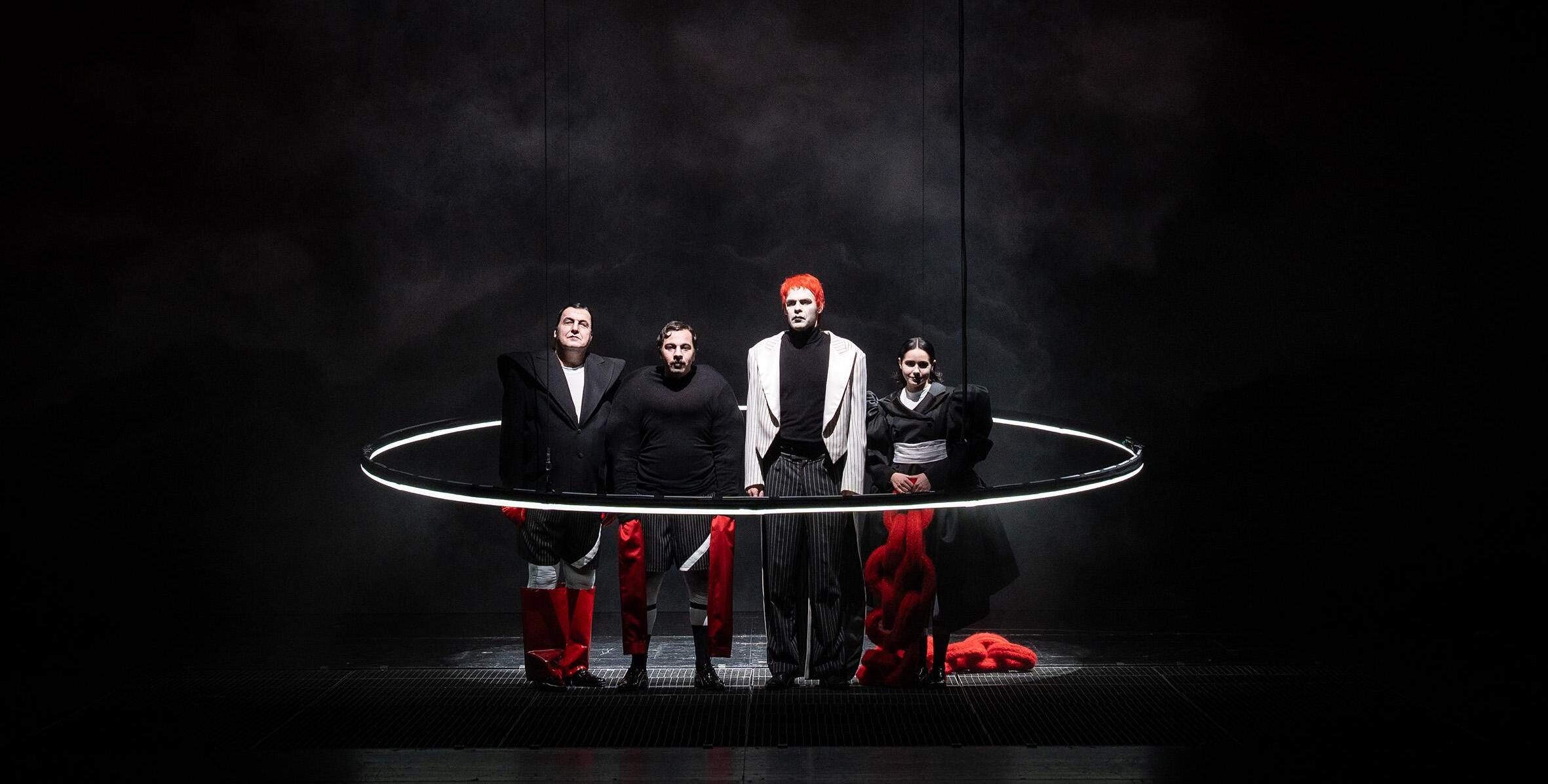
Klaus Mann’s novel Mephisto, published in 1936, deals with the opportunistic rise of its main character, Hendrik Höfgen to become one of the leading actors, directors and theatre managers during the times of the Nazi regime. There are undeniable parallels between Höfgen as depicted in the novel, and Gustaf Gründgens (1899-1963), who was Intendant (artistic manager) of the main theatre in Berlin from 1934 to 1944. Publication of the novel was prohibited in Germany for a long time, as discussed and confirmed in several seminal court cases, with freedom of artistic expression (Mann’s novel) considered limited by the more fundamental right to inviolability of human dignity (Gründgens), which was deemed to extend beyond an individual’s lifetime. Mann considered the novel as an exploration of opportunism under specific political conditions, inspired, by nature of his close relationship with Gründgens, by Gründgens, but not explicitly and only about this man. Ariane Mnouchkine directed the theatre version of the novel in 1979 for her Théâtre du Soleil in Paris, which was translated by Timberlake Wertenbaker for the 1986 production at the Royal Shakespeare Company’s Barbican Theatre, directed by Adrian Noble, with Alan Rickman as Höfgen. Klaus Maria Brandauer had played the role of Höfgen in the 1981 film directed by István Szabó.
For the 2026 production of the play at Staatstheater Oldenburg, director Ronny Jakubaschk did not use the text of Mnouchkine’s stage version from 1979, as translated into German by Lorenz Knauer for the first German language production (directed by Eike Gramss at Theater Basel in 1981). Instead, he developed his own stage version based on a contemporary view on the novel and current theatre practice. A prologue was based on an interview with Gründgens from shortly before his death in 1963; the first part focused on the rise of Höfgen in the provincial Hamburg theatre scene, the second part on his life in Berlin under and with Nazi Germany. The epilogue gave a reflective voice to those theatre artists who left Germany under the Nazi regime.
Further research might compare previous adaptations with this new one. Further research might also revisit the parallels between the lives of the inspiration, Gustaf Gründgens, and the life of the fictional character, Hendrik Höfgen. For this review, I am more interested in the principles of life that these characters represent – a variation on the theme of how we would respond to, react, and behave in comparable situations (see also my review of Ein Deutsches Leben). When a totalitarian regime comes to power, in a state or in a smaller unit, down to a company or even a university department, there seems to be a certain range of responses, including, but not limited to: those who do not notice that anything is amiss; those who are not too worried as long as it does not affect them; those who realize the dangers and escape as soon as possible; those who do realize the dangers but who cannot escape and form, or join, or seek to lead, the internal opposition; and those who align with the regime, become its tacit or active supporters, all the way to its henchmen. Ronny Jakubaschk’s Oldenburg stage version of Mann’s novel depicted Höfgen as the opportunist who was later, rather weakly, seeking to justify his behavior with reference to having supported some, or even many, people directly persecuted by the regime. There was not much to like about this character, and there was not much by way of suggesting, let alone demonstrating, exceptional qualities of Höfgen as actor, director or manager. Thus, he came across as an overly ambitious, possibly mediocre provincial theatre person, with the implication that he did not even quite deserve his star status in the provinces, who rose to stardom in the capital merely through the support of unpleasant people in an unpleasant environment.
Hagen Bähr played Höfgen very well in this restricted and restricting interpretation of the role; he was genuinely believable in the character’s vagueness (even Höfgen’s sexual relationship with Julian remained vague, rather than in any way described, or presented, with precision and clarity). The other actors were given not rounded characters to perform, but stereotypes, some based on the real people of the Nazi regime. Darios Vaysi, for example, was fitted with a hunchback and limped, like Richard III (Goebbels, on whom this character was based, limped because of a clubfoot).
The question also arises how artists who comply with a totalitarian regime, as one example of immoral or illegal behavior, are considered by their contemporaries and later generations. Many factors come into this, and any such case will always have to be judged on an individual basis. There are no general rules or overarching principles. Two examples: I witnessed an activity at the curtain call of an opera performance that I considered sexual infringement, at best borderline. I will actively not attend any further performance by the perceived perpetrator. I remember colleagues in Wales were outraged when Peter Brook objected to simultaneous translation into Welsh at an event in Cardiff because “we are all English”. I understand and respect their outrage, I agree that Brook’s statement was inappropriate, I understand why some of those colleagues would not attend any further Brook production after that incident, but hearing about the incident did not stop me from attending further Brook productions. The circumstances were not as close to me as they were to my Welsh colleagues.
Frank Castorf is set to direct his second production of Mephisto, in his own version, for Berliner Ensemble in the 2026/27 season – watch this space!
This post was written by the author in their personal capacity.The opinions expressed in this article are the author’s own and do not reflect the view of The Theatre Times, their staff or collaborators.