







Playwright-actor Pamela Mala Sinha is in the spring of her creative life, with several projects on the go during the first third of 2026. In a trilogy of articles for Intermission, critic Nirris Nagendrarajah, a participant in Neworld Theatre’s Page Turn program, documents this fertile artistic period; his methods include interviews and extended behind-the-scenes observation.
This feature serves as the series’ final part. The first is available here, and the second here.
Pamela Mala Sinha was scrolling through Instagram when the portrait of an extremely unhappy Indian girl in a Victorian dress stopped her in her tracks. “Who the fuck is that?” she thought, feeling herself drawn in by the inherent contradictions, her inner writer stirring awake.
During the next few days, she fell down a rabbit hole, learning what she could about the enigmatic life of Victoria Gouramma, a wayward princess born in Benares, India in 1841.
At the age of 11, Gouramma’s father, Chikka Virarajendra, the last ruler of Coorg — then a British-administered province in the country’s south — sent her to England in the hopes of gaining favour with Queen Victoria, who soon adopted her as a godchild. Before her death at the age of 23, Gouramma was, as Pamela puts it, a wild one: making friends with those below her station, falling in love with an underbutler, and refusing to let others’ expectations define her.
“All these qualities made for a fierce, compelling subject,” Pamela told me over tea.
The black-and-white photograph she’d initially encountered, which dates from 1854, came into stark contrast when she saw a painting of the unhappy girl from a year before her displacement. “There’s a switch between the pride and the elegance,” she told me, showing a side-by-side of the images on her iPhone. “Look how miserable she became: that switch was my story.”
She continued researching, but soon discovered that historians had relegated Gouramma to a footnote in the storied life of Prince Duleep Singh — the golden boy among the Queen’s adopted godchildren. “That there was hardly anything on her enraged me,” she said, “I thought, ‘My girl needs a voice.’”
Years after that encounter, the discovery of that voice is materializing in Pamela’s fourth play: Majesty. In January, Pamela sent me the most recent draft, which, in addition to alternating between fluent and broken English, depicts Gouramma and Duleep as their divergent lives collide over its two acts. Majesty is, in my opinion, unlike anything she has written before, with its epic scope and literary depth. Yet it’s a natural extension of familiar themes in her work as it circles trauma, parenthood, and historical legacy. The script retains her characteristic dry humour, poetic tenor, electric verbal volleying, and inventive temporal shifts.
Unlike Pamela’s previous plays, based on the narrative and emotional events in and around her life, here centuries-old historical facts are the story’s skeleton. In preparation for its creation, Pamela submerged herself in archives, finding inspiration in the memoirs of Lady Login — a courtier who educated Gouramma and Singh — the Queen’s correspondences, and war reports.
With a proposed cast of 11 playing 17 characters, this Tarragon Theatre commission will be Pamela’s largest and most expensive yet. Lately, uncertainty around whether the script will make it to full production has caused her fear familiar to many independent Canadian theatre artists who struggle to access adequate funding to match the scale of their ambitions.
“There are a lot of beautiful plays that are not going to be done,” she said. “We’re in a climate where most theatres can’t commit to doing big, original, expensive plays. Even when you’re a commissioned playwright, it doesn’t guarantee you’re going to be staged. It’s all up in the air.”
At the time of this meeting, in late January, she was focused on the Montreal premiere of her first one-person show Crash, which, at our first meeting, I’d agreed to attend. Crash, narrated in the third person, tells the story of a Girl simultaneously experiencing the deterioration of her father’s health and confronting the traumatic aftereffects of a sexual assault. The production, staged by Imago Theatre, would be the first time a performer other than Pamela stepped into the role — in this case, the Iranian-Canadian actor Ghazal Azarbad.
The prospect of observing an artist passing the torch to another performer attracted me; in addition to a post-show interview, I wanted to capture the subtle shades of that re-orientation.
“And you will meet my mother on opening night,” Pamela said, smirking. “She’s a fireball.”

It was almost Valentine’s Day.
Only after I arrived at the Segal Centre for Performing Arts did I see Pamela’s text informing me that she and her mother were running late.
I plopped down on a cushioned bench and pulled a book from my coat pocket, often glancing up and catching sight of people I’d seen on Imago Theatre’s website, including Imago’s artistic and executive director Krista Jackson receiving a fresh marigold from associate director Keith T. Fernandez to pin to her black blazer.
The image of marigolds, often used in Hindu rituals to signify the cycles of life and death, arrives near the end of Crash. In that scene The Girl recounts scattering her father’s ashes in the Ganges: “Her eyes are burning but she doesn’t care because marigold garlands floating on smoke on water is not something she ever wants to close her eyes to,” the character says.
In the archival recording of this scene from 2013, Pamela stands centre-stage, waves projected over her body, silhouette cast on a wall. Pamela’s voice becomes more forceful as the memory deepens in her mind and she briefly pauses between the words “water” and “is,” her actorly cadence breaking apart her poetry.
Seated in the lobby, I wondered how the new production would render this scene.
By the time they arrived, the audience had already begun filing in and Rubena Sinha was swept inside before we could meet. Pamela was taken aback when Keith handed her a marigold and processed it. “You see,” she turned to say to me, “These are the people who are putting on Crash. The love, care, and attention they’ve paid to it!”
Having now been in her presence when she’d received both good and bad professional news, I identify with how Pamela can alternate between states of ecstasy — her current state — and despair, when a more critical voice emerges. Suspended between the two was the life sentence of every artist I know: the anxiety to honour one’s calling, the perpetual task of using art to make sense of one’s existence. She’s a fireball too, I thought. We agreed to reconvene at the reception after the show.

What immediately struck me inside the Segal’s 186-seat Studio Theatre were the differences to Alan Dilworth’s 2013 staging of Crash at Theatre Passe Muraille’s Backspace.
Rather than a glossy, Escher-like staircase, the Segal Centre set design by Eo Sharp features a three-tier platform framed by a moat. The props Alan’s version had brought to life through Cameron Davies’ projections — a silk slip, a police report, a knife, a cigarette carton, and a crowbar — were now physically realized and submerged or floating in the water.
Pamela was one of the last people to enter the auditorium, the edges of her ivory coat grazing the floor as she made her way to the back row, her face lost in theatre darkness. When, in her opening remarks, Krista mentioned the playwright was in the room, the audience clapped but didn’t know where to direct their attention; it was Pamela’s desire to step back and allow the work to speak for itself that took precedence as this new era for Crash commenced.
Compared to the poor audio quality of the archival, what instantly stood out to me in Jackson’s production was the incantatory effect of the sound design by Debashis Sinha, Pamela’s brother, reproduced exactly from the original production. As it alternated between evoking levity inside a loving home, to making stark jumps where trauma asserts itself, the sonic landscape deftly connected me to the various fluctuations within The Girl’s frenetic states of mind.
“He can feel India through his music in a way only someone with our upbringing can,” Pamela said a few days later about Debashis’ work on the show. “He is so deeply intuitive. It didn’t matter to me back then that he’d never designed sound for the theatre before. It could only ever be him.”
The audience laughed in almost the exact same places as in the archival — for instance, when The Girl says of her daily prayer, “It usually came out joybhagavanjoybhagavanjoybhagavan,” or the line about her imaginary horse who is “pink and her name is Lavender.” When The Girl remembers Constable Blier, a character based on the police officer who found Pamela after she was assaulted, Ghazal slipped in and out of a Quebecois accent that reminded me we were in the city where it had occurred, lending the production a visceral meta-fictional dimension.
In the aforementioned ending scene, actual marigolds fell into the moat from a hatch and plumes of smoke eddied from under the steps, plunging us into Pamela’s own past. Rather than raise her voice, as Pamela had, Ghazal took a more serene tack, savouring the memory rather than reliving it, her performance lending the scene a welcome lightness and grace.
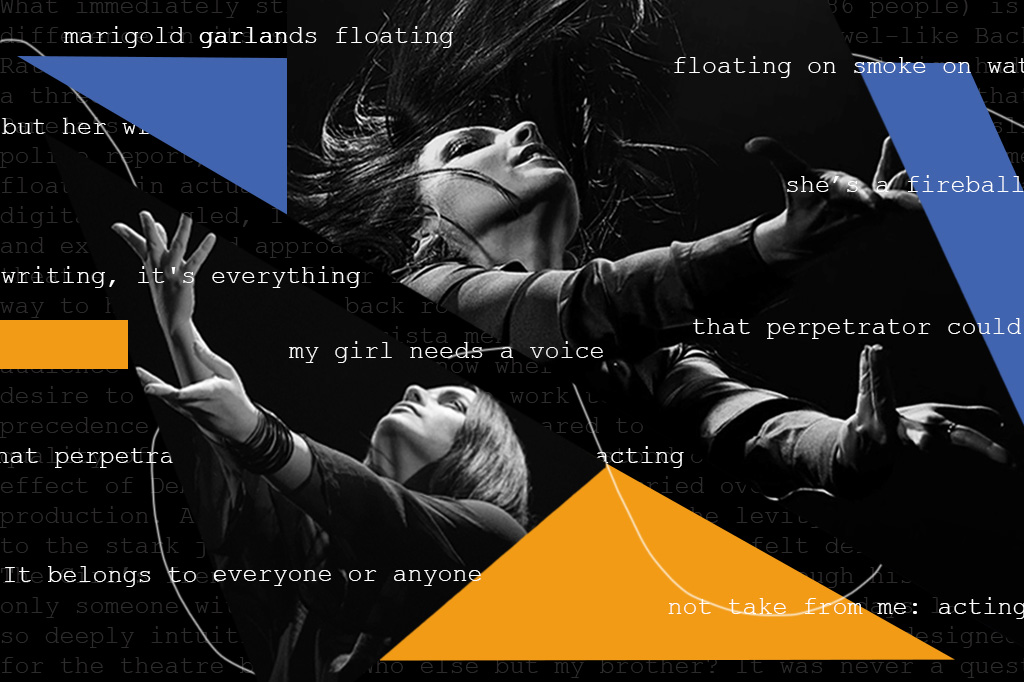
“Pamela has the lived experience,” Fernandez, the associate director, later said to me. “But Ghazal makes it her own. She treats The Girl like a character, not an homage.” Ghazal’s fierceness emerged in the dance of the Rudaali, where her voluminous hair flew up in the air like fireworks, recreating the signature image associated with the play. In these scenes, she was riveting, reaching the edge of a catharsis that will necessarily never arrive — which is part of Pamela’s artistic ethos.
Ghazal playfully walked in the water, poured a bit of it onstage, before uttering the play’s last line, borrowed from the 12th-century poet and saint Mahadevi Akka. “Like the colour of gold, you are in me,” she intoned, descending the steps and walking into the light ahead.
For a moment, there was a silence, not awkward or uncertain, but I couldn’t quite articulate it just then. “For every single audience I’ve performed it for,” Pamela later told me, “there is always that communal experience of silence at the end. The audience needs to sit with it for a moment. Whatever is going on needs to take space and then they can come to celebrate the performer. Whether you like a play or not, good theatre affects you in some way. Crash does that in a non-sensationalist, poetic, compassionate way within the artistic container. That is the offering I hope every production of this play — however it may be interpreted — will make.”

Back in December, when we first met for this series, Pamela handed me a red folder.
“This might help you,” she said.
Inside was a sun-touched article from the Winnipeg Free Press that profiled Rubena Sinha before the world premiere of Pamela’s 2022 play New, for which Rubena — a dancer, choreographer and storyteller — is credited as a cultural consultant and one of its inspirations.
“I needed to take my mother with me because I knew those relatives were not going to open up to me unless I told her stories as an example,” Pamela said about the interviewing process for creating New.
Recently Rubena has released River, a 45-minute audio play and companion piece to Crash.
The play, accompanied by a thundering, multi-layered score by Phoebe Man, follows the narrator as she grapples with her daughter’s trauma and loses a beloved husband. In a key scene, Rubena finds herself at a river. “I see you flowing and floating the way you want to, but you change,” she pleads. “When both sides of someone are broken, what do you say to them?”
Listening to River, I better understood where the poetry in Pamela’s work derived from.
After the show, at the reception, beer in hand, I found myself speaking to artists such as choreographer and performer Charo Foo Tai Wei and sound designer Ashley Naomi. But the entire time I had been closely eyeing Rubena, who spoke to various people she knew across the room, until an opening finally presented itself and I decided to walk over.
“Nice to finally meet you,” she said, extending the firm grip of her soft hand to me.
I asked her about the impulse to create River: “That was the first time I’ve ever written anything. Dancing is copying, in a sense, but this was completely original.”
Her preferred hour to create: “Nighttime.”
How she viewed the interviewing process for New: “She also needed me to drive her around!”
And what she, having seen productions of Crash from Vancouver to New York, thought of tonight’s performance: “It was the first time I could hear the words because it was the first time Pamela wasn’t performing it. I don’t know where it comes from, but her writing, it’s everything.”

At the end of the night, Pamela finally made her way to me. There were two things she wanted to share, glancing aside as she sifted through the thousands of thoughts twirling in her mind.
“First, what impacted me,” she started, “was the fact Crash was being performed in Montreal. Hearing Constable Blier’s Quebecois accent and experiencing the play in a city I love — a city that changed my life, not for the good, but had a huge impact on my younger self was… I still can’t talk when I think about his kindness following the devastation I barely survived. To hear the accent of that beautiful person, that officer, who was a form of love for me in a time of horror… people ask me if it isn’t triggering for me to be in Montreal. But how can I not love this city? It’s the city that gave me him. Hand in hand with what I had to suffer walking to National Theatre School every day — a building that faced the apartment where it happened — is also the city that gave me the one thing that perpetrator could not take from me: acting.”
The second thing?
“The play doesn’t need me,” she said. “I knew it, as a playwright, but this just proves it. I felt validated in my belief that Crash has never been my play. It belongs to everyone or anyone who wants to step into The Girl. Ghazal’s performance… I am so proud of and for her. I am moved by the depth of thought and the rigour of the exploration undertaken by Krista and the entire team that gave us this tonight… I really can’t put into words how it felt watching it.”
I looked down, noticing a marigold on the floor by my feet, then picked it up and pocketed it.
“It was harsh,” she said, locking eyes with me and pausing before adding: “And it was beautiful.”
Nirris Nagendrarajah wrote this three-part series of articles as part of Page Turn, a professional development network for emerging arts writers, funded by the Canada Council for the Arts and administered by Neworld Theatre.
This feature is unrelated to Intermission’s partnered content. Learn more about Intermission’s partnership model here.

WRITTEN BY
Nirris Nagendrarajah
Nirris Nagendrarajah (he/him) is a writer and culture critic from Toronto who writes about literary fiction, film, opera, theatre and himself. In addition to Metatron Press, his work has appeared in MUBI Notebook, Little White Lies, CBC Arts, Literary Review of Canada, The Film Stage, Ricepaper, Ludwigvan, In the Mood Magazine, and Cha: An Asian Literary Journal. He is currently part of Neworld Theatre’s Page Turn program and received the 2026 Telefilm Canada Emerging Critic Award from the Toronto Film Critics Association.
LEARN MORE


