



In a number of contributions, I want to reflect on my seven years as owner / artistic manager of piccolo teatro Haventheater in Bremerhaven.
In 2017 I ended my academic career, combining voluntary severance with early retirement. I spend another 18 months wrapping up academic projects, while embarking on narrating audiobooks on the ACX platform for Amazon Audible. Over the months I narrated some 80 titles, for a one-off fee or passive income (royalties in the form of a percentage of the sales price of every copy sold). While I enjoyed the work and had a good flow of projects to work on, I felt that there was no growth potential for at best medium-term, and the work also proved rather a lonely endeavor.
I subscribed to Theapolis, the major German portal for theatre jobs, and in October 2018, Roberto Widmer, founder and owner of piccolo teatro Haventheater in Bremerhaven advertised the role of his successor, given that he wanted to retire. I had known Bremen, the larger of the two cities, Bremen and Bremerhaven, which make up the German federal state of Bremen, since early childhood because most members of the family on my mother’s side were resident there. In addition, the idea of running my own theatre appealed to me, in particular because of its size (then around 50 spectators) and its focus on comedy. I sent an application, and Roberto invited me to see a performance and have dinner with him afterwards to get to know each other and to discuss my potential for the theatre and vice versa.
I arranged my visit and saw Dirk Böhling’s play about Bremerhaven-based Lale Andersen, under his own direction, with Roberto playing all the men and a Bremen-based actress as Andersen. There was also a musician providing live accompaniment for the songs. See my review here of the revival of that play, also under Böhling’s direction, at the Packhaustheater in Bremen in 2025.
For the dinner afterwards, we were joined by another applicant for the role of artistic director, who was clearly uncomfortable with the scenario, to which I came with more ease because of my experience of job applications and interviews in the UK University sector, where all shortlisted candidates, at least for senior positions, will have dinner together with local colleagues the night before the interviews. The conversation was cordial, and I used a moment at the end of the evening, when my competitor was using the restroom, to tell Roberto that I would be honored to take over his theatre, and to continue on the basis of what he had created, but that I was not him, and would bring my own spirit to the theatre just as it was now breathing his spirit (just as the Bouffe du Nord in Paris was breathing Peter Brook’s spirit). In his E-Mail offering me to take over the theatre, which I received a week later, Roberto emphasized that those comments had been essential in allowing him to make up his mind whom to select among the group of six or seven competitors.
The day after receiving the offer I accepted, signed the pre-sale contract, put my UK house on the market, sold within six months at a price not too much below the asking price, and arranged the move from the UK to Germany. I arrived there in May 2019, patiently went through numerous administrative procedures of settling myself and establishing my role in the theatre, ready to take over officially on 1 August 2019.

A view of the auditorium and stage. Photo credits: piccolo teatro.
My theatre did not receive any public funding on a regular, i.e. annual basis, as institutional funding, but was able to apply for project funding to the culture section of the municipal council. Applications for up to 3000 € annually were decided within the culture section, whereas applications for up to 10000 € had to be presented to the Culture and Schools commission. I was lucky that I found a strong working relationship with the municipal council’s chief politician in charge of the sectors of culture and schooling (a former member of the Green Party, now without party affiliation), and the head of the culture section (a civil servant who had been artistic director of two different theatres, one further afield, one in Bremerhaven, before joining the Bremerhaven municipal council). Both, and their respective teams, were particularly supportive during the Corona years and the aftermath of the pandemic, ensuring the frequently updated government regulations were communicated to the players in the culture sector in a manner that translated them, almost, from legal language to instructions we could understand immediately and work with.
I was also lucky to have found a competent tax advisor, whose staff did the bookkeeping for the theatre, who compiled the tax returns and submitted them on my behalf, and who guided me expertly through the raft of applications for state support during the Corona crisis – in such a way that when the support once given was double-checked, I was fortunate not to have to pay any money back.
The first production under my management was Die Magd Zerline, based on a prose text by Hermann Broch. Roberto had asked me to take this up from his inheritance, as it were, as he had promised this production to a director who had worked with him before, and the two actors – Michael Gruner, Katharina Schumacher, and Michael Schories, respectively. Gruner was a major name in the German theatre scene at the time, having served many years as head of theatre within the management of Theater Dortmund. So of course, I agreed with Roberto’s request and did not regret it.
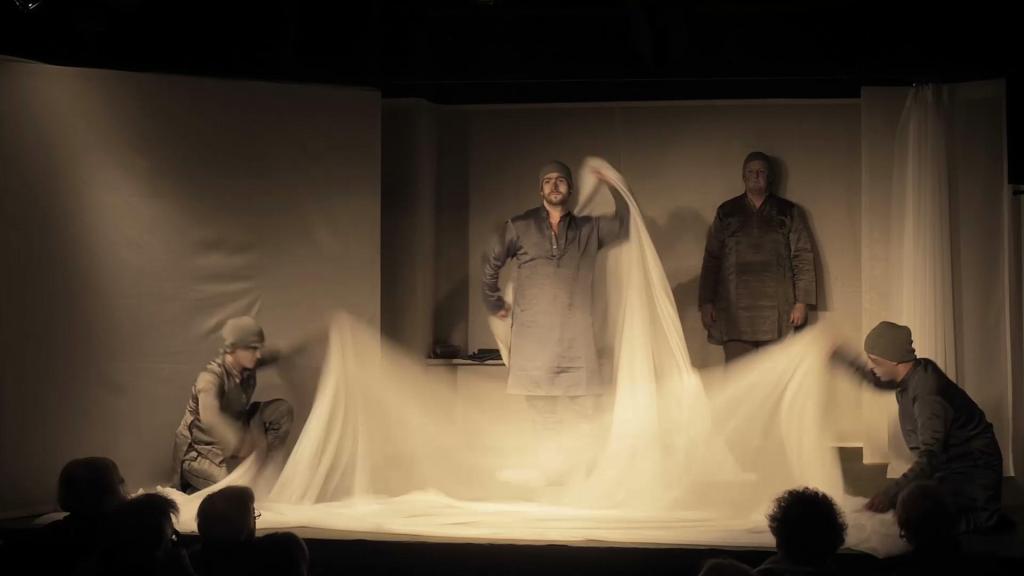
Heinz-Uwe Haus’s production of The Persians by Aeschylus. Left to right: Britta Werksnis as Atossa / chorus, David Gundlach as messenger / chorus, Daniel Meyer-Dinkgräfe as Dareios / chorus and Andreas Brendel (Xerxes / chorus). Photo credits: Rillke.
For the subsequent productions, which I had to decide in terms of text, director and cast, I chose The Persians by Aeschylus, to be directed by Heinz-Uwe Haus, and for the first production of my own I selected Willy Russell’s Educating Rita. The Persians represented a major financial risk. Audiences would be (and were) hesitant about the work of a new artistic director, unknown to them, anyway, and they were clearly accustomed to comedy. However, I wanted to be part of a production at the launch of my time as artistic director as an actor on stage myself, and I had full confidence in Haus, whom I had met back in 1996 at an academic conference, and developed a friendship with since. Thus, while the production flopped in financial terms, it confirmed all my hopes and expectations in artistic terms, laying the foundations for my subsequent work at the piccolo teatro Haventheater. It supported my ideas about directing, and it also confirmed my self-critical concerns about my wish to be active on stage as an actor. I realized that I needed far more time to focus on learning lines and developing characters to my own satisfaction than I would have left in addition to the numerous activities involved in the management role. For my role as Dareios in The Persians, an additional hurdle presented itself in an unexpected way: I had played that role in 1979 within the theatre group of the school I had graduated from in 1977. We had been rehearsing since 1976, I had used the role for one of several oral exams for the subject of German / Theatre, and I knew the lines so well that I can still recite them today. For the 2019 production we used a different translation. For every 2019 rehearsal and performance, I had to fight, to force myself, line by line, to produce the 2019 text rather than the mid-to-late 1970s lines that were still so very present and alive in my mind.
This post was written by the author in their personal capacity.The opinions expressed in this article are the author’s own and do not reflect the view of The Theatre Times, their staff or collaborators.