





There was something almost suspiciously neat about the programming. MİTEM opened with Richard III and closed with Richard III. On paper, that sounds like a clever curatorial decision, maybe even an elegant one. But after Itay Tiran’s production for Gesher Theatre, the symmetry felt less decorative than unsettling. The same play had returned at the end of the festival, but it came back changed – colder, sharper, and much harder to sit with. Before the audience has even fully settled into the hall, the title Richard III is already being altered onstage, smeared and reduced until, for a moment, what remains reads HARD III – a blunt visual pun, and a fair warning about the weight of the evening ahead.
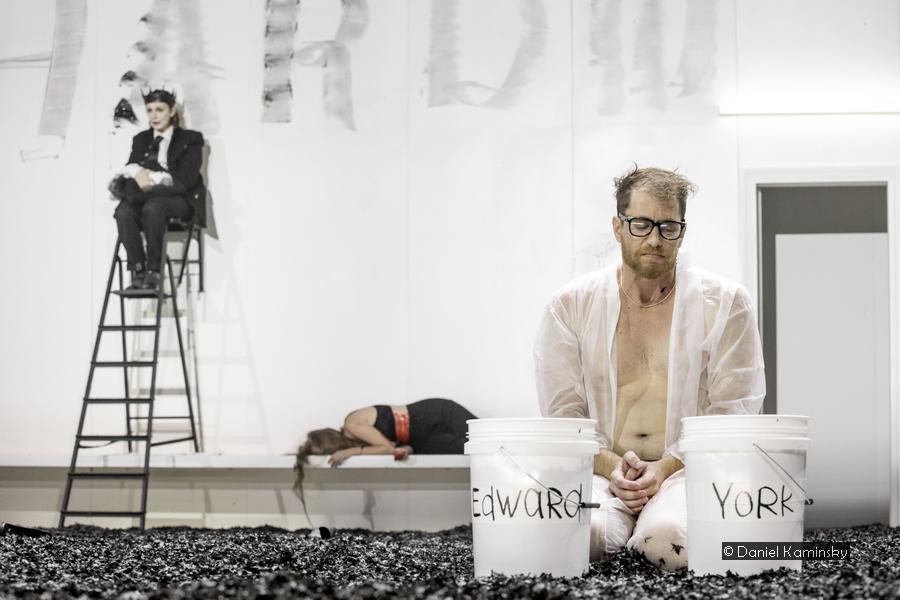
Photo by Daniel Kaminsky
Tiran’s Richard III does not treat Shakespeare like a museum object. It does not polish the play as a sacred classic, and it does not force it into the present with obvious topical references. That is one of the production’s strengths. It trusts the text enough to let it breathe. Its modernity comes from something quieter: from the way it understands power, compromise, fear, and the speed with which people adjust to violence when adjustment becomes useful.
The performance is in Hebrew, with Hungarian and English surtitles, but the most direct language of the evening is physical. People watch one another all the time. They measure risk. They step back, smile, hesitate, calculate. The court understands danger very quickly, but it also understands opportunity. Richard does not rise among innocents. He rises in a society that already knows how to bend.

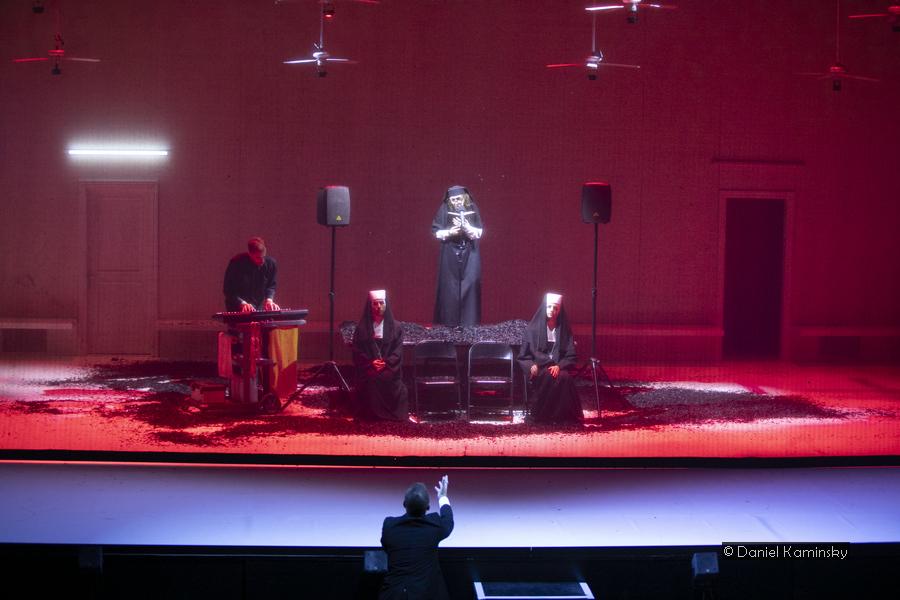
Photo by Daniel Kaminsky
This is where Tiran’s reading feels most precise. Richard is not simply a monster who breaks into politics from the outside. He is someone politics recognizes. His violence may be extreme, but the world around him is not clean. The court fears him, but it also makes space for him. It resists, then negotiates. It mourns, then moves on. It condemns, then adapts. The real horror is not only Richard’s hunger for power, but how quickly everyone else learns to live around it.
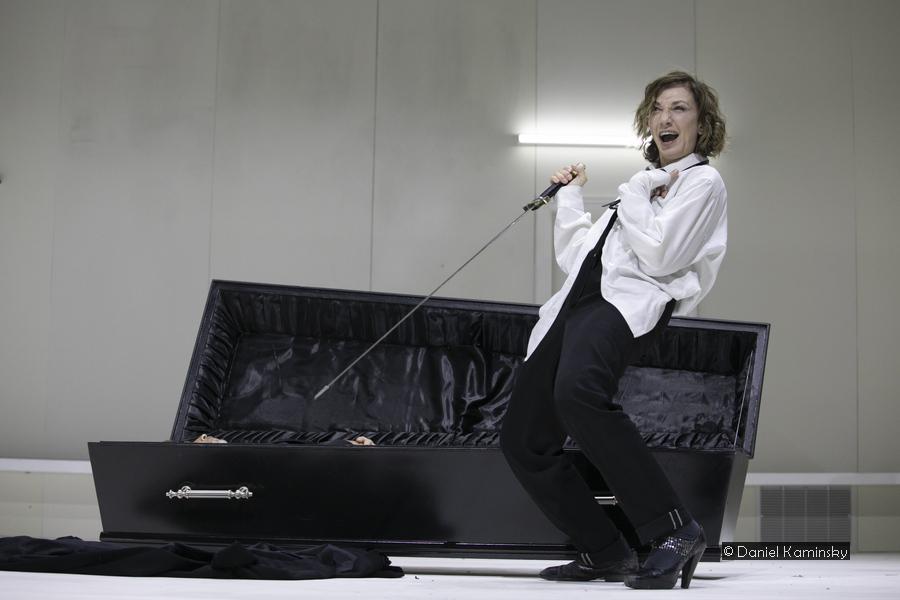
At the center of the production is Evgenia Dodina’s Richard, and it is a performance of remarkable control. The fact that Richard is played by a woman is important, of course, but it is not the main point of the interpretation. Dodina does not turn the role into a concept about gender. She builds it from intelligence, damage, theatrical instinct, and appetite.
Her Richard is not a psychological case study, though the wounds are there. Nor is she simply a stylish villain. Dodina is most compelling when we can see Richard thinking. A pause shifts the whole scene. A smile comes just a little too early. A weak movement suddenly becomes a threat. The limp is not only a mark of deformity; it becomes rhythm, timing, even a weapon.

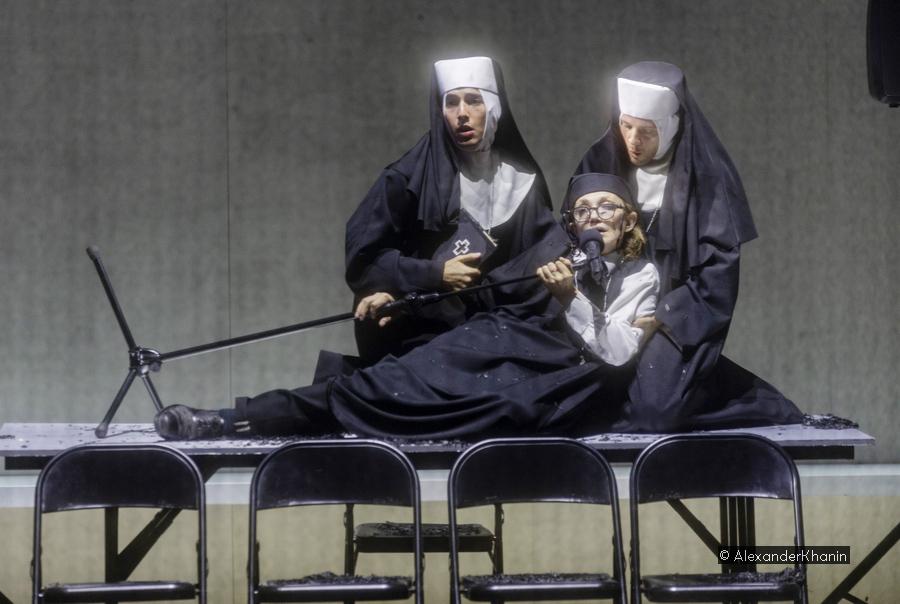
Photo by Daniel Kaminsky
What makes the performance so disturbing is that Richard is not only repulsive. He is funny. He is quick. He is, at times, very entertaining. Dodina understands the seduction built into the role. Richard wins partly because he lets us in. He makes us feel clever for seeing the manipulation, while the manipulation continues to work. The production does not give the audience the easy pleasure of feeling morally superior. We watch him deceive people, and we enjoy the skill of it.
Eran Atzmon’s set creates a severe visual world, but not an empty one. The black-and-white structure suggests several things at once: a public chamber, a courtroom, a laboratory, maybe even a place already waiting for a crime. Judit Aharon’s costumes place the figures somewhere between ceremony and decay. These are people dressed for power, mourning, survival. Gleb Filshtinsky’s lighting is crucial. It does not just create atmosphere; it seems to register the moral temperature of the evening. As the performance goes on, the stage feels as if it is darkening from the inside.

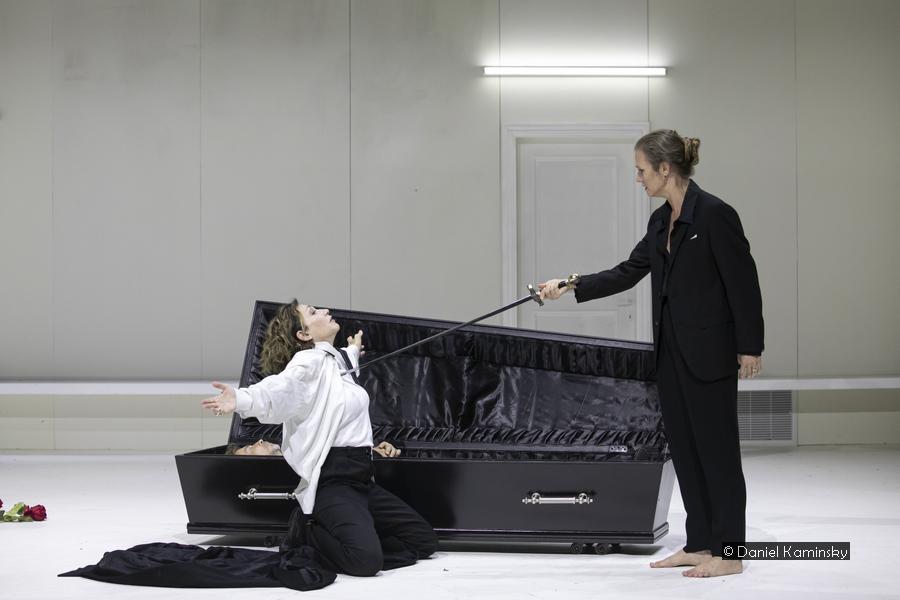
Photo by Daniel Kaminsky
The throne, when it appears, offers no comfort. It does not look like the symbol of order. It looks unstable, almost infected before Richard even reaches it. That image stays with you. The crown is not a solution to violence; it is one of violence’s instruments. By the time Richard approaches power, the state no longer looks like an institution. It looks like a crime scene that has learned protocol.
The ensemble around Dodina is one of the production’s real strengths. Doron Tavori, Israel Demidov, Gilad Kletter, Michal Weinberg, Yuval Scharf, Alexander Senderovich, and the rest of the company do not simply frame the central performance. They create the world that allows Richard to happen. That matters. A simpler production might isolate Richard as an exception, a personal nightmare. Tiran’s version insists on the people around him: frightened people, ambitious people, tired people, people who understand more than they admit and still continue.
There are moments when the production presses its argument a little too hard. The darkness accumulates heavily, and the almost three-hour running time is certainly felt. But even that fatigue seems partly connected to the design of the evening. Tiran is not showing tyranny as one sudden catastrophe. He shows it as a process: repetition, compromise, exhaustion, and the gradual weakening of resistance. We are made to feel that process, not just recognize it intellectually.

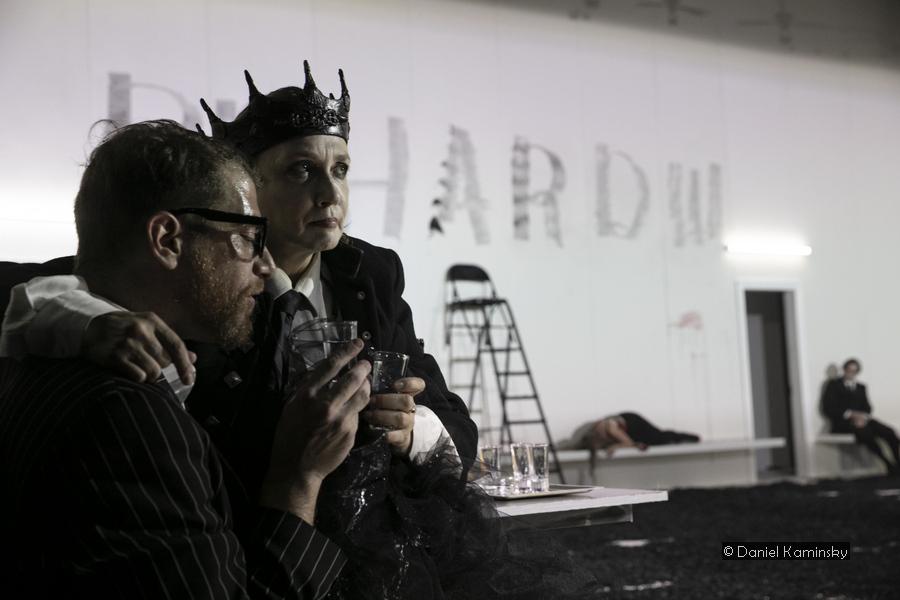
Photo by Daniel Kaminsky
What saves the production from becoming a simple political allegory is that it does not point too neatly at one leader, one country, or one present crisis. Its force is broader and more uncomfortable. It shows authoritarianism as a kind of theater. Someone performs certainty. Others accept the performance. Spectators watch and tell themselves that watching is not the same as taking part.
That idea landed strongly at MİTEM. A festival creates its own temporary public: people from different languages and histories sitting together in the dark, testing what old plays can still tell us. In that context, ending with Richard III did not feel like a tidy programming choice. It felt like a question left in the room.
Dodina’s achievement is that she does not only play Richard’s cruelty. She plays his charm. She makes him quick, wounded, shameless, funny, and frighteningly close. He does not simply dominate the stage. He recruits it. The laughter he provokes becomes less comfortable as the bodies begin to gather around him.
By the end, Tiran has not so much modernized Shakespeare as shown how modern the play already is. This Richard III leaves behind admiration, but also unease. It suggests that the monster is not only the person who reaches the throne. The monster is also the pattern of glances, silences, jokes, compromises, and applause that helps him get there.

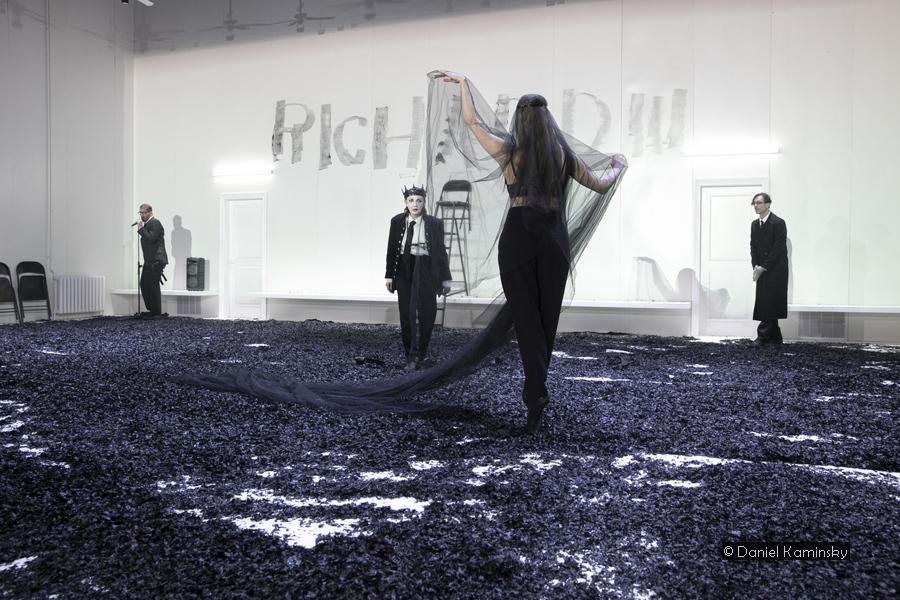
Photo by Daniel Kaminsky
This post was written by the author in their personal capacity.The opinions expressed in this article are the author’s own and do not reflect the view of The Theatre Times, their staff or collaborators.
This post was written by Emiliia Dementsova.
The views expressed here belong to the author and do not necessarily reflect our views and opinions.