




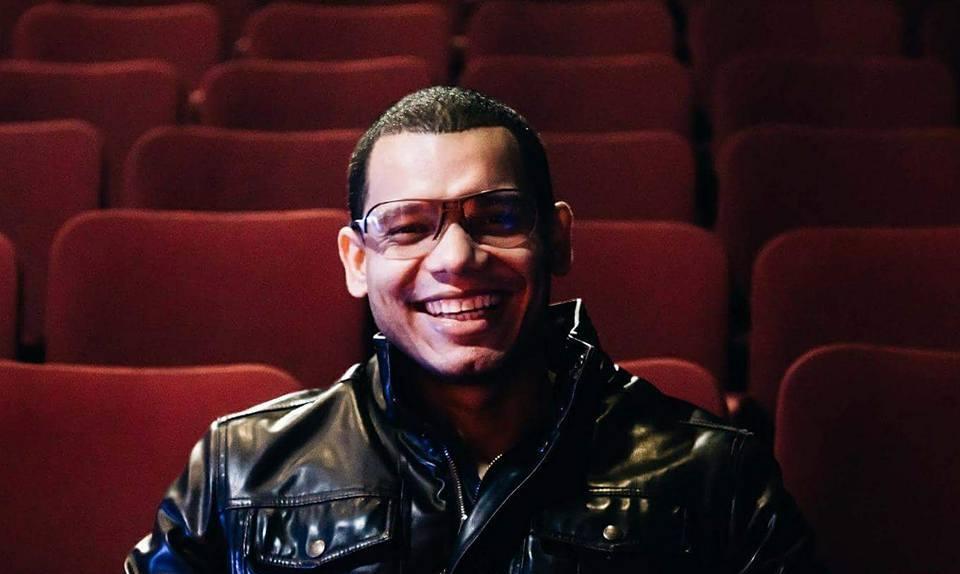
An Interview with Lenerson Polonini, theatre director (Companhia Nova de Teatro, Sau Paulo, Brazil).
Lenerson Polonini is a dynamic theater director based in Sao Paulo, Brazil. With a rich artistic background spanning over 20 years, he is the co-founder of Companhia Nova de Teatro. Lenerson’s artistic journey has been marked by an unwavering passion for exploring the works of renowned playwrights such as Samuel Beckett and their intersection with visual, performative, and hybrid elements in theater. Throughout his career, Lenerson has directed a diverse range of plays, including works by iconic playwrights like Heiner Müller, Samuel Beckett, Gertrude Stein, Edgar Allan Poe, Wilhelm Reich, and Richard Foreman. In addition to his directorial achievements, Lenerson has also showcased his own compelling dramaturgy. As a highly regarded independent curator, Lenerson has curated noteworthy events such as Acesso Livre, Beckett 100 years, and Downtown Variety: Brazil Edition, produced by CultureHub and La MaMa, among others. His curatorial expertise has contributed to the vibrant cultural scene, fostering artistic dialogues and creating captivating experiences for audiences. Lenerson’s recent works include Apátridas (Stateless), a production inspired by Greek myths in conflict zones, which has been presented in Sao Paulo, Milan, and Tehran. He has also collaborated on A Scream in the Dark, produced in partnership with La MaMa Experimental Theater of New York. His works have been presented in various countries including Romania, Greece, the USA, Italy, Germany, India, Russia, Iran, Iraq, Uruguay and more. Recognized for his exceptional contributions to the arts, Lenerson Polonini proudly serves as the Brazilian Cultural Ambassador of La MaMa Experimental Theatre, contributing to the global exchange of artistic experiences and fostering cultural dialogue. More information: https://www.cianovadeteatro.com/.
Ivanka Apostolova Baskar: In your performances, particularly Apátridas, the body becomes a carrier of collective memory. What kind of “testimony” does the actor embody: personal, historical, or politically constructed?
Lenerson Polonini: In my work, the actor’s body is never a single layer of testimony. It is simultaneously personal, historical, and politically constructed. The performer does not “represent” memory, they become a site where different temporalities collide. In Apátridas, the body carries fragments: of exile, of myth, of contemporary violence. It is not about telling a story, but about allowing these forces to inhabit the body and generate presence.
IAB: Do you believe that theatre today should function as an archive of human suffering, or as a means of transforming it?
LP: I do not believe theatre should function only as an archive of suffering. If it becomes merely archival, it risks paralysis. Theatre must transform. Not by resolving trauma, but by reactivating it in a way that produces awareness, tension, and confrontation. Transformation, for me, is not healing, it is awakening.
IAB: How do you define the boundary between document and fiction in your work?
LP: The boundary between document and fiction in my work is deliberately unstable. Fiction allows access to deeper truths that documents alone cannot reach. Myth, image, and abstraction do not deny reality they expose its invisible structures.
IAB: In the context of global crises (migration, war, apathy), does the stage have a moral obligation to “prove” reality or to deconstruct it?
LP: In times of global crisis, theatre does not have the obligation to prove reality. Reality is already overwhelming. Theatre must deconstruct it, fracture it, and reveal its contradictions. Only then can we see what is hidden behind normalized violence.

Carina Casuscelli. Photo by The Companhia Nova de Teatro.
IAB: In your aesthetic, the actor does not “play a character,” but becomes an icon/image. Is this an attempt to move away from psychological realism and toward a more radical theatrical language?
LP: My work moves away from psychological realism because I am not interested in the illusion of character. The actor becomes an image, an icon, a presence. This is not an aesthetic choice alone; it is a political one. It resists the consumption of identity and opens space for something more universal and more disturbing.
IAB: How do you work with the actor to transition from “representation” to “presence”?
LP: The transition from representation to presence happens through rigorous physical and energetic work. I often collaborate very closely with Carina Casuscelli in this process; our partnership is fundamental. We share a deep investigation into the actor’s body as a field of forces rather than a tool of narration. Presence emerges when the actor stops trying to signify and starts to exist within tension.
IAB: Can the actor’s body be read as a political text?
LP: Yes, the actor’s body can absolutely be read as a political text. It carries history, violence, desire, oppression even when silent. The body does not lie.
IAB: Your performances function as a kind of “sensory box,” with synchronized visual and sound layers. Is the audience meant to understand, or to feel?
LP: My performances are constructed as sensory experiences. The audience is not meant to “understand” in a rational way, but to feel to be affected. Understanding may come later, or not at all. Feeling is immediate and unavoidable.
IAB: What is the role of video and visual arts in constructing stage “truth”?
LP: Video and visual arts in my work are not illustrative. They create layers of reality. They destabilize what we see on stage and expand the space beyond the physical. They do not support the actor, they challenge them.
IAB: Does technology increase distance or intimacy between the stage and the spectator?
LP: Technology can create both distance and intimacy. It depends on how it is used. When integrated organically, it intensifies presence. When used superficially, it creates detachment.

Carina Casuscelli. Photo by The Companhia Nova de Teatro.
IAB: In Apátridas, you employ mythological figures to address contemporary refugee crises. Why is myth more effective than direct documentation?
LP: Myth is more effective than direct documentation because it operates beyond time. It allows us to see the present as part of a larger human condition. A refugee today is not only a political subject they are also a tragic figure, like Hecuba or Cassandra. Casuscelli explores this in the dramaturgy, the myth as a universal identity.
IAB: Is the contemporary human being a new kind of “apatrid” not only geographically, but existentially and identity-wise?
LP: The contemporary human being is indeed a new kind of “apatrid”. Not only geographically displaced, but existentially fragmented. We no longer belong fully to places, identities, or narratives.
IAB: How do you perceive the relationship between the ancient tragic hero and today’s migrant?
LP: The ancient tragic hero and today’s migrant share a fundamental condition: they are both caught in forces beyond their control. Their suffering is not individual, it is systemic.
IAB: When working with themes such as suffering, war, or migration where do you draw the line between art and exploitation?
LP: The line between art and exploitation is always delicate. For me, it lies in responsibility. We do not reproduce suffering for spectacle. We create spaces where it can be confronted with dignity and complexity.
IAB: In A Scream in the Dark, history is not only told, it breathes through the body. How do you let the past pass through flesh, so that it is no longer only Brazil, but everybody that remembers?
LP: In A Scream in the Dark, the past is not represented, it passes through the body. Through physical work, rhythm, and silence, the performer allows history to resonate beyond Brazil, reaching a collective memory. Carina is doing this with intensity on stage.
IAB: Silence not as absence, but as weight, as pressure. How do you stage what cannot be said? How does the body speak when language has been forbidden?
LP: Silence is a material in my work. It has weight. It presses on the body. When language fails, the body continues to speak through tension, breath, stillness.

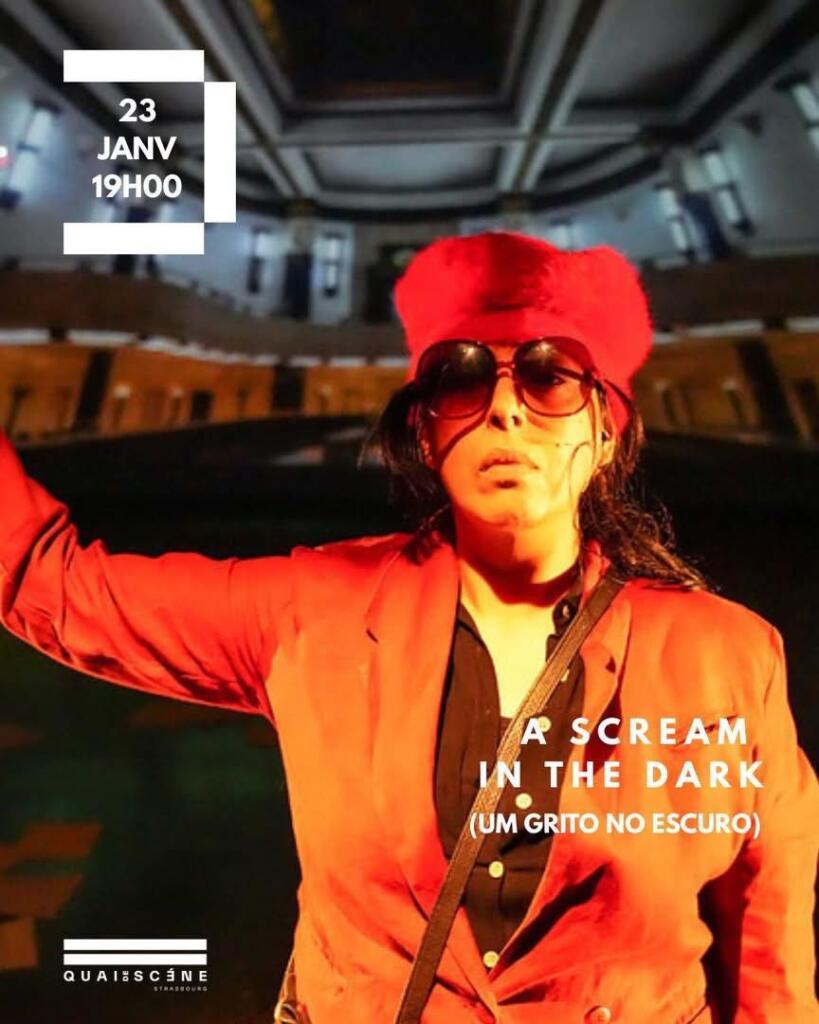
A Scream in the Dark. Photo credit by The Companhia Nova de Teatro.
IAB: Your dramaturgy seems to dissolve borders between image, sound, and movement. In your process, do these elements call each other into being, like echoes, or does one wound open first?
LP: My dramaturgy is not linear. Image, sound, and movement emerge together. Sometimes an image appears first, sometimes a sound. It is a process of listening of allowing the work to reveal itself.
IAB: When this work travels to deserts, to foreign tongues, to other memories what happens to its cry? Does it transform? Does it become another history inside another body?
LP: When the work travels, it transforms. It is absorbed by different cultures, different memories. The cry is never the same, but it remains necessary.
IAB: A single performer carries a multiplicity of silences. What kind of inner opening, or breaking, is needed for the performer to become a vessel for so many unspeakable stories?
LP: For the performer to carry multiple silences, there must be an inner rupture. A willingness to be vulnerable, to lose control, to become a vessel rather than a subject.
IAB: Memory in your work feels like a living organism fragile, resistant. Do you see theatre as a place where memory refuses to die, where it insists on returning, again and again?
LP: Memory, in my work, is alive. Theatre is a space where memory insists on returning. It refuses disappearance.
IAB: Dictatorship is not only a past; it leaves traces in the present. Where do you see its shadows today, and how does your work allow us to feel them, rather than only understand them?
LP: The shadows of dictatorship are still present in control, in fear, in silence. Theatre allows us not only to understand these traces, but to feel them in the body.
IAB: The body as archive trembling, resisting, remembering. How do you work with the body as a place where history is not written, but inscribed, almost like a scar?
LP: The body is an archive of scars. History is not written, it is inscribed. Our work is to make these inscriptions visible.
IAB: A scream is it a rupture, a birth, or a wound that never closes? In your work, does the scream reach us, or does it remain suspended in the dark?
LP: A scream, in my work, is all at once: rupture, birth, and wound. Sometimes it reaches the audience. Sometimes it remains suspended and that tension is essential.


Lenerson Polonini. Photo credit by Cristian Gonzalo.
IAB: What can theatre do when it touches pain, power, and silence? Is it to reveal, to disturb, or perhaps to open a space where something long buried can finally speak?
LP: Theatre must reveal, disturb, and open spaces. It is not about answers, but about creating conditions for what has been silenced to emerge.
IAB: Is there a risk that theatre aestheticizes tragedy?
LP: There is always a risk of aestheticizing tragedy. That is why we must remain vigilant constantly questioning our own choices.
IAB: Who has the right to tell someone else’s story?
LP: No one “owns” a story. But we must approach other people’s experiences with responsibility, respect, and awareness of our position.
IAB: You are also a curator of international projects and platforms. Is directing today more about the curation of reality than authorship?
LP: Today, directing is also an act of curation. We organize realities, materials, and perspectives. Authorship becomes more porous.
IAB: How do you select texts (Beckett, Miller, Foreman) in relation to the contemporary moment?
LP: I choose texts like Beckett, Müller, or Foreman because they resist time. They are not fixed they speak to the present in different ways.
IAB: Can classical texts be approached as “documents” of other epochs?
LP: Classical texts can absolutely be seen as documents but living documents, open to reinterpretation.
IAB: Your performances travel from Brazil to Europe, Iran, and the United States. Does the meaning of a work shift with geography?
LP: Yes, meaning shifts with geography. Each audience creates a new version of the work.
IAB: Is there a universal language of the body and visuality?
LP: There is a universal language of the body but it is always filtered through culture.
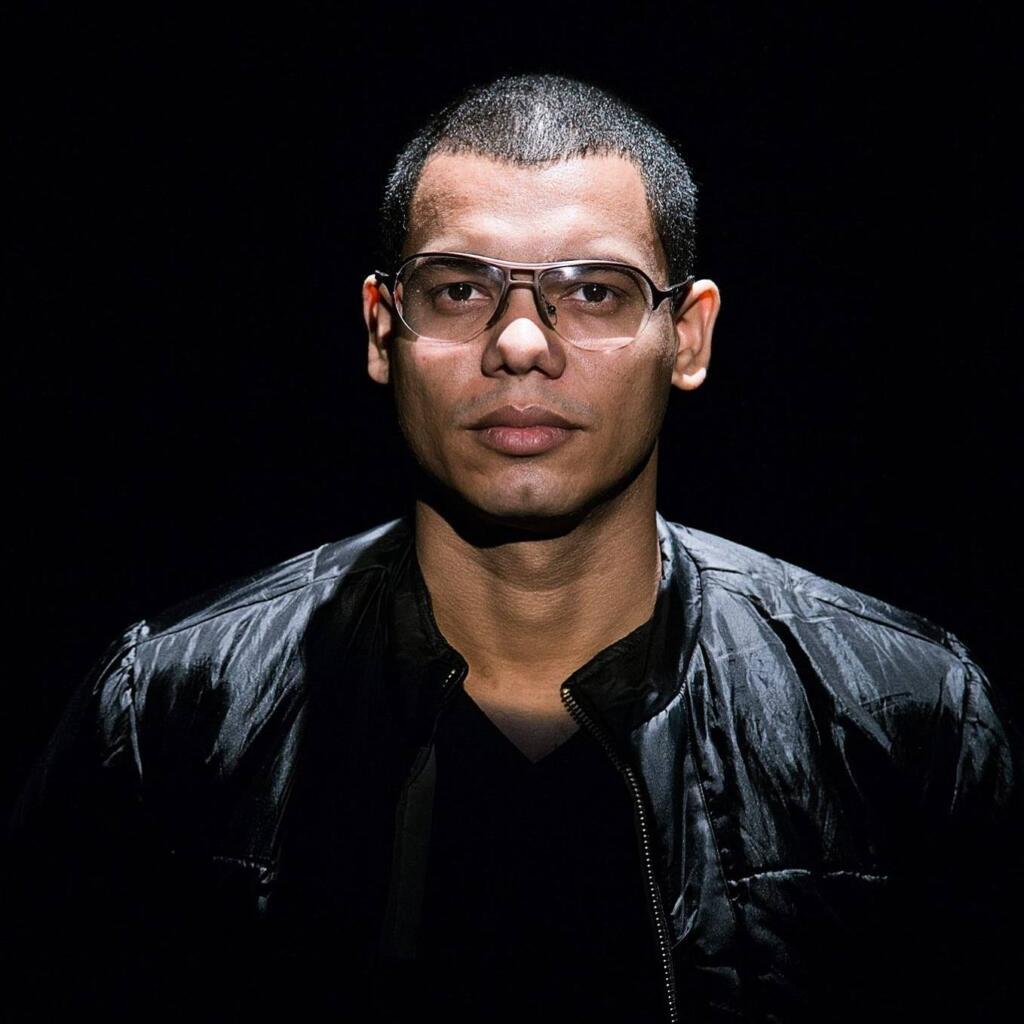
Lenerson Polonini. Photo Credit by Henrique Oda.
IAB: How do you perceive audiences across different cultural contexts?
LP: Audiences are different, but the capacity to be affected is universal.
IAB: You address the growing apathy and desensitization toward tragedy. Can theatre reawaken empathy, or does it merely reflect its disappearance?
LP: Theatre can reawaken empathy, but it is a fragile process. We are also confronting a world that normalizes indifference.
IAB: What is more dangerous: censorship or indifference?
LP: Indifference is more dangerous than censorship. Censorship at least acknowledges the power of art. Indifference erases it.
IAB: If you were to define it: What is theatre today art, resistance, or testimony?
LP: Theatre today is all three: art, resistance, and testimony. It cannot be reduced to one.
IAB: What is your greatest fear as a director?
LP: My greatest fear as a director is repetition, losing the sense of risk.
IAB: What is your most radical vision for the future of theatre?
LP: My most radical vision for theatre is that it continues to exist as a space of encounter where bodies gather, resist, and transform reality, even if only for a moment. And, in this journey, my partnership with Carina Casuscelli along 25 years remains central not only as a collaborator, but as a co-creator of a shared language that continues to evolve.
IAB: Thank you very much, dear Lenerson Polonini.
Skopje/Sao Paulo 2026
This post was written by the author in their personal capacity.The opinions expressed in this article are the author’s own and do not reflect the view of The Theatre Times, their staff or collaborators.
This post was written by Ivanka Apostolova Baskar.
The views expressed here belong to the author and do not necessarily reflect our views and opinions.