



Picture Credit: Todd Fjelsted / Netflix
Production designer Todd Fjelsted, whether he’s building worlds for GLOW or The Altruists or spaces for filmmaker Gregg Arraki, always begins from the same starting point. “Character,” Fjelsted said. “I always want to figure out what’s the best way to give the audience as much data about the character as possible, even if it’s subconscious. Who are they? Where have they been? Where are they going? It all plays into how we determine their decor, their belongings, any objects in their space, their artwork, et cetera.”
In the case of The Altruists, from creator Graham Moore (The Outfit), Fjelsted had two crypto scammers to explore: Sam Bankman-Fried (Anthony Boyle) and Caroline Ellison (Julia Garner). Initially unfamiliar with the true story, as well as crypto, the production designer relished taking these quirky yet dangerous characters abroad, from nature to tech spaces.
Fjelsted explained to What’s On Netflix why The Altruists and the strange world of Sam Bankman-Fried and Caroline Ellison turned out to be one of his “favorite projects ever, and certainly one of the most challenging and rewarding.”
When you were starting to read Sam and Caroline on the page, what spaces and ideas really expressed who they were to you?
Well, it was really fun because neither Sam nor Caroline really are that interested in architecture or decor or fashion or any of this. So, that created this vacuum of what we normally do to approach character and set. You’ve got somebody who lives in cargo shorts, a T-shirt, and tennis shoes, and somebody else who writes Harry Potter fan fiction and dresses poorly and is very odd.
So, the two of them being neurodivergent, math whiz wunderkinds, that kind of freed us in a way. We didn’t have to approach it with what’s their taste level, what’s their income, et cetera. It allowed us to think more like, okay, so if Sam’s in the world, he never ever puts anything into his personal spaces. He rents a space, sets up a computer, and now it’s just the computer and snacks for him. That’s all he cared about.
What is it from The Social Network? He’s wired in all the time.
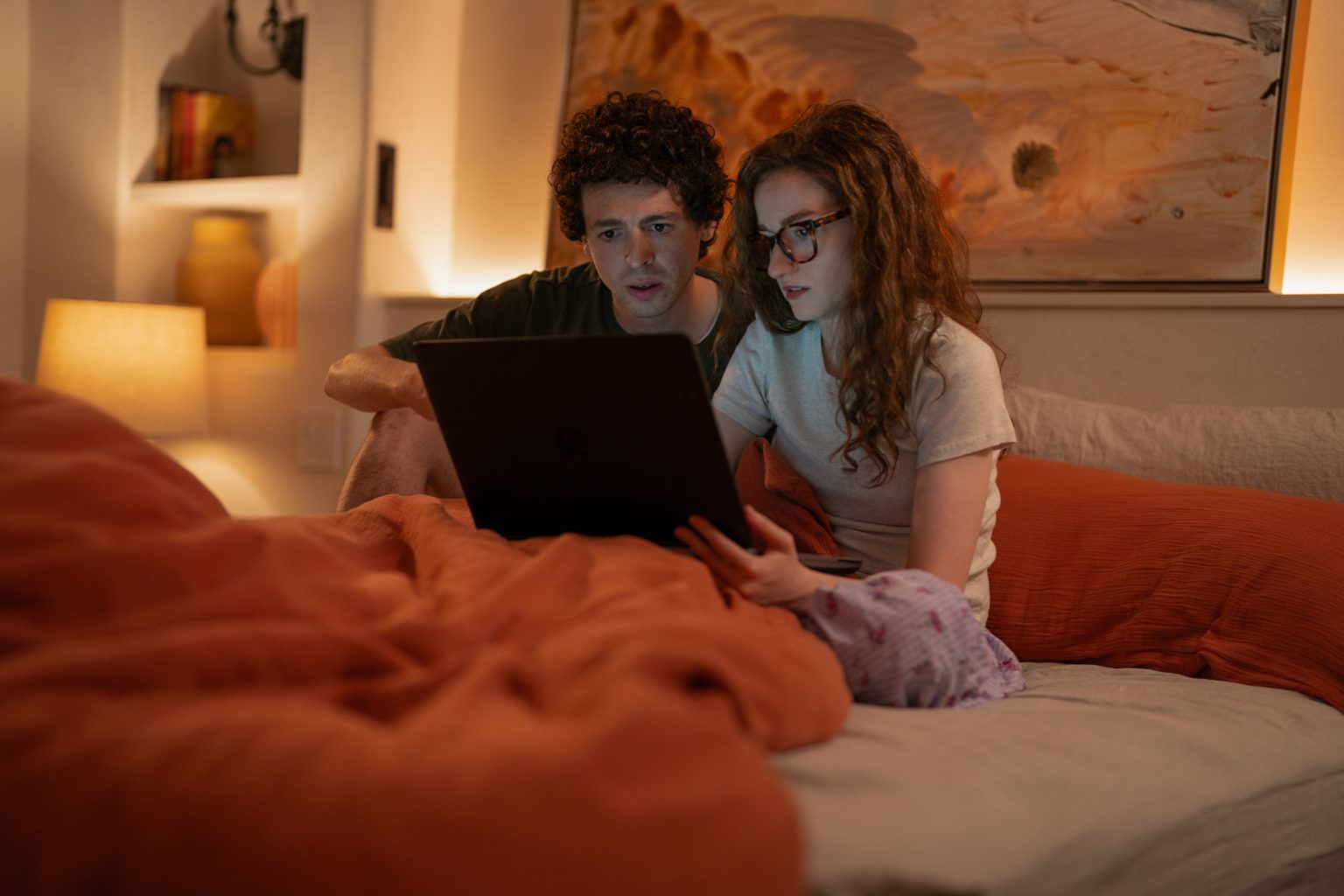
The Altruists. (L to R) Anthony Boyle as Sam Bankman-Fried, Julia Garner as Caroline Ellison in Episode 102 of The Altruists. Cr. Ricardo Hubbs/Netflix © 2026
He’s got his Xbox. He’s good.
Yeah, he’s good. Whereas Caroline, a little bit more of a romantic, a little bit more into erotica, this kind of thing. So there’s a little bit of that vibe with her, but there’s also the big Harry Potter fan that she is. There’s the whole history of math camp and other things that we could play on. For example, when we went to her childhood bedroom in one of the later episodes, she goes home to see her mom.
I was like, okay, this set is when we learn who she is. It’s all posters of boy bands and all her tickets from the concerts she went to. It was so fun because all of it was real. We did a tremendous amount of research on this. I mean, obviously Graham researched her for four years, but then, as we got into the personal spaces, I was like, everything she ever wrote on Twitter, I want to read it.
I want to read everything. I want to know who she is, how she presents herself to the world, because that would help educate us on what her personal spaces would be like and what her decisions would be like in the selection of, say, an apartment in Hong Kong or the selection of an Airbnb in San Francisco. Even just her choosing those places says something about her. If it’s not her personal space, the choice itself is the indicator for her character.
What were the tweets that really inspired some ideas?
There were some tweets about polyamory. There were some tweets about Harry Potter. She also had a tweet at one point, which is not really addressed in the show, about how if you’re not working on Adderall, you’re not working, or something along those lines [Laughs]. I’m paraphrasing, but she was pretty ballsy with her tweets until, of course, she became a major power player. Then she was all business, but who was the nerdy math athlete behind all of that?
What’s the line for you as a production designer where you always want to stay true to reality, but also, you’re telling a dramatic story as well?
Probably the most often used term in my art department is “movie language,” because you do want to, regardless of, for example, the space, the FTX HQ in the Bahamas, that penthouse. Actually, when you look at the FBI photos, it’s really ugly. Not the architecture itself, but the decor and the color choices. You’re like, “I don’t want to recreate this. It’s going to look terrible on camera.”
So, we put that through the filter of movie language. It’s the same architecture, you’ve got the same deck, you’ve got all that stuff, but you change out the palette a little bit. You make sure the artwork is not overpowering the characters. Everything kind of stays a little more neutral behind them.
It’s definitely the movie language for me. How do you make it believable and real, but then also nice to look at? If you’re going to spend several episodes in a space, you don’t want it to be ugly. Even if it was ugly in real life, you’ve got to dress that up a little for television and film.
Did I tell you about the miniatures of the FTX space?
No but please do, though.
It’s pretty crazy. I first got the call from the showrunners on this, and we were talking about how, because we’re in the Bahamas penthouse in pretty much every episode, that’s a lot of time spent on a set. Obviously, we can’t go to the Bahamas and rent out a giant $16 million penthouse, so we decided that had to be built on stage.
It’s called an anchor set, the set you return to again and again.
The only way we could figure out, based on those FBI photos, if you’re on this huge deck overlooking a whole marina with luxury apartments and yachts, how do we do that without it looking just really crappy?
I pitched the idea, and I still can’t believe to this day they actually let me do this, but we did a 440-foot-long miniature marina that wrapped all the way around our two-story set with nine 10-foot-tall apartment buildings you could see off the deck. Each one had its own little lighting, furniture, everything, all on a board so that we could say, “Okay, now it’s dusk,” or, “Now it’s night,” the lights would be on here, the yacht lights are on, et cetera, in camera.
So, then the actors can just be followed around through the spaces, see out windows, and everything’s in camera. You just have to add in a little, let’s add some clouds, let’s add a seagull or whatnot with visual effects, which allows the camera to move faster. It allowed the actors to feel more embedded in reality. I remember Paul Reiser walking out on the deck and going, “What’s this? I can’t believe what I’m looking at.” He’s like, “It feels like an illusion.” I’m like, “Well, that’s the idea. It’s an illusion.” [Laughs]
But it was more immersive for them. They really got to feel like they were in the Bahamas on a stage, as did the crew, and it was just much more fun, I guess, in a lot of ways. We started calling it our anti-AI set.
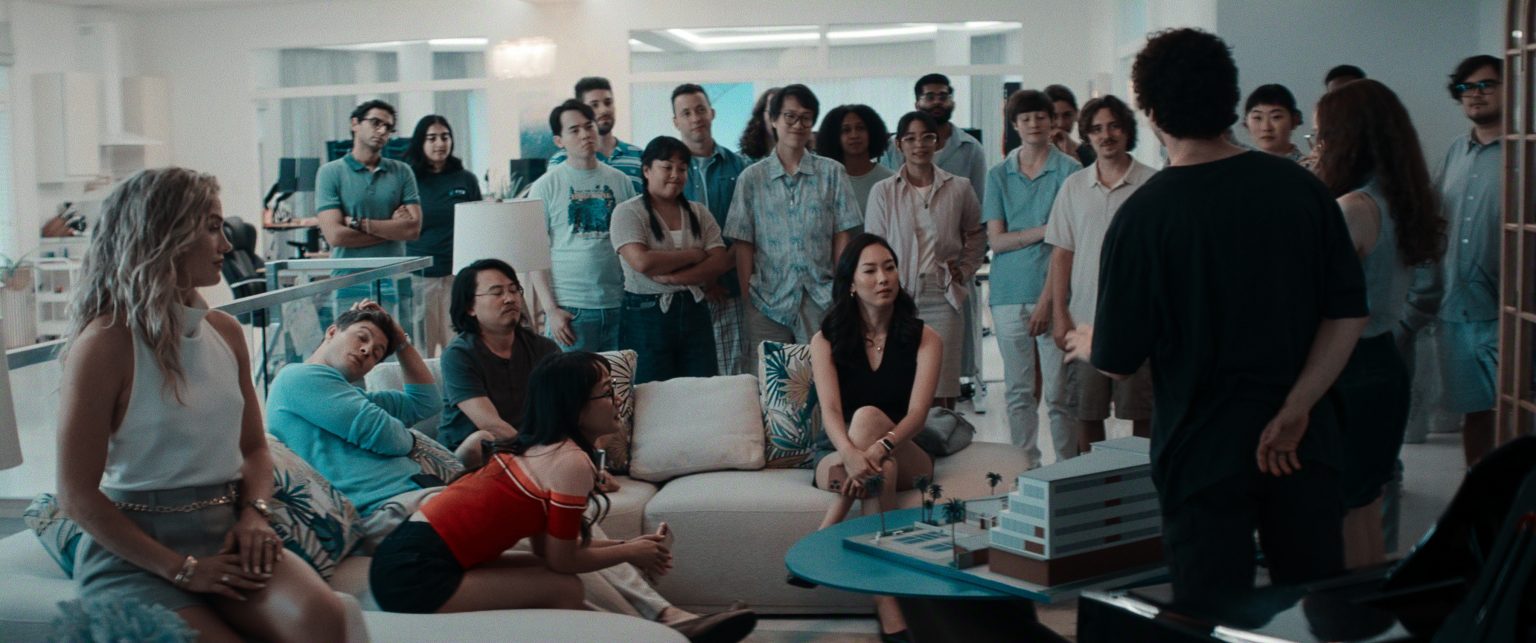
The Altruists. (L to R) Maddie Hasson as Lauren Remmington Platt, Matt Rife as Ryan Salame, Karan Soni as Nishad Singh, Eugene Young as Gary Wang, Madison Hu as Constance Wang in Episode 104 of The Altruists. Cr. Netflix © 2026
How was it just working with the model makers? What were some attention to detail you were just so happy with?
We had to do a lot of tests of perspective to see how that was going to work if you’re in motion. I kind of recreated the shape of the marina to wrap it in equal distance around so that we remained on the same scale. The one-twelfth scale is what we learned through many tests. Then once we realized it was one-twelfth scale, we built digital models, started looking at stuff and realizing, oh my God, we can see in every window. Oh no, this is going to get complicated.
It was so much detail that started to become overwhelming. And, of course, the budget was like… We finally did a little pass on episode five where they’re all playing chess on the patio, and we were like, okay, so every single shot in this is going to need a background replacement if it’s not miniatures. Let’s do the budget with miniatures.
What we learned was we would pay for the miniatures in one episode and then save the visual effects across the other seven. So, it ended up saving a ton of money and being faster and more immersive. And in the long run, that was a surprise to us all, but also incredibly exciting because then we could just go for it.
There is incredible artistry in VFX with set extensions and everything.
Oh my God, yeah.
But do you also sometimes miss the handmade quality as a production designer of models and matte paintings?
I do. It’s such a fascinating thing to think about how many of the greatest sci-fi, fantasy films, et cetera, over the years, action films, have utilized miniatures and we just didn’t really know it, or we knew it way after the fact. I learned that the entire sequence in The Dark Knight where Batman is chasing the Joker underground – that’s all miniatures except for two shots. The shot of the Joker opening the truck and the shot of Batman in his car, everything else is miniatures. I was just blown away by that because it never even occurred to me that that was the case.
Then you can go back to Blade Runner, Star Wars, and several features that utilize miniatures a lot. It’s very rare in today’s world, certainly for television, almost never for television. I did a small miniature set for GLOW a few years ago where we needed to do the ’80s Vegas Strip outside of a window as a view.
I was like, they’re going to comp that in again and again and again. It has to be built digitally. It has to be animated each time because there’s a lot of moving neon. I was like, “What if we just made miniatures?” And the same thing. It didn’t really save money in that scenario, but it balanced out evenly because it was just the one apartment. It wasn’t like we weren’t going to be in every single episode, but it still was better for the camera. They could just move around and not think about it. They didn’t have to, like, “Don’t set them in front of that. That’s another visual effect shot. It’s okay. Do whatever you want.”
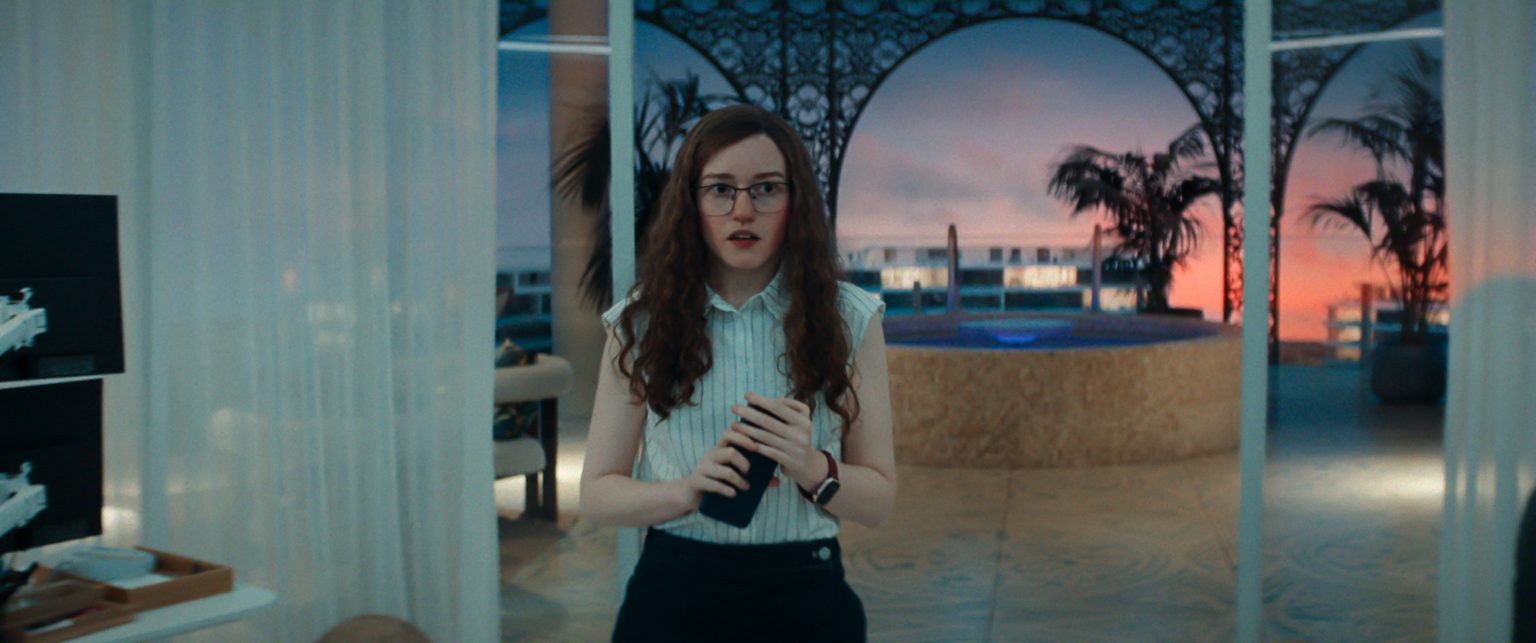
The Altruists. Julia Garner as Caroline Ellison in Episode 107 of The Altruists. Cr. Netflix © 2026
When the model was out, was a part of you like, “I really hope executive producers Barack and Michelle Obama visit the set this day…”
[Laughs] I got to say, in the studio parking lot for all the producers, there was a parking place for B. Obama that the entire crew lost their minds over. We were all convinced either he or Michelle is going to come at some point. They did not come, but the people at their company who were absolutely lovely to work with, just wonderful producers and creatives. Every day they were there, just in the trenches with us, and they were fantastic. They were well-represented.
Do you ever miss building the world of GLOW?
Oh my God, that was such a dream project because the showrunners were lovely. The cast was just wonderful, and it was a very female-focused scenario where you had a lot of female directors, producers, writers, cast, and a lot of the crew was female. So, it really just had a very different flavor. It’s hard to put your finger on exactly what it was that was different, but I think it was just a different energy.
The women were all excited to be in such a large group of women that it just made the mood better. The energy was higher, the camaraderie was really great, and then the ideas just flowed. Those showrunners, Liz [Flahive] and Carly [Mensch], are super collaborative. They’re interested in what their team is bringing to the table and open to ideas. It was a dream project in so many ways.
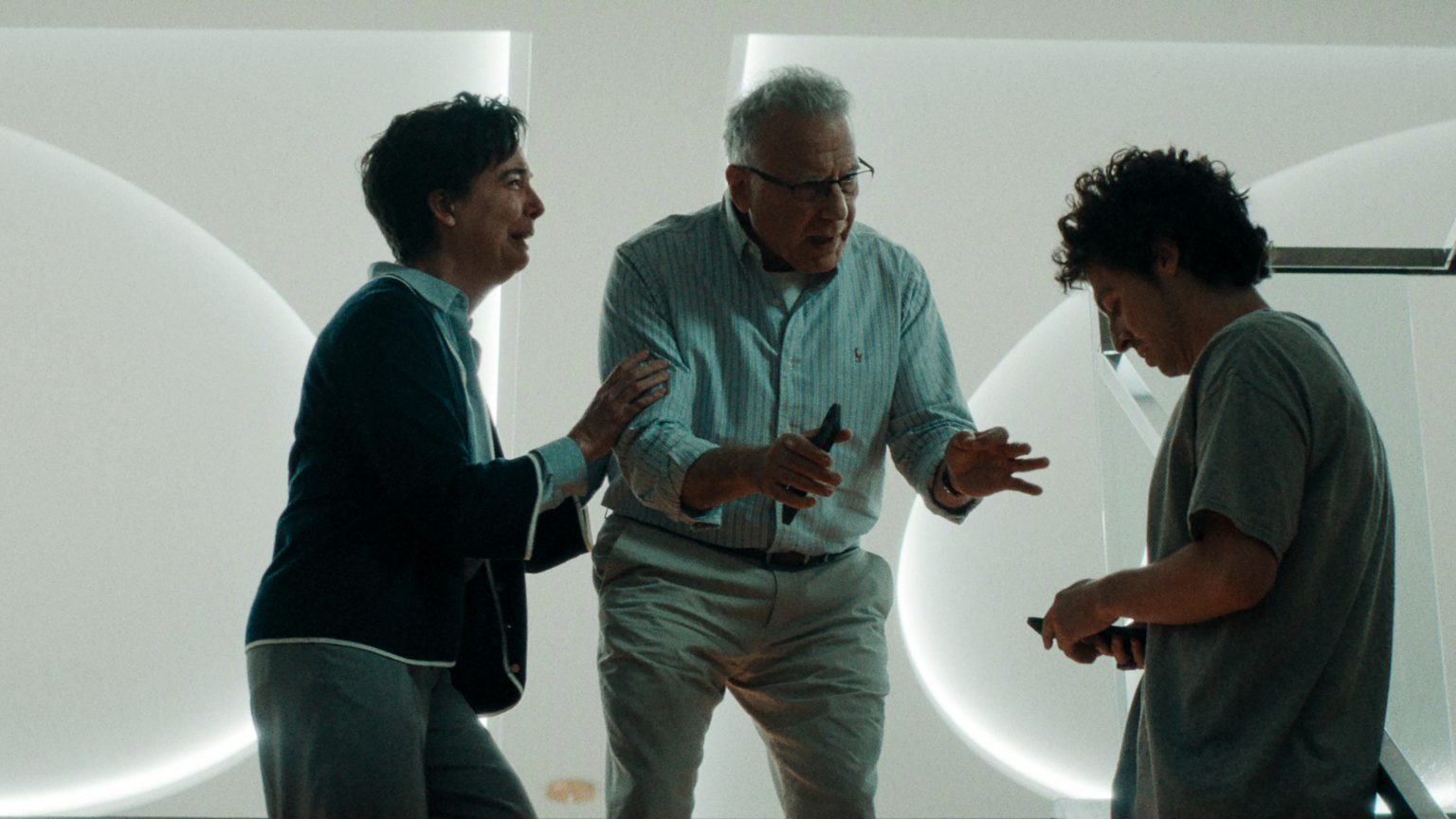
The Altruists. (L to R) Robin Weigert as Barbara Fried, Paul Reiser as Joe Bankman, Anthony Boyle as Sam Bankman-Fried in Episode 108 of The Altruists. Cr. Netflix © 2026
The Macau alleyway looks dreamy in The Altruists, by the way. Great work there.
Oh, thank you. There was a moment when we were finishing the dress on it and the camera crew and everybody was getting ready to show up in an hour, and we’re just finishing everything and adding the final lights and details. Passersby in downtown Vancouver were coming by, and this one older man stopped, and he just kept looking around, and he said, “Macau?” We were like, “Yeah.”
He goes, “I grew up in Macau.” And then he’s like, “Can I take pictures?” I was like, “Not really, but you can walk around.” We showed him stuff. He’s like, “This is like being home.” It made us all so emotional because we’re like, “Are we getting this right?” We had translators and advisors and all to ensure everything, but you’re always still worried. Are people going to watch us and go, ‘That’s not Macau’? But that guy confirmed for us, and we were like, “Whew.”