



If we view playwriting as a literary form, what distinguishes it from others is its reliance on collective effort. A playwright can write a script alone at a desk, but it takes at least a director and actors to bring the text to life, allowing it to travel and reach an audience in multiple ways. Driven by this belief, the Taiwan-based Prologue Center for New Plays collaborated with Taipei Performing Arts Center (TPAC) to hold its very first International Play Reading Festival in Taiwan, featuring plays across different cultures and focusing on the written text as an active medium for creating meaningful dialogue on both a personal and cultural level.
Play Readings – It’s All About Dialogue
Taking place in June 2026, the first Taiwan International Play Reading Festival was a ten-day event introducing emerging and established playwrights, pairing theatre companies with foreign plays, and exploring up-to-date development of playwriting. Rather than testing the plays’ potential market values, as similar play readings usually do, the festival explores how plays can expand their possibilities to engage cross-cultural dialogue. With Korea as the featured country of its inaugural edition, the festival brought together contemporary plays from both Taiwan and Korea. The four plays from Taiwan included Air Raid Siren by Yu-Chia Wei, Between Classes by Cheng-Chun Lee, The Thousand-Year Itch by Chiao-Jung Chen, and Long Live the Mango Tree by Kuan-Ting Lin. The six plays from Korea were A Crazy Play by Choi Chieon, The Story of Wang Seo-Gae by Kim Do-young, A Woman from Afar by Pai Sam-Shik, Texas Aunt by Yun Mi Hyun, But That’s Not It by Lee Mee Kyung, and Cherry Blossom Theatre 1937 by Mun Ui-young.
Following the diverse concerns of contemporary playwrights, the festival also looked back nearly a century to when Lin Tuan-chiu—a pioneering playwright, stage, and film director who introduced modern theatre to Taiwan under Japanese colonial rule—first transformed stage performance into a site of public dialogue. Every play, whether originally written in Korean, Mandarin, or even Japanese (as with Lin Tuan-chiu), was translated into English and either Korean or Mandarin, depending on the language spoken on stage, while the other two languages were projected as surtitles for the audience. At the end of each performance, the audience were invited to stay for a post-show discussion to share their thoughts with the director and the playwright.
Alongside the stage readings, two keynote speeches provided a comprehensive look at the historical development and contemporary landscape of playwriting in Korea and Taiwan, followed by forums featuring playwrights, translators, and other theatre professionals. Shinhyoung Sohn from Korea, President of K-Story Up, focused on the economically marginalized situation of stage plays, which represented only about 5% of box office revenue when the market size of Korea’s performing arts had reached unprecedented heights. Amid the booming global popularity of K-musicals and K-pop, Sohn highlighted collective efforts to carve out a space for playwriting within a profit-driven industry through workshops, long-term development programs, and platforms like “K-Story Up” designed to promote Korean plays. Meanwhile, Taiwanese theatre practitioner and scholar Yu-Hui Fu offered a concise overview of the development of Taiwanese scripts which included both performance texts and literary texts, emphasizing its fluid possibility among performance, dramaturgy, production, and publishing.
Sohn jokingly shared her observation that playwrights tend to be introverts. Whether one agrees or not, it somehow explains why most of them work behind the scenes. Similarly, when a play reaches a foreign audience, people tend to forget its translator working in the shadows to make it possible. Either literally behind the scenes or metaphorically in the shadows, both playwrights and translators were brought center stage during two separate forums at the festival. Their dialogue with each other and the audience touched upon individual training backgrounds, artistic creation, playwriting as a profession, the core themes of the plays, and the challenges and possibilities of translation. Yet, for the pioneering Taiwanese’s playwright who was no longer here to defend his own works and explained the historical and cultural backdrop, the festival invited theatre historians Wan-Shun Shih from Taiwan and Im Miju from Korea to reexamine how Lin Tuan-chiu’s classics could spark fresh interpretation as the texts traveled across space and time.

Shinhyoung Sohn’s at her keynote speech, titled Contemporary Korean Theatre and New Play Development. Photo by Lin Yu-Quan. Courtesy of Taipei Performing Arts Center.
By Exchanging Languages, We Find Resonance
One unique aspect of the festival was that, unless someone was equally fluent in both Korean and Mandarin, most audience members experienced a “translated” version rather than the play as it was originally written. As mentioned previously, every script was translated into two other languages: English and either Korean or Mandarin. What’s more, the festival featured Korean teams reading the plays of Taiwanese playwrights and Taiwanese teams reading the plays of Korean playwrights. These teams include Chungbuk Theatre Company and the School of Drama at Korea National University of Arts from Korea, alongside approaching theatre, La Cie MaxMind, The Double Theatre, The Gluttons Assemblage, Rafaz Performance Lab, and Blend Co. from Taiwan. Additionally, Lin Tuan-chiu’s two classics were presented by Chungbuk Theatre Company and Taipei Theatre Lab.
This “exchange” through translation, with directors working closely with the playwrights and translators, set a distinct tone for the festival that not only promoted contemporary plays but also enabled an active cross-cultural dialogue. The first striking revelation was the deep-seated social, political, and cultural parallels between Korea and Taiwan, rooted in a shared history and East Asian values. Once the language barrier was removed, one could easily recognize familiar struggles, such as social hierarchies, colonial histories, post-war conflicts, economy-driven societies, and gender inequality.
Cherry Blossom Theatre 1937 by Mun Ui-young centers on the Aengjwa Theatre, which existed in 1930s Cheongju, Korea—the very same decade Lin Tuan-chiu wrote Takasago Inn. Though nearly a century separates these two writers, both plays set their stories in a “gathering place,” either a theatre or an inn, against the backdrop of Japanese colonization and the final years of World War II to depict a varied group of people and their complex mix of dreams, hopes, and anxieties about an impending new era.
As a comparison, Air Raid Siren by Yu-Chia Wei chooses to directly confront wartime experiences by opening the story with the Allied air raid, Taiwanese soldiers in the tropical jungle, and Kamikaze pilots, as it gradually confuses historical reality with the modern warfare through a drone screen and a dream-party of great-power leaders. Perhaps one should not forget that both Korea and Taiwan belonged to the same “empire” during the Japanese colonization and shared similar post-war political trajectory; the wounds of a past war and the threat of an impending one, especially how humans survive in this extreme condition, continue to haunt and intrigue their playwrights.
Apart from the geopolitical parallels between Korea and Taiwan, plays addressing specific contemporary situations also revealed identical issues urgently confronting both societies. These include the influx of “foreign brides” as a solution to labor shortages and gender imbalances in rural areas, the struggle of children born to new immigrants, youth bullying, and the collective trauma left behind by public disasters.
During many of the post-show discussions and the festival’s concluding forum, participants frequently noted how specific incidents in the plays reminded them of parallel situations in their own domestic contexts, allowing them to easily relate to the stories. However, as how theatre scholar and director Katherine Hui-ling Chou pointed out: “In modern theatre, we tend to look to the West for models rather than developing our own identity by positioning ourselves among neighboring countries.” To have our voice heard, we must build a collective community. In this regard, the play reading festival indeed provided an opportunity to foster direct cultural exchange that departs from West-centrism.


Cherry Blossom Theatre 1937 by Korean playwright Mun Ui-young. Mandarin translation by Wan-Mei Lin. English Translation by Walter Byongsok Chon. Photo by Lin Yu-Quan. Courtesy of Taipei Performing Arts Center.
The Possibility and Impossibility Through Translation
Despite the shared experiences, characters and actors from Korea and Taiwan still react to parallel situations very differently. A clear example is found in Lee Mee Kyung’s award-winning absurd play But That’s Not It, which is inspired by the 2005 Seoul elephant escape incident. The plot unfolds within an interrogation room where the elephant trainer is questioned by a detective, a psychiatrist and a loving mother, while each of them is firmly convinced of their own speculations, refusing to listen to the trainer’s explanation. At the end of play, the trainer shouts out his frustration and transforms into an elephant, bringing the performance to a climax. Nevertheless, actors from different cultures interpreted and performed this climatic “shout” quite differently.
Following its long-running success in Korea, But That’s Not It had been translated and staged in Japan and Hong Kong before being presented at the festival in Taipei. The playwright Lee surprisingly noticed: “Unlike Korean actors, who always deliver a visceral, desperate outcry as if they cannot take it anymore, the actors from Japan, Hong Kong and Taiwan performed this scene in a relatively suppressed manner, without fully unleashing their emotions.” In fact, Lee Mee Kyung was not the only playwright to make this observation: the Taiwanese actors tended to temper the emotional intensity of the Korean scripts, managing it in a subtler and more internal way, while the Korean actors transformed the often lyrical, poetic Taiwanese texts into explosive, dynamic speech.
This intriguing divergence perfectly demonstrates the inherent impossibility of a “truthful” translation or interpretation. The journey from script to stage is a process of continuous, multilayered dialogue among the playwright, director, actors, production team, and ultimately, the audience. When translation and cross-cultural interpretation are involved, it further accentuates the “gap,” creating the necessary distance for a more profound and multidimensional dialogue to take place. In other words, by acknowledging this “gap” or “distance,” the play expands its possibilities to continuously evoke new and different resonances.
Korean novelist and translator Kim Yisak, currently a writer-in-residence at the Taiwan Literature Base, shared her experience translating Air Raid Siren by Yu-Chia Wei and The Thousand-Year Itch by Chiao-Jung Chen. These two plays are both collages of fragmented short scenes floating between reality and imagination, with narratives leaping through time and space to depict people in diverse situations; in The Thousand-Year Itch, the protagonist-narrators are even a family of mites to challenge the human scale of “time.”
To convey every nuanced detail so that the director and actors could fully grasp the scripts, Kim spent over ten hours in online discussions with the team. Despite the “gap” that initially appeared unbridgeable, she remarked: “Art and culture are simultaneously universal and distinctive. By looking at artistic creations from different cultural contexts, we actually get to know our own culture better.” She noted that when discussing the plays with Korean actors, it was initially difficult to explain the deeply diasporic and pluralistic nature of the Taiwanese text. However, she kept reminding herself and the team of a realization: “Korean people often consider our culture mono-ethnic and mono-lingual, but the truth is, our diverse languages and cultures are simply downplayed in the society, especially in the mainstream entertainment industry.” Ultimately, it is through navigating this very “gap” that both cultures gain a rare opportunity to reexamine and question what we have long taken for granted in our own societies.

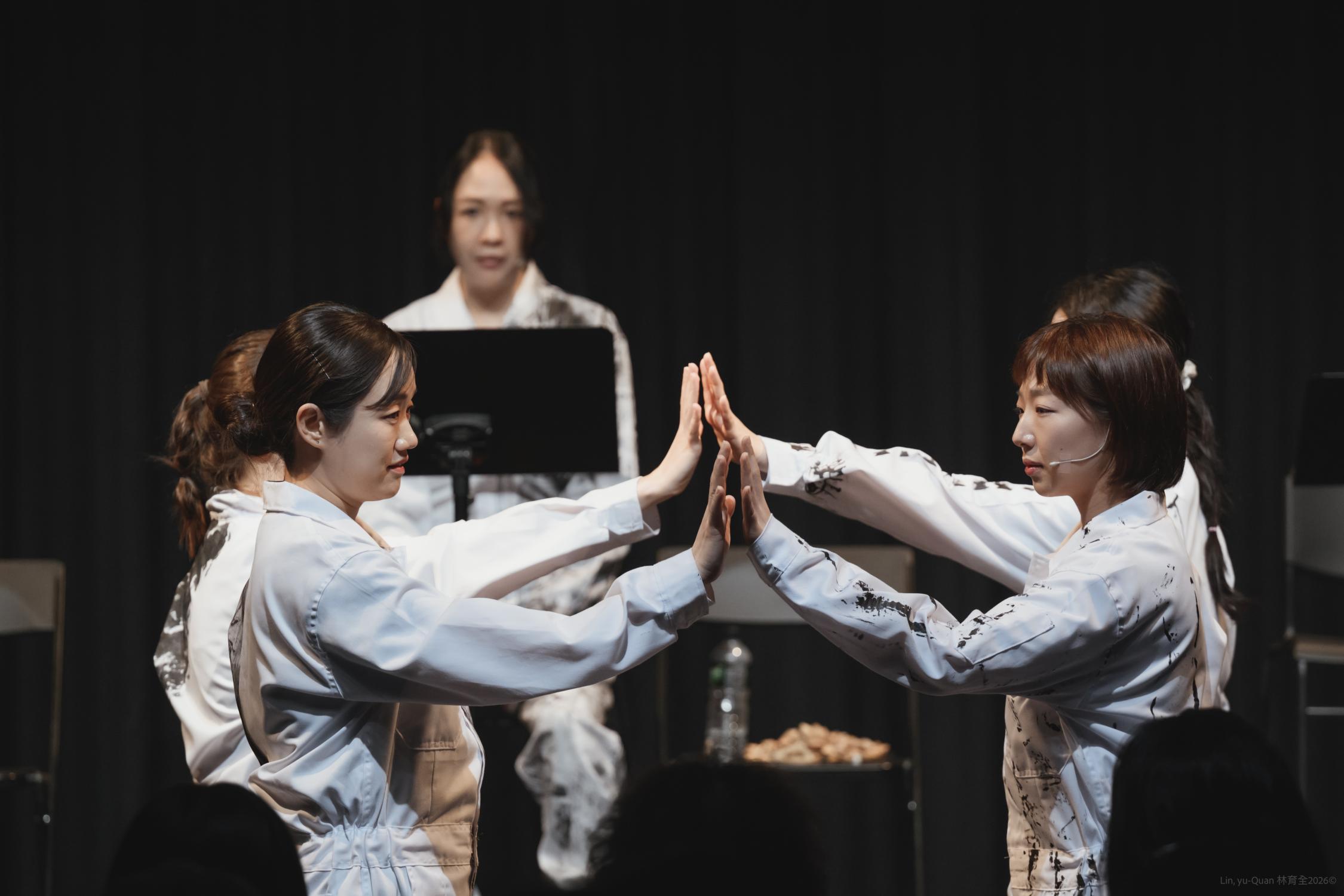
The Thousand-Year Itch by Taiwanese playwright Chiao-Jung Chen. Korean Translation by Kim Yisak. English Translation by Cheryl Wang. Photo by Lin Yu-Quan. Courtesy of Taipei Performing Arts Center.
The Journey from Script to Script
Similarly, when it comes to the medium of the play reading itself, we often take for granted that it merely serves as a preparation or testing ground for a potential stage production, rather than existing as an event with its own intrinsic artistic value. We tend to forget that plays can travel afar and gather people together. What begins as a personal creation can ultimately trigger a collective dialogue for all. Throughout the ten-day festival, the playwrights finally stepped away from their “solo tasks” to embark on a shared journey with fellow translators, directors, actors, and the audience. By exchanging stories, we find our own anew.
In an era when online activities increasingly take over our time and alienate individuals from collective experiences, theatre remains a place that brings people together for tangible, physical connections. Practically, play readings can be the most convenient and direct vehicle to make it happen. It is through the twelve plays presented at the Taiwan International Play Reading Festival that the outward and inward dialogues continue to resonate.
Below is a recap video of the 2026 Taiwan International Play Reading Festival.
(Siraya Pai is a Taiwan-based translator and theatre critic exploring the intersection between theatre, music, and language. She has translated Michael Chekhov’s To the Actor, Christopher Balme’s Theatrical Public Sphere, Jonathan Burrows’s A Choreographer’s Handbook, and Eleanor Margolies’s Props, as well as works by Beckett, Ibsen, and Tennessee Williams, alongside the musical Hedwig. Her most recent book is a history of Taiwanese musical theatre.)
This post was written by the author in their personal capacity.The opinions expressed in this article are the author’s own and do not reflect the view of The Theatre Times, their staff or collaborators.
This post was written by Kuan-Ting Lin.
The views expressed here belong to the author and do not necessarily reflect our views and opinions.