





As a dance artist, you are, at a young age, bestowed with the supposed gift to make people feel. You are told that this is a matter of profound and sacred importance to the state of the world. You nod your head and blink your naive, adolescent eyes, and it is off to the races. And then you watch as ICE agents abduct your neighbors off the streets of the Twin Cities via your little handheld glowing box from the 12th floor of a New York City high rise.
Needless to say, I began the creation of 71 Minutes of Movement in a place of great cynicism about the dance industry and my capabilities as a dance artist in the social justice space. 71 Minutes was born first from helplessness as I watched my home and community be attacked from afar. I felt deeply critical of the way we typically approach ‘difficult’ or ‘political’ topics in the art space, and equally pessimistic about dance’s place within social justice movements. I nursed ideas of this project enacting real change, none of that wishy-washy feelings shit we always do.
I clung to these ideas right up until my first research interview for 71 Minutes with Carl Flink, artistic director of Minnesota dance company Black Label Movement and professor of dance at the University of Minnesota. Flink also spent several years working as a social justice attorney.
“When I think about my art-making in relation to that social justice and social activism work that I did as an attorney … they’re different modalities,” Flink says. “But I am not necessarily trying to be the activist I was when I was an attorney, to say, and now this is what you should do.”
Flink’s work often deals in the highly physical and anti-classical, blurring the lines between dance and movement. His 2024 work Battleground examines America’s relationship with the military industrial complex, featuring movers engaged in conflict within a pit of loose soil. I asked him about the aims and methodologies of Battleground: “I’m really trying to engage both the emotional, the physical, and the intellectual process of giving a lens to an audience to say, ‘Is this what we want? What is the society we live in? What are we trying to achieve?’ and give a platform for reflection that hopefully inspires action or directionality in following lines,” Flink says.
The thing that I find most interesting about Flink’s work is that the emotional stimulus has its choreographic roots in the way the movement physically interacts with the movers, rather than attempting to choreograph a specific ‘look.’ I had the privilege of learning excerpts from Flink’s Riding the Maelstrom, which visualizes a long struggle with the poisons of chemotherapy. Rather than choreographing movements that look exhausting to the audience, Flink conveys this prolonged battle by actually exhausting his movers. Battleground, similarly, does not seek to portray violence as much as it is, simply, violent. Theatre spaces in some ways necessitate a social agreement – the audience commits to being physically present for the duration of the work, regardless of content, in a way that is otherwise rare to find in the high-velocity digital age. When this commitment of attention meets the high physicality of Flink’s work, the resulting confrontation is particularly forceful and embodied.
This concept of choreographing, first and foremost, the physical sensations of the dancers became a guiding methodology for 71 Minutes of Movement. Rather than trying to portray a specific narrative, this work became an investigation of what it feels like to maintain a resistance. What does it feel like to sustain movement for an unlikely amount of time? What does it feel like to intentionally choose the pain of action? What do you have to demand of yourself?
Flink’s ideas were echoed in my conversation with Ananya Chatterjea, professor of dance at the University of Minnesota and director of Ananya Dance Theatre. “When I worked with activists in the past, they’re always like, ‘so what legislation is going to change as a result of this work?’ As an artist, it is not my goal. It is not my job to change legislation. It is the job of our political representatives to do that,” Chatterjea says. “[The] most important thing I think I can do [is] offer audiences the invitation to think about what might a world which is not ruled by violence, what might that look, feel like? … It is my job to make that palpable for audiences. That kind of provocation can actually lead to a larger culture shift.”
Chatterjea touches upon a point here that can be difficult to come to terms with for any kind of social justice artist: progress made by artists will rarely be quantifiable or tangible, and will always be fundamentally communal. But rather than viewing this as a limitation, we can instead see within this the unique capacities of story-telling forms. Dr. Sonya Kufinec, scholar of theatre and social justice at the University of Minnesota, refutes the easy assumption that abstract, ‘emotional’ work is in some way inferior to more easily quantified modes.
“Research indicates that people do not change when they get information. Information does not change people, because information doesn’t tap into the kinds of effective repertoire and self narration that people have that link themselves to community and identity. So if you actually want to engage in the possibility of change with people, the better vehicle is story, because that enables people to … be able to reframe themselves in relationship to others rather than feeling like they’re being subject to some authoritative set of statements or set of information.”
Taking this idea into consideration, I asked some of the dance artists if they think that dance has any unique or special capacities as a social justice form. For the last stop on my interview tour of the Twin Cities, I sat down for a coffee with Palestinian-American social justice artist Leila Awadallah, for once able to substitute the usual zoom meeting for a conversation face to face. Awadallah has a striking presence in a room, at once firmly grounded and brightly electric. “Our bodies are all we have, and we all have one.” Awadallah says, “I mean, even activists, or protests… [are] kind of about spatial awareness, and momentum, and, like, where are you? How fast should we go? When should we stop? Like, how far should we push? Dance is constantly teaching you all these things. So I feel like dancers could be more activated in these places, because we know a lot about space, time, momentum.”
Ananya Chatterjea’s response to the same question was also striking: “Dance is a strange thing because unlike the visual arts, it doesn’t give you a thing that you can hold onto … It involves a great sacrifice because you give of yourself so fully as the artist, and you invite your audiences into a connection in that moment, and then you have to live with that. At its core, dance is the ultimate anti-capitalist mode because you cannot possess it. There is not a thing called a dance. There’s only dancing.”
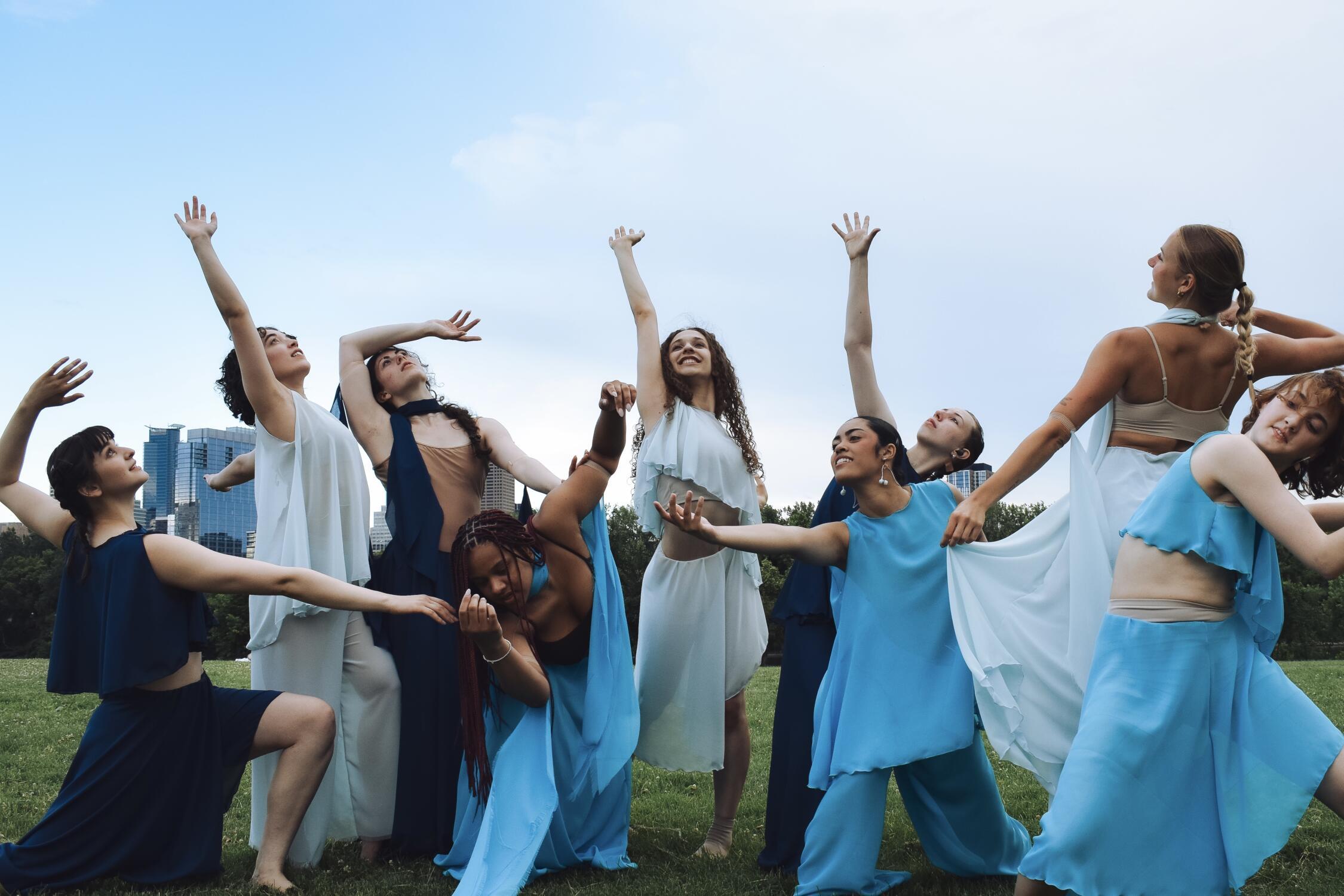
Dealing with this almost paradoxical relationship between the inherent dispossession of dance and the unique possession of one’s personal experience lies at the heart of 71 Minutes of Movement. The final choreographic product featured nine dancers, dressed in the colors of the Minnesota flag, dancing their way across the Stone Arch Bridge with music privately playing in their ears, one minute for every day of Operation Metro Surge. More than any specific messaging or storyline choreography, these 71 minutes of dance with like-minded members of my community became a simultaneous celebration of community and internal strength that both belongs only to ourselves and to no one at all.
I visited the memorials of Alex Pretti and Renee Good shortly after the conclusion of 71 Minutes. Probably I should’ve done this long before the piece was finished, but I didn’t. In fact, only I found myself there by accident, running hurried, last-minute errands before leaving town.
The day was dull and overcast, but when we got to the site of Alex Pretti’s murder, the clouds cleared and we could faintly hear birdsong. For downtown Minneapolis midday on a Saturday, it was unnervingly quiet. My mother and I took a slow walk through the poetry, flowers, prayers, paintings arranged by the community. I am not a person who cries easily, but I felt as though if I were to speak even a few words then the tears would flow, unending. It seemed wrong to cry, almost; here was immeasurable grief only overshadowed by even greater humanity, and I had been tasked to hold it within me now, if for only a little while.
Dear Minnesota: You are magic.
It poured rain the whole drive home.
Credits:
Artistic Consultant: Dr. Fadi Skeiker
Referenced Interviewees: Leila Awadallah, Ananya Chatterjea, Carl Flink, Sonya Kuftinec
Interviewees not referenced in text: Rachel Doran 71 Minutes
Cast Members (seen in photo): Anna Bollman, Emma Conley, Claudia d’Auria, Corynn Harvieux, Avi Schaffhausen, Greta Soens, Dafne Tekmen, Susana Torrence, Olivia Young
This post was written by the author in their personal capacity.The opinions expressed in this article are the author’s own and do not reflect the view of The Theatre Times, their staff or collaborators.