



An Interview with the Motivating and Deeply Creative Dr. Irene Moundraki, Dramaturg and Theatre Critic at the National Theatre of Greece, Athens
Irene Moundraki (Eirini Mountraki) has obtained a BA, an MA, and a PhD in Theatre Studies from the National and Kapodistrian University of Athens. She also studied Arts at the University of Milan, Italy. She is head of Drama, Library, Archive and International Relations Departments of the National Theatre of Greece. She teaches in the MA Programs of Theatre Studies of the Universities of Peloponnese and Athens. She also teaches History of Theatre and Dramaturgy at Drama Schools. She is the founder and head of the Greek Play Project, a dynamic platform in Greek and English for the promotion and study of contemporary Greek dramaturgy. Furthermore, GPP is a network of collaborations and activities; the “Greek Play Project New York” is part of it. She works as a dramaturg and has collaborated with important Greek directors in productions of the National Theatre, the Athens Epidaurus Festival, and the independent stage. Alongside this, she has published books, translated several plays from Italian and English into Greek, participated in scientific conferences, curated exhibitions, organized and led workshops and seminars and lectured about theatre in Greece and abroad. Among other significant roles, she has been President of the Consultative Committee on Theatre Grants of the Greek Ministry of Culture (2017-2021) and President, Vice President, and member of the board of the Hellenic Association of Theatre and Performing Arts Critics (2016-2023). She is an International Visitor Leadership Program (IVLP 2013) Alumna of the United States. She is a member of the Board of the European Theatre Convention (2023 – present) and a member of the Executive Committee of the International Association of Theatre Critics (IATC) (2024 – present).
IAB: What artistic questions are currently most important to Greek theatre-makers?
IM: From the very beginning, Greek theatre has developed a direct relationship with the community and with the major issues of its time – both in dramaturgy and on stage. It is a theatre deeply concerned with the present and at the same time with the eternal existential questions. Even when it cannot fully grasp or interpret what is happening, precisely because its creators are themselves immersed in it, it has a remarkable ability to capture reality. Even when it turns towards something more abstract or detached from the immediate world, it remains connected to the questions of its time. So, what concerns Greek theatre at this particular moment is, above all, the relationship between human beings and the world around them. We live in an era of dramatic change and people are trying to understand where they stand within this new reality, seeking to identify themselves in this context. A great number of the performances being created today are, in one way or another, concerned with this question: how do we adapt to a changing reality? And how can we reposition ourselves in relation to a world that is constantly transforming? So, we deal with questions of identity and human relationships, dehumanization, AI, the environmental crisis, the crisis of humanity, war, refugees and of course always with love, death, grief and God. And even when artists return to classical texts, they inevitably bring a new perspective to them and reposition themselves in relation to the questions those texts raise. Because, after all, we should not forget that our fundamental questions as human beings remain, in many ways, the same throughout the centuries. What changes is the world in which we ask those questions and, consequently, the way we understand and approach them.
IAB: How would you describe the current artistic landscape in Greece, beyond the major institutions and established theatre centers?
IM: Τhe Greek theatre landscape is, I would say, going through a difficult moment. Since the 1980s, Greece has developed a professional theatre reality that, more or less, still defines the framework we operate within today. We have two National Theatres, one in Athens and one in Thessaloniki, sixteen municipal and regional theatres across the country, although not all of them have managed to fully fulfill the role they were created to play, and a growing independent theatre scene, which has expanded enormously over the past years, particularly since 2010 and the economic crisis; 2010 was a landmark year. The economic crisis that Greece went through, instead of limiting or consolidating the theatre landscape, as some had hoped, actually multiplied and I would even say dramatically multiplied the number of productions. It led to a kind of creative explosion.
I would not say that this creative explosion has always produced the best results. But it created a very broad base, a huge pool of artists and productions from which we are able to discover both remarkable creators and truly outstanding performances. Although the State does provide some funding, the subsidies remain very limited and are not sufficient to respond to the needs of the independent theatre sector or to provide meaningful support to its artists and organizations. Nevertheless, we have an extremely active and productive independent scene, but one that continues to operate under considerable financial constraints. So, we find ourselves in a city, Athens, that concentrates approximately 85% of the country’s entire theatre activity. More than 1,500 productions premiere here within a single theatre season. And yet, despite all the difficulties, theatre remains remarkably alive and active.

Photo credit: Irene Moundraki.
IAB: How does contemporary Greek theatre connect with the wider European theatre landscape?
IM: I think that this is the first time in history that countries and societies, no matter how far apart they are geographically, are sharing the same Time. We also find ourselves sharing a very common reality. For the first time, what is happening in Greece, in Europe, and even in Africa is part of a shared contemporary experience. We are all living through the same historical moment, and this creates a common ground on which artists struggle, question, reflect and create.
Theatre has always been one of the arts most closely connected to its time. It is an art that responds directly to what is happening around us, and contemporary theatre across Europe is therefore engaging with many of the same questions. At the same time, we should not forget how much more connected artists are today. People travel, they meet, they see each other’s work, they follow playwrights and directors from other countries, and they travel participating in festivals, residencies, workshops, and international networks. As a result, we have strong connections and a shared artistic vocabulary. But this does not mean that we are becoming the same. On the contrary, the cultural traditions, histories, and particular circumstances of each country continue to create important differences. And this makes the European theatre landscape so interesting: we share many of the same questions, but we approach them from different histories, experiences, and cultural and social perspectives. For me, contemporary Greek theatre is very much part of this conversation. It is connected to the wider European theatre landscape not because it abandons its particular identity, but because it brings that identity into dialogue with a world that we increasingly experience together.
IAB: What do you think Greek theatre can contribute to the current European theatrical conversation?
IM: Greek theatre contributes dynamically and creatively to the European and international dialogue. It comes from a very strong tradition, one in which many of humanity’s fundamental questions were explored with extraordinary depth and intensity: Ancient Greek Drama. But beyond this immense legacy, Greek theatre is also a very dynamic part of contemporary life. Theatre-going has always been deeply rooted in Greek culture and theatre has a remarkable presence in Greece. Contemporary Greek theatre continues to reflect on the fundamental questions of humanity. And I think one of the things it has to contribute most strongly to the international conversation is that theatre in Greece is still deeply permeated by emotion. Human qualities are still very much present. And we owe a great deal to this not only in our texts, but also in the artistic potential of the country. And I say this without any hesitation: Greece has extraordinary artists. It has extraordinary actors, with very powerful material to work with, material that is both raw and highly developed, intellectually and emotionally. I believe this is something Greek theatre can bring to the contemporary international dialogue, particularly at a time when so much of our experience is dominated by fragmentation, acceleration and an overwhelming flow of information, rather than by reflection, depth, and knowledge. Greek theatre can have a meaningful role in bringing those human qualities back into the conversation.
And this does not mean that Greek theatre lacks innovation or experimentation. Quite the opposite. It also has strong experimental and research-driven dimensions. There is a very broad framework within which artists can work, and a remarkable openness to exploring different subjects, forms, and artistic languages. This coexistence, between tradition and experimentation, between emotion and intellectual inquiry, between the human and the formally innovative is, I think, one of the great strengths of contemporary Greek theatre.
IAB: What motivated you to create the Greek Play Project, and what need did you want it to address?
IM: The Greek Play Project was an idea that had been on my mind for quite some time. It grew mainly out of my professional work and the many opportunities I had to travel abroad, as well as from my contact with international artists, scholars and theatre professionals. I realized that there was nothing organized that I could really refer people to if they wanted to understand what was happening in Greece, especially in contemporary dramaturgy. The language barrier, combined with the lack of international bibliography material written in English, French, or simply in a language that is more widely accessible makes us somewhat like ghosts within the international theatre landscape. Greek is spoken by relatively few people, and this inevitably makes our work much less visible internationally. So, the idea was to create a kind of dramaturgical map of Greece: a platform that would introduce professional playwrights whose work had already been presented in at least two or three professional productions. The concept was to make contemporary Greek dramaturgy easily accessible to anyone interested in understanding the particular voice and artistic profile of each playwright, discovering their work and finding information about their plays. It has also proved to be a valuable tool for the Greek theatre community – theatre groups, directors, and students. I am really proud of that. What began rather modestly grew very quickly. It developed into numerous collaborations and eventually, among other projects, led to the Greek Play Project New York, in collaboration with the Eclipse Group in New York. That is really what the project is about: creating connections that might otherwise never happen. Allow me to mention that this is a completely unfunded project. It is realized at my own expense, in my own time, with the support of a few people who share this vision with me. I am very proud of all the work we have done and the things we have achieved so far. And there is still so much more to come. This year, for example, we are collaborating with the Playwrights Guild of Canada. But, to be honest I believe that individuals can contribute, take initiatives and pave the way, but they cannot substitute for the State when it comes to developing the serious, long-term cultural strategy and infrastructure that a country needs in order to have a meaningful international presence. It is a path that requires both parts; individuals and the State.
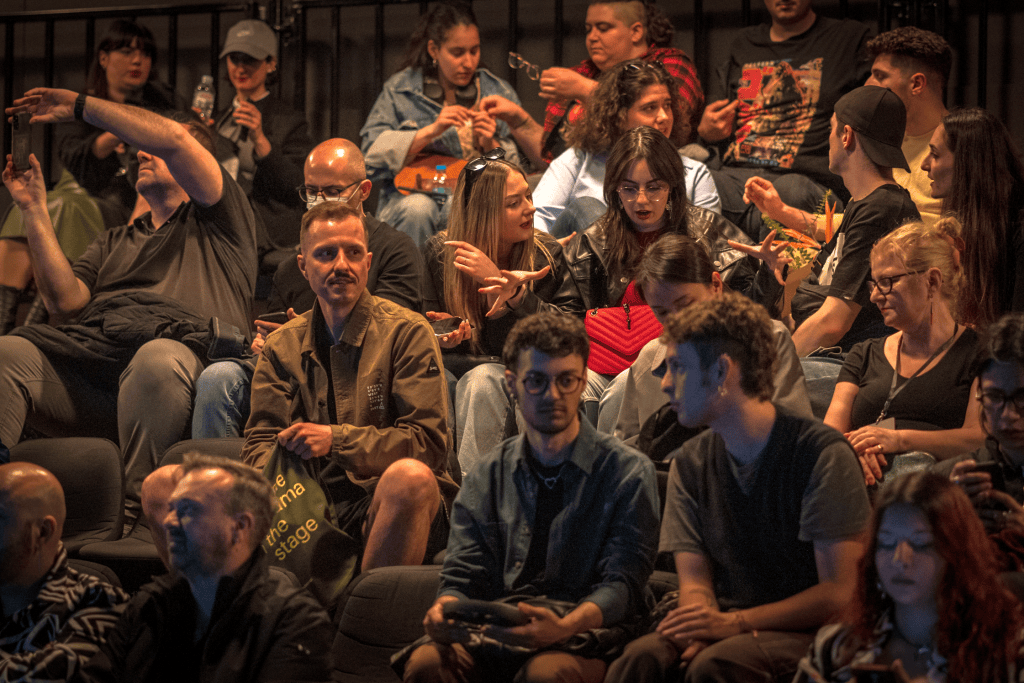
Photo credit: Showcase NTG Athens.
IAB: What does the Greek Play Project reveal about the diversity and evolution of contemporary Greek playwriting?
IM: From the very beginning, the Greek Play Project set out to create a mapping of contemporary Greek playwriting, which at the same time became a mapping of the trends and directions of contemporary theatre practice in Greece. As I mentioned earlier, the GPP was never conceived simply as an archive, a place where anyone who writes plays could upload their texts and have them recorded. An essential criterion was that the playwrights included should be alive and have an active presence and engagement with contemporary theatrical life in Greece.
What the Project reveals is a remarkably diverse and vibrant theatrical landscape, where very different texts, voices and dramaturgical approaches coexist. Classical forms and productions exist alongside highly experimental ones; research-based and exploratory practices alongside more traditional theatrical forms. We see physical theatre, devised theatre, musicals, object theatre, mime, and many other forms, all contributing to the richness of contemporary Greek theatre. At the same time, this diversity reflects an evolving theatrical culture. Greek playwrights are increasingly engaging with new forms, new modes of storytelling and new ways of relating text to performance. The boundaries between playwriting, performance, and other artistic practices are becoming increasingly fluid. More and more artists identify themselves as “creators” expressing this fluidity. In my opinion, this is one of the most interesting things that the GPP makes visible: contemporary Greek playwriting is not one single voice or aesthetic. It is a field of many different voices, constantly changing, responding to its time and searching for new ways to speak to audiences.
To read PART II of this interview, go to this link.
This post was written by the author in their personal capacity.The opinions expressed in this article are the author’s own and do not reflect the view of The Theatre Times, their staff or collaborators.
This post was written by Ivanka Apostolova Baskar.
The views expressed here belong to the author and do not necessarily reflect our views and opinions.