



Article content
Reviews and recommendations are unbiased and products are independently selected. Postmedia may earn an affiliate commission from purchases made through links on this page.
Advertisement 2
Article content
It was because of a life defined by a childhood in the Alberta Badlands that Neil Griffin was revisiting a place of treasured memory. But dinosaur relics weren’t on the veteran biologist’s mind on this occasion: it was the need to see some bats — real, live, flapping and squeaking bats — that had brought him back to the fabled Rosedale suspension bridge over the Red Deer River.
Article content
Article content
Maybe, hopefully, it would reconnect him with a species in very real danger of disappearing from Planet Earth.
As it turned out, his pilgrimage would provide him with some of the most memorable pages in his new book, Endings: Encounters With Extinction.
“I’m leery of nostalgia in writing about nature or the environment,” Griffin tells Postmedia. He believes in writing about the world as it is, a planet that will one day inevitably undergo another round of mass extinction. “But I had such fond memories as a kid of being along the Red Deer River near Rosedale and watching the bats come out. As a child I didn’t know where they came from — as an adult I know they roosted under the bridges in the Badlands, those weird and strange bridges.”

Shopping Essentials
Article content
Advertisement 3
Article content
But would they still be there? Would he be on a mission impossible? A species that had had survived for 15 million years, overcoming all manner of planetary catastrophe, was now being felled in huge numbers by the deadly white nose virus. “It has been killing 95 per cent of the bats that it infects,” Griffin says sombrely.
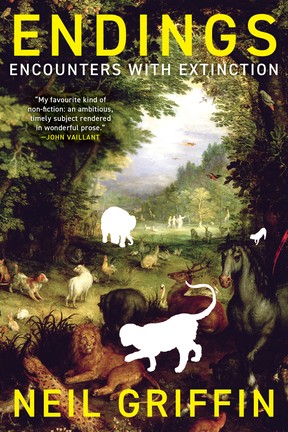
Endings: Encounters With Extinction
Neil Griffin
Anansi
He would spend hours crawling about various bridges that day — and find nothing. “I was growing not just despondent but resigned to the possibility that the bats had already gone. And then when I came to the last bridge of the day, the Rosedale, a group of bats came out from underneath.
“It was a real and beautiful moment, a real and vivid and lived thing — and for me, trying to live inside such a moment is a key part of how to live.”
In his new book, Griffin is writing about a planet that modern science believes to have gone through at least five mass extinction events due to a range of factors that include planetary wobbling, meteorite assault and carbon-capture upsets. In the process 99 per cent of life — animal, vegetable, fungal — has gone extinct. “And yes, we will be extinct one day,” Griffin adds matter-of factly. “But I don’t think it will be soon.”
Advertisement 4
Article content
And yes again, there have been astonishing survivors. Consider the bat. And the crocodile “which really hasn’t had to change in 235 million years.”
He has delivered a book that seeks to engage and excite readers rather than plunge them into depression.
“I didn’t want to write a book about extinction that would just be doom and gloom — a dour catalogue of disaster. I wouldn’t want to read that myself. Instead, and I know this is a cliché, I wanted to say that endings always contain beginnings. Extinction makes space for discovery and there’s still so much of the world that we don’t know.”
He cites estimates of 10 million species currently on the planet, coupled with science’s success in describing and identifying maybe a million of them.
“I didn’t want to write a book about extinction that would just be doom and gloom — a dour catalogue of disaster. I wouldn’t want to read that myself.
“Of that million we may have a sense of the live histories, the home range and behaviour of maybe 150,000. So our knowledge of the natural world is maybe 1.5 per cent of what we think is out there.”
Griffin is fascinated by how much of our present is still linked to the past, and says there are lessons to be learned from this. He suggests there are difficulties in understanding “extinction” in the context of today’s planetary life.
Advertisement 5
Article content
“I do feel that we don’t get a sense of great age, of an earth with its wonders of change, as we walk around cities made of marble that is 500 million years old, that if we go to the zoo and see a crocodile, we’re looking at something that survived the extinction of the dinosaurs. I wanted to try and widen the scope of our understanding of the planet, where we exist on it and how we exist on it.”
He gently reminds readers that humanity’s current presence on Earth represents a tiny “fragment” of planetary history. “But I hope they will take away a sense of beauty, a sense of wonder that the world is still filled with incredibly strange things that we have only begun to understand.”
Article content