



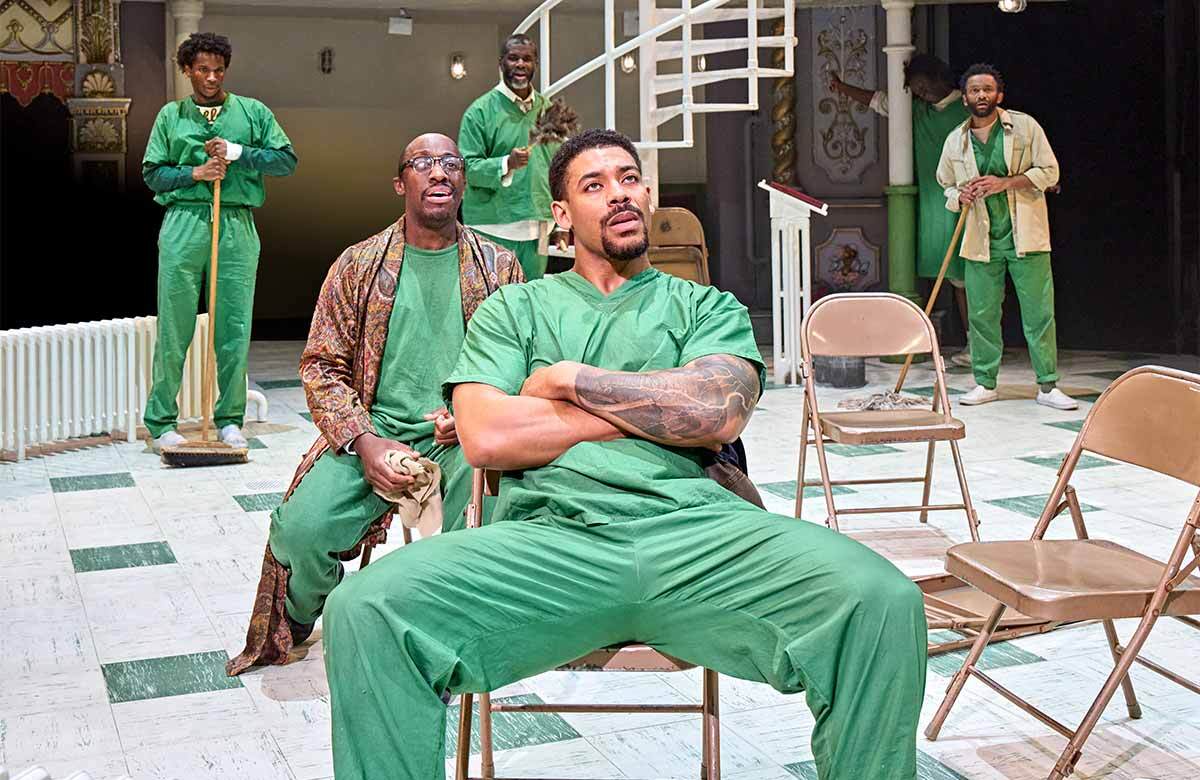
The London Old Vic Review: Clint Dyer’s politically ambitious revival reframes Ken Kesey’s classic through the lens of power, prejudice, and institutional control
By Ross
Once again (and for the last time), our whirlwind London theatre trip theme of “madness” steps into the circle, but this time the word that echoes through nearly every title on our itinerary, from Equus and Romeo and Juliet to Inter Alia and Les Liaisons Dangereuses, is almost too brazen and obvious. As we arrived at the Old Vic for One Flew Over the Cuckoo’s Nest, the framing insisted on this theme. Yet, I found myself wondering whether madness itself had become less the subject of these productions than the language through which they explored power. Clint Dyer (Royal Court’s The Westbridge) and his bold revival certainly believe that to be true. It asks us to view Ken Kesey’s world not simply as an examination of psychiatric institutions and treatment of those deemed different, but as another system built to control, diminish, and silence those it deems inconvenient, particularly along racial lines. It is a fascinating proposition, even if playwright Dale Wasserman’s adaptation never fully allows that idea to flourish.
Before the play even begins, projected images, designed by Gino Ricardo Green (West End’s Barcelona), invoking the importance of Congo Square in New Orleans, the historic gathering place where enslaved Africans preserved music, dance, and communal identity despite oppression, immediately establish the production’s political ambitions. Tribal rhythms pulse through Benjamin Grant’s sound design as a ghostly chief muscularly moves around the stage, electrifying the circular space. The spiritual strains of “Nobody Knows the Trouble I’ve Seen” fill the theatre, suggesting histories of survival, resistance, and oppression that stretch far beyond the hospital walls. Ben Stones’s white-and-pond-green tiled design places the audience basically inside the ward itself, surrounding it on all sides like those white radiators, while Chris Davey’s vivid lighting repeatedly washes the space in scarlet and blue, transforming institutional order into something almost ritualistic, promising a powerful reinterpretation of Kesey’s novel. The invocation of Congo Square attempts to reframe the play’s narrative as a metaphor for systemic oppression, white authority, and Black and Indigenous resilience. It is a fascinating conceptual lens, one that ultimately plays out most successfully in brief moments and in the unfolding journey of its one Indigenous character.
Dyer’s most provocative choice is to cast the ward predominantly with Black actors, immediately altering the way authority functions within the story. When Nurse Ratched leaves the room, and bids farewell with a condescending
“Behave yourself, boys,” Olivia Williams (“The Crown“; Donmar’s Marys Seacole) loads the phrase with generations of historical implication. The text itself never explicitly discusses race, apart from Chief Bromden, the surviving member of an Indigenous community whose silence has become both an act of protection and imprisonment, yet Dyer clearly invites us to connect Bromden’s experience to histories of colonial violence and institutional erasure. It’s a compelling idea, particularly for this Canadian Mohawk reviewer, as it was difficult not to think of the atrocities committed in the North American residential school system and their systematic attempt at the destruction of Indigenous identity. It is a devastating parallel. Yet although the idea is intellectually stimulating, Wasserman’s script rarely supports it directly, leaving the production caught between its conceptual brilliance and the limitations of the text it is staging.

The arrival of Aaron Pierre (Netflix’s “Rebel Ridge“) as McMurphy is vivid and explosive, carrying within his frame a remarkable physical authority. He is testosterone and charisma in constant motion, determined from his first appearance to become the “bull goose loony” who dominates every room he enters. Pierre’s performance burns with confidence and energy, and his sheer magnetism and muscularity pull focus whenever he strides into the circle. Yet his physicality sometimes overwhelms the quieter emotional currents of the role. McMurphy’s humanity is certainly present, but it occasionally struggles to emerge beneath the power of his pull and personality.
Standing opposite and opposed, Williams delivers a performance built on precision rather than overt menace. Stepping into the role of Nurse Ratched at the last minute, replacing the ill Michelle Gomez, her posture and professionalism remain perfectly controlled, her smile impeccably maintained, and her authority rarely wavers. She presents herself almost maternally while quietly and forcibly demanding conformity to a rigid hierarchy that strips the patients of their autonomy. It fulfills the task, yet I never fully felt the chilling danger that the role can unleash. The performance is disciplined and intelligent, but its coolness never quite settles into the territory of genuine menace.
Filling out the circular ward, Giles Terera (Donmar’s Clyde’s) gives Dale Harding a deeply nuanced sadness. Arthur Boan (West End’s Oklahoma!) unpacks a Chief Bromden with a captivating force, emerging as the production’s emotional centre. Our “deaf, dumb” chief narrator fills the space with metaphoric spiritual energy, and although introduced as a selective mute, his physical bearing gradually shifts, revealing a crushed spirit struggling toward dignity and spiritual enlightenment. Early on, when McMurphy jokes that if Bromden ever reaches his full growth, he will be “a good size,” the remark carries an uneasy mixture of encouragement and diminishment, as we watch Boan quietly unwrap that contradiction until Bromden becomes the one character whose inner journey feels entirely earned.

The production also exposes one of the enduring difficulties of One Flew Over the Cuckoo’s Nest: its relentless misogyny. Medication becomes pacification. Group therapy becomes licensed humiliation. Electroconvulsive therapy is staged as ritualized punishment. Yet the women exist largely as obstacles or symbols within a profoundly masculine struggle for dominance. Dyer’s racial reframing illuminates many aspects of institutional power, but it cannot entirely overcome the limitations of the script’s treatment of gender.
Perhaps that explains why I remained an observer rather than a participant. I admired the ideas, respected the ambition, and appreciated the extraordinary craft surrounding me. I was intrigued by the Congo Square framing and found myself wishing its implications were explored more fully within the production itself, but I rarely felt the emotional discomfort the play was asking me to experience. The cast of characters inhabiting the ward is compelling as an idea, but too often, the tics and impediments of the inmates felt handed out like diagnostic cards, making certain every condition was represented rather than organically lived. In that space and framing, I found myself wanting to revisit the film and rediscover the immediacy and honesty that have made this story so enduring.
As our London journey continued its accidental meditation on “madness“, this production of One Flew Over the Cuckoo’s Nest at the Old Vic offered another definition altogether. Here, insanity belongs not simply to those confined within the institution but to the structures that classify, diminish, and control them. Clint Dyer’s revival bravely attempts to expose those systems through a new political and racial lens, and many individual moments find that organic power and purpose. Even if the production never fully reconciles its bold concept with Wasserman’s text, it remains an intriguing and often provocative evening that insists madness may lie not in those deemed different, but in the society determined to silence them.
