


What was it like working with Katharine Isabelle and Emily Perkins? Ginger Snaps would not be what it is without their charisma and their chemistry, so I’m curious how they both came in and what the process was like of tapping into the energy between them on set.
My superpower with actors has always been that—regardless of age, regardless of experience level—I want to be genuinely collaborative with them. I’m never a person who’s dictating, and I wanted to create this safe space to be able to explore the material. I want to be enthusiastic with my energy. They were both very young. Katie was seventeen or eighteen, and Emily was a little older, but she’s also permanently 22. You see her now, and she still looks like she could do the sequel with it picking up immediately after. It felt like it was very much just me and them on set; my strongest memories are all of us working together on the set. Yes, I have a lot of friends who were on the crew, and I brought a lot of people along, but my memories are of me and them in this little bubble of creativity, trying stuff out and making it happen.
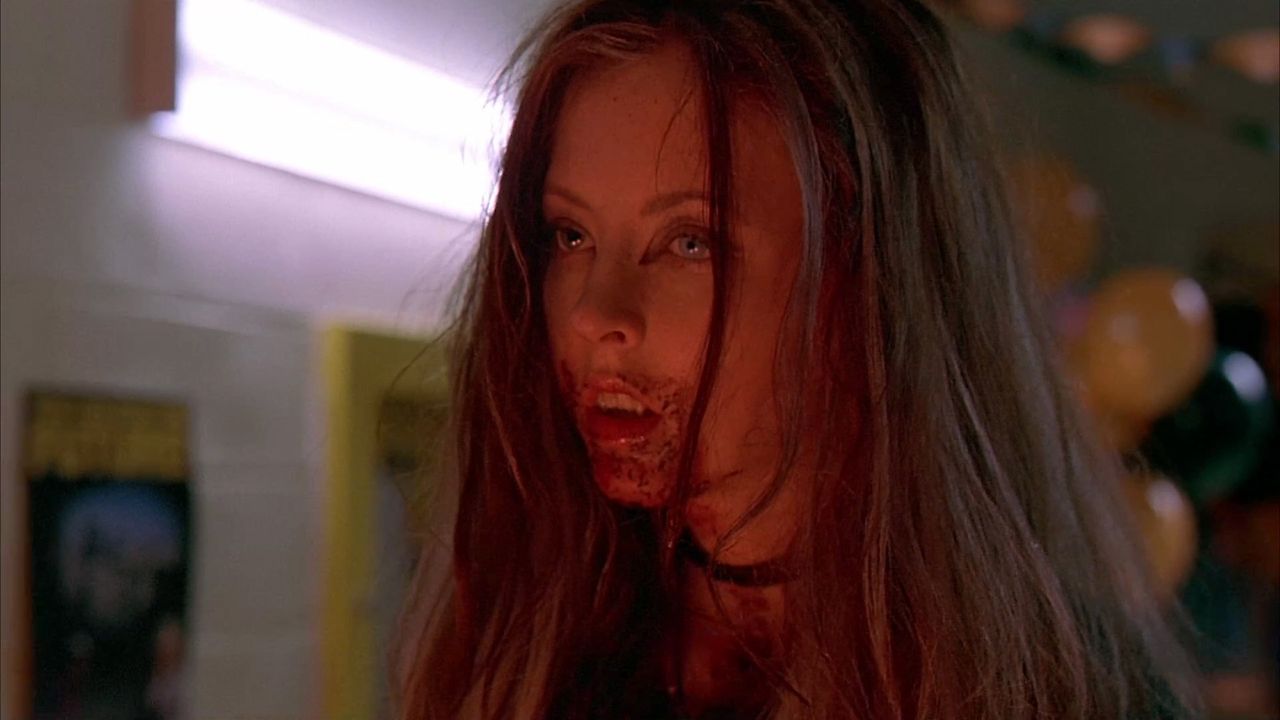
I think there was a lot of trust. They trusted me. I trusted them. We were doing some pretty outlandish stuff. One of my favorite sequences with the two of them specifically—that really felt like we landed it just right—was the sequence in the school, after Ginger kills the teacher and the janitor, with the weird conversation that ensues once Ginger has thrown the janitor into the lockers, and he’s dying on the ground. She punches him through his sternum and licks the blood off her hand, then he crawls towards Brigitte—all of the stuff in that scene, from the makeup to Katie’s performance, Emily’s performance, the way we managed to shoot it. Everything about it came together at the right time, because it’s a pivotally important sequence, dramatically, in the story.
My memory is that it was fairly early on in the shoot; we had been outdoors, shooting some locations, and then we’d come indoors, and that was one of our first sets that we were shooting. And I remember being on set with Katie and Emily, and we’d rehearsed that—we’d done a lot of rehearsal going into this movie—and I remember being in those hallways, behind the cameras, feeling like we were making the coolest movie possible, that it was going to be a big hit. Of course, I was wrong.
At first, at least—but time’s proven those initial instincts weren’t faulty. But I can picture even now so many moments from Ginger Snaps that have imprinted on my brain, like the shot of blood and split milk swirling together on the floor. How do you pull off images like that and not think you’re making a masterpiece?
Right, it only took several more years. No one noticed Ginger Snaps to begin with. I mean, some reviewers noticed it, but nobody went to see it. But, when we were making it, I thought I was making a masterpiece. I really did. I was also 30 years old, so I was young. But as you get a little older, you realize that the world doesn’t think that you’re as much of a genius as you think you are.
When did the tide begin to turn, in terms of the subsequent critical re-evaluation and wider embrace of the film?
The film got very noticed at the 2000 Toronto International Film Festival, and we came close to selling it. We had a lot of weird comments from buyers who wanted to change it, things like, “It’s an R-rated movie, but it’s got a 16-year-old protagonist, so we don’t know how to sell it, and so you’ve got to change the story to avoid it being R-rated.” There was no possible way to do that. The movie is filled with F-bombs. There’s tons of graphic gore and sex, and there was no way we could change that. It is what it is. But we never were able to make an American sale after the festival, and that’s why no one saw it there. The Canadian distributors—God bless them—tried their best. They stuck it in movie theaters at the beginning of May, and it was gone the week after, because The Mummy Returns came out.