




“I am Zangetsu.”
For years, that line in Tite Kubo’s Bleach sounded like a threat. Coming from the monstrous voice buried within Ichigo Kurosaki’s sword, Zangetsu, the declaration felt invasive, almost parasitic, like something trying to overtake him from within. But over time, the line transforms into something far more tragic. What once sounded like the voice of a monster ultimately becomes the most honest expression of Ichigo himself, distilled in a mere blade.
That reversal is what makes Zangetsu such a fascinating weapon. More than just a cool sword with iconic transformations and devastating attacks, Zangetsu evolves alongside Ichigo’s understanding of himself, reflecting every fractured and contradictory part of his identity back at him.
Bleach is home to its fair share of iconic blades. Swords are, in a very literal sense, tied directly to the plot through careful narrative groundwork, acting as central elements in major twists, worldbuilding, and character progression. Called Zanpakuto, these blades act as physical manifestations of a Soul Reaper’s spirit, representing the connective tissue between spiritual power and inner self.
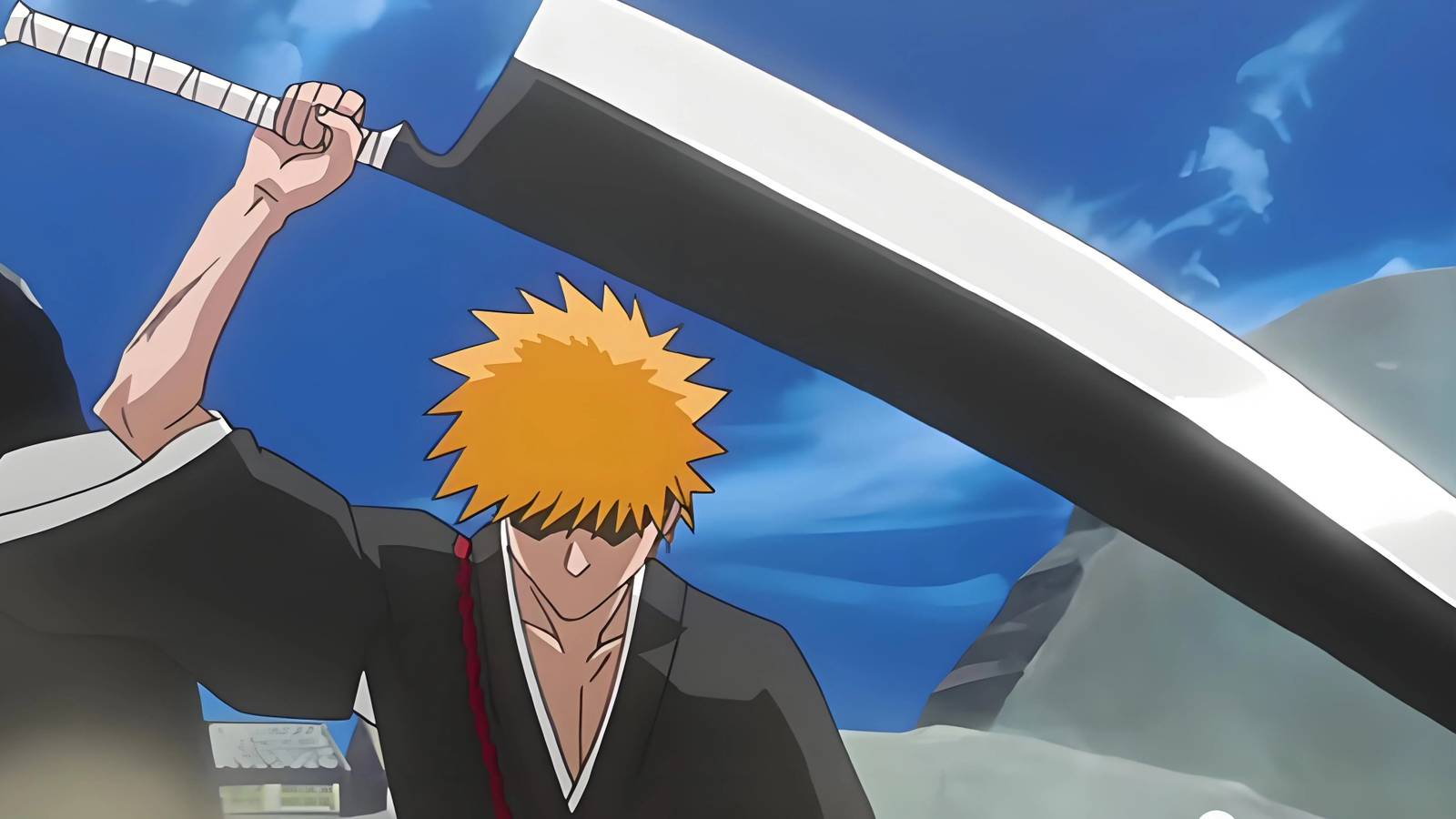
More than any other Zanpakuto in the series, Zangetsu evolves according to who Ichigo believes himself to be at that moment. Its massive cleaver-like form early in Bleach feels crude and unfinished, mirroring Ichigo’s raw spiritual potential and incomplete understanding of himself. Later, Tensa Zangetsu compresses that overwhelming power into something faster, sharper, and more controlled, reflecting Ichigo’s growing discipline while still hinting at instability buried beneath the surface. Even the Hollow mask and White Ichigo are not interruptions to that evolution, but extensions of it, serving as manifestations of the instincts and violence Ichigo repeatedly tries to suppress rather than accept.
That sense of evolution is built directly into the structure of Zangetsu. Like most Zanpakuto in Bleach, the Zangetsu bears a distinct male entity that is a humanoid manifestation of Ichigo’s spiritual power. But in Ichigo’s case, this manifestation is split in two, forming a dual identity that highlights the very fragmentation Ichigo refuses to acknowledge within himself: the White Ichigo, who represents Ichigo’s Soul Reaper and Hollow instincts, and Old Man Zangetsu, who represents his Quincy powers inherited from his mother.
These two identities clash in fascinating ways throughout the story, turning Zangetsu into the central thesis of Bleach in miniature form. For over 600 chapters, Kubo draws out the inner conflict in Ichigo through Zangetsu’s two personas, highlighting Ichigo’s repeated misunderstandings of not just the sword, but of himself. On one side is the Old Man, whose mentor-like guidance and control help Ichigo maintain a semblance of trust in his own strength. On the other is White Ichigo, a confident yet ruthlessly violent entity that often mocks Ichigo’s hesitation, disrupts training sessions, and consistently threatens to take over Ichigo’s body.
This inner struggle becomes even more devastating in Bleach: Thousand-Year Blood War, when it’s revealed that the “monster” Ichigo feared in Zangetsu was actually the truest manifestation of his Soul Reaper power all along, while the mentor figure he trusted most was suppressing that truth out of a desire to protect him. Suddenly, White’s famous line — “I am Zangetsu” — stops sounding like a threat and starts sounding tragic. He was telling the truth from the very beginning, but Ichigo simply could not accept what that truth implied about himself.
Ichigo spends most of the series trying to separate acceptable parts of himself from the unacceptable ones, drawing a fine line between monster and human. He wants to be the protector without acknowledging the violence required to protect people. He wants power without instinct. Control without rage. Heroism without fear. Even Zangetsu’s transformations reflect that instability, shifting between forms that emphasize brute force, restraint, instinct, and eventually balance.

Where one entity is suppression and containment, the other acts as raw expression. Despite those vast differences, Bleach ultimately argues that Ichigo needs both to reach his highest potential. That is the significance of the dual blades Zangetsu becomes much later in the series. They are not merely a lore reveal explaining Ichigo’s Quincy and Hollow origins, but physical proof that Ichigo no longer needs to reject one side of himself in order to embrace the other.
That realization fundamentally changes what strength means in Bleach. Ichigo’s final evolution does not come from conquering his inner darkness or eliminating contradictions. It comes from finally understanding that contradiction was never the problem in the first place, which is why the line “The Blade is me” cuts so deep. By the time Ichigo says it (episode 13 of Thousand-Year Blood War, and Chapter 542 in the manga), he is no longer talking about a weapon. He is talking about every fragmented, conflicting, frightening part of himself that he spent the entire series trying to divide into separate identities, now finally rolled into one.
Few swords capture that meandering emotional complexity and character growth quite like the Zangetsu, which explains why it remains one of the most iconic weapons in anime. The ironic twist is that Zangetsu was never a sword at all, but Bleach’s most honest expression of identity itself.
![15th Jul: Stranger Things: VHS Special Edition (2026), 8 Episodes [TV-14] (6/10)](https://occ-0-82-1001.1.nflxso.net/dnm/api/v6/0Qzqdxw-HG1AiOKLWWPsFOUDA2E/AAAABUBdOyuDJ2FKfEtwKXmADSqUCZBt8yJ6SHNXIl-M0O1s-fNYLudWhZOKb9D--5X5uHlYaCQH_ziPnXzqkdiGfFIl2C0NJ-r7-nndgk5fjzpCbzXlClEsiLklt83hfcUy5o4D_XX5-5LdF37Z5dWpbjKe9KNvqdmY_ORqGDzWv22zSg.jpg?r=e0e "15th Jul: Stranger Things: VHS Special Edition (2026), 8 Episodes [TV-14] (6/10)")